



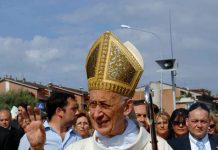













Pope Leo XIV urges ethical leadership and dialogue to combat dehumanization at the first Borgo Laudato si’ Dialogues in Castel Gandolfo.
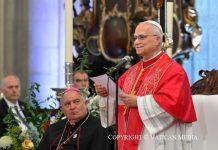
Newsroom (19/06/2026 Gaudium Press ) Pope Leo XIV has called for a renewed model of moral leadership rooted in dialogue, historical awareness, and care for human dignity, as he addressed participants in the first-ever Borgo Laudato si’ Dialogues held in Castel Gandolfo. The two-day gathering brought together experts, practitioners, and leaders from across disciplines and countries to examine some of the most urgent challenges facing humanity today.
The discussions focused on issues including artificial intelligence and its implications for human dignity, healthy ageing, sports diplomacy, and environmental sustainability—fields that increasingly intersect in shaping the future of societies worldwide.
The initiative is part of the broader mission of Borgo Laudato si’, a center for integral ecology established within the Papal Villas of Castel Gandolfo. Inspired by Pope Francis’ 2015 encyclical Laudato si’, the center seeks to promote a holistic vision of ecological, social, and economic transformation through dialogue and collaboration.
Dialogue as the Foundation for the Common Good
In his address at the conclusion of the meeting, Pope Leo described the event as “the first step of a process aimed at renewing and reimagining moral leadership in a world that today appears fractured and forgetful of its historical roots.”
Drawing from themes in his encyclical Magnifica humanitas, the Pope emphasized that dialogue is essential in confronting the complexities of the modern age. He highlighted the need to work collectively toward “new paths for the common good and for promoting a dignified life for all,” stressing the importance of engaging with people from all walks of life who share common concerns and aspirations.
The Pontiff framed the gathering as an example of synodality in action—an approach that values listening, inclusivity, and unity amid diversity. By bringing together participants with varied expertise and backgrounds, the dialogues sought to foster a shared commitment to addressing global challenges through ethical leadership.
Warning Against Cultural Amnesia
A central theme of Pope Leo’s address was the danger of what he described as “spiritual and cultural blindness.” He warned that modern society risks losing touch with its historical memory, particularly when driven by what he termed a “false pragmatism.”
Such pragmatism, he cautioned, encourages the abandonment of historical roots in pursuit of a perceived “new creation” detached from the past. The Pope further warned that even those who uphold moral principles can fall into “historical nihilism,” a mindset that dismisses the lessons of history and assumes that past tragedies—especially those of the twentieth century—cannot recur.
This loss of historical consciousness, he argued, undermines the moral foundations necessary for building a just and humane society.
Technology, Profit, and the Risk of Dehumanization
Turning to contemporary technological and economic challenges, Pope Leo contrasted two competing visions of society. On one hand, he described the temptation to construct a modern “Tower of Babel,” driven by the idolatry of profit and marked by disregard for the most vulnerable.
Such a model, he warned, intensifies the risk of dehumanization—particularly in an era of rapid technological advancement, where artificial intelligence and economic systems can inadvertently erode human dignity if not guided by ethical principles.
In response, the Pope called on Christians—and all people of goodwill—to work toward building what he described as the “New Jerusalem,” or a “civilization of love.” This vision prioritizes solidarity, compassion, and respect for human worth over purely economic or technological gains.
Building a “Civilization of Love” Through Daily Action
Rather than dramatic or isolated efforts, Pope Leo emphasized that such a civilization is constructed through consistent, everyday actions grounded in fidelity and care. “The civilisation of love will not arise from a single or spectacular gesture,” he said, “but from the sum total of small and steadfast acts of fidelity that serve as a bulwark against dehumanization.”
This approach underscores the role of individual responsibility in shaping societal values, suggesting that meaningful transformation begins at the local and personal level.
Inspiration from Nature and Global Responsibility
The setting of the dialogues—within the natural environment of the Pontifical Gardens at Borgo Laudato si’—also carried symbolic significance. The Pope noted that participants were able to draw inspiration from “the beauty of creation—and of the Creator,” reinforcing the connection between ecological awareness and moral responsibility.
By situating the discussions in a place dedicated to integral ecology, the gathering highlighted the importance of linking local experiences with global challenges, particularly in the areas of environmental sustainability and social justice.
Looking Ahead
Concluding his address, Pope Leo expressed gratitude to participants for their engagement and commitment, while voicing hope that the process initiated at Castel Gandolfo would continue through future meetings and initiatives.
The first Borgo Laudato si’ Dialogues thus mark the beginning of a broader effort to foster ethical leadership in an increasingly complex world—one that seeks to balance technological progress with human dignity, and global development with ecological stewardship.
- Raju Hasmukh with files from Vatican News
Related Images: