






















A surge of kidnappings, murders, and religious violence darkens Syria’s February, with Christians facing growing threats from Islamist militias.
Newsroom (26/02/2026 Gaudium Press ) A new wave of religious violence has gripped Syria this February, marking one of the bloodiest months for the nation’s Christian minority since the civil war began. The latest victim, Iman Matanius Jrousi, a 47-year-old teacher and mother of three, was shot in the head by a terrorist group in the Wadi al-Nasara region, a traditionally Christian enclave once known for its relative peace.
Jrousi, originally from the town of Ain al-Rahib but living in Homs for work, was killed on Monday evening as militants attacked the Akrama neighbourhood. Her murder has been blamed on an Islamist faction connected to Hay’at Tahrir al-Sham (HTS)—a jihadist alliance that, since the rise of President Ahmed al-Sharaa’s government, has intensified campaigns against religious minorities.
A Nation in “Chaos”
Activists and aid organisations describe a nation ruled by “chaos.” According to the NGO Chrétiens d’Orient, the country now faces “a climate of growing fear,” driven by targeted killings, intimidation campaigns, and disturbing disappearances. Humanitarian workers say that the authorities in Damascus appear powerless—or even complicit—in the face of resurgent extremism.
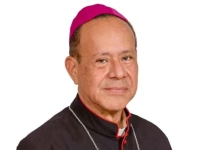
Cardinal Mario Zenari, former apostolic nuncio to Syria, recently stated that more than 80 percent of Syrian Christians have fled since the early years of war, fleeing persecution, violence, and uncertainty.
Flags of Defiance, Tensions on the Streets
Religious tensions flared this month in several towns near Damascus. In Saidnaya, young radicals hoisted the flag of the al-Nusra Front while shouting religious slogans. When local Christians attempted to replace it with the national flag, an angry standoff erupted. Despite mayoral intervention, local security forces refused to remove the extremist banner, and only the order of district officials eventually ended the confrontation.
Still, a “climate of defiance” lingers. Similar flags reappeared days later in Bloudan, another primarily Christian community, and in Maaloula, the historic town known for preserving the Aramaic language of early Christianity. Residents now speak of living under constant threat.
Ramadan Brings New Violence
As the Islamic holy month of Ramadan began, the violence took a new turn. In the coastal city of Latakia, restaurants and bars in the Christian-majority Al-Amrican district were raided by militias under the HTS-linked General Security Force, accused of selling alcohol. Witnesses report that customers were beaten, arrested, and verbally abused.
In Aleppo, a Christian-owned liquor shop in the Sulaymaniyah neighbourhood was attacked twice this month. Throughout February, raids on businesses seen as violating conservative codes have multiplied, creating a chilling atmosphere of sectarian enforcement.
Disappearances, Kidnappings, and Fear
Behind the headlines, dozens of disappearances have gone unreported. On February 18, Amar Joseph Samean, an employee at Kashkoul monastery, vanished while driving to visit family in Al-Zablatani. Days later, Nashed Kassouha, a jeweller from al-Qusayr, narrowly survived an assassination attempt when two gunmen on a motorcycle opened fire at his car before escaping.
In the borderlands near Lebanon—regions already destabilized by shifting militias and smuggling routes—locals describe relentless fear. Families report extortion, abductions, torture, and routine threats by security forces demanding emigration or silence.
The Broader Toll
The violence spans beyond Christian communities. At least ten Alawites—members of the sect once associated with the Assad regime—were killed in Homs in February, further illustrating Syria’s fractured reality. Sectarian distrust, economic collapse, and political inertia have left vast parts of the country on edge.
What was once hailed as Syria’s slow recovery from civil war has turned into a new landscape of intimidation, bloodshed, and exile. The killing of Iman Matanius Jrousi is not just a personal tragedy—it is another reminder of a society broken by fanaticism and fear, where coexistence now struggles for survival.
- Raju Hasmukh with files from Asianews.it
Related Images: