





















Pontifical Academy for Life advances global dialogue on bioethics, AI, and care, reinforcing its mission to uphold human dignity at every stage.
Newsroom (21/05/2026 ) More than three decades after its founding, the Pontifical Academy for Life continues to occupy a central role in global discussions on bioethics, reaffirming its commitment to safeguarding human dignity “from the beginning of one’s life to its end.” Established in 1994 by Pope John Paul II, the academy was designed as a hub for collaboration among universities, scientific societies, and research centers engaged in life-related issues—a mission that has grown increasingly complex amid rapid scientific and technological change.
In March, Pope Leo XIV reinforced this mission by promulgating new statutes that highlight the academy’s enduring objective: “the defense and promotion of the value of human life and the dignity of the person.” The updated framework underscores the academy’s evolving role as both a research institution and a moral voice navigating emerging ethical challenges.
Addressing Complex Modern Challenges
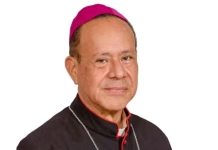
At the center of this effort is Archbishop Renzo Pegoraro, who has led the academy as president since May 27, 2025. A trained physician and bioethicist, Pegoraro brings a unique interdisciplinary perspective shaped by both medical and theological formation.
In an interview with EWTN Pro-life Weekly, Pegoraro emphasized the institution’s commitment to examining “new challenges” and “new problems concerning human life.” He described the academy as a forum for rigorous interdisciplinary dialogue involving biologists, doctors, philosophers, theologians, and legal scholars—an approach designed to confront “very urgent and very complicated issues” arising from advances in medicine, biology, and technology.
Among the most pressing topics are artificial intelligence, end-of-life care, and broader questions in public bioethics. These areas, Pegoraro noted, require careful ethical scrutiny to define responsibilities that both protect and promote life while respecting the dignity of every person.
Structural Evolution and Broader Inclusion
The academy itself is composed of a presidency, a central office, and a global network of members—known as academicians—and supporters. In recent years, its composition has evolved in ways that reflect a broader commitment to international and interreligious dialogue.
A significant shift occurred in 2016, when the requirement for members to sign a formal pro-life declaration was removed. While adherence to Church teaching on human dignity remains essential, the change has opened the door to greater diversity within the academy.
“We realized the last 10 years, to have members that are not Catholic,” Pegoraro explained. Today, the academy includes representatives from multiple religious traditions, including Jewish, Muslim, and Greek Orthodox members. Despite differing backgrounds, these participants share agreement on core principles related to the value of human life and align with the Church’s teachings on these issues.
Research at the Intersection of Ethics and Innovation
The academy’s work is organized around a number of specialized research initiatives that address both longstanding and emerging concerns in bioethics.
One such project focuses on neuroscience, particularly the ethical implications of human enhancement and potential manipulation. As scientific capabilities expand, these questions have become central to debates about the limits of medical intervention and the preservation of human identity.
Another key initiative examines neonatal care, with a focus on the critical period before and immediately after birth. This research is especially concerned with premature infants, exploring how to ensure both high-quality care for newborns and comprehensive support for mothers.
The academy is also advancing work on ethics and disability, reflecting a growing recognition of the need to address dignity and inclusion for individuals with diverse physical and cognitive conditions.
Engaging the Future
In addition to these areas, the academy is actively exploring the ethical dimensions of artificial intelligence and robotics—fields that are reshaping many aspects of human life. These efforts reflect a broader commitment to engaging with technologies that have the potential to transform healthcare, social interaction, and even conceptions of personhood.
Throughout these initiatives, the academy remains grounded in its foundational mission: to articulate ethical frameworks that respond to scientific progress while preserving the intrinsic value of human life.
As Pegoraro and his colleagues continue to navigate these evolving challenges, the Pontifical Academy for Life stands as a unique forum where faith, science, and ethics converge—seeking answers to some of the most profound questions of the modern age.
- Raju Hasmukh with files from CNA
Related Images: