
















The Church and Philippine Coast Guard plan to build Pag-asa’s first Catholic chapel, deepening faith and presence in contested Spratly Islands.
Newsroom (26/02/2026 Gaudium Press ) The Catholic Church in the Philippines is set to make a historic move on Pag-asa Island, the country’s northernmost civilian outpost in the contested Spratly Islands. Plans are underway to build the first Catholic place of worship on the island, a symbolic and pastoral initiative that carries both spiritual and geopolitical significance.
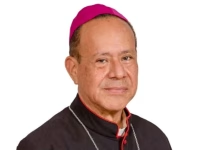
Bishop Socrates Calamba Mesiona, Apostolic Vicar of Puerto Princesa, met this week with Commodore Jay Tarriela, spokesman for the West Philippine Sea Command, to discuss logistical preparations and timing. According to both officials, construction could begin in late March.
A Mission of Faith in a Disputed Sea
For the Catholic Church, the construction is not about politics but about meeting the pastoral needs of a growing and isolated community. Pag-asa’s small Catholic population includes civilians as well as personnel from the armed forces, coast guard, navy, and police stationed on the island.
Bishop Mesiona explained that the new structure would initially serve as a mission station rather than a full-fledged parish—a designation given to communities not yet large or stable enough for full parish status. “It is about presence, care, and commitment,” the prelate noted, describing the Church’s aim to ensure that residents “receive regular pastoral care and spiritual support.”
Commodore Tarriela confirmed that preparations are underway, including the coordination of a groundbreaking ceremony for late March. The church’s name and patron saint will be determined by Church authorities in consultation with local clergy.
A Place of Prayer and Peace
The planned church offers not only a physical space for worship but also a symbol of peace and perseverance. “This would be a welcome development for them,” Tarriela said, referring to the Catholic community on Pag-asa. He dismissed fears of increased Chinese surveillance or interference as a result of the construction, pointing out that foreign maritime presence around the island has long existed.
Bishop Mesiona, meanwhile, called for “peace, justice, and national dignity” to prevail in the region—values that the Church hopes to embody through its presence on the island.
A Strategic Outpost Under the Cross
Pag-asa Island—part of the municipality of Kalayaan in Palawan—is home to over 400 residents and serves as a crucial symbol of Philippine sovereignty in the West Philippine Sea. The Philippines asserts its claim based on geographic proximity, effective occupation, and international law.
Senator Risa Hontiveros recently underscored this position during a maritime surveillance flight over the Kalayaan island group. Her visit included a medical and dental mission, food distribution, and the donation of 47 desalination machines to local troops and residents. “The Philippines is made up of thousands of beautiful islands, including Kalayaan,” she said. “We must protect and defend it with all that we’ve got.”
A Broader Context of Regional Tension
The Spratly Islands remain one of Asia’s most contested maritime areas. China asserts control over nearly 85 percent of the South China Sea, overlapping with claims by the Philippines, Vietnam, Taiwan, Malaysia, and Brunei. Despite a 2016 ruling by The Hague’s Permanent Court of Arbitration in Manila’s favor, Beijing continues to reject the decision.
The United States has reiterated support for Southeast Asian nations in upholding freedom of navigation, declaring China’s expansive “nine-dash line” claim illegal and excessive. Control over the area carries strategic weight: nearly one-third of global maritime trade and vast amounts of oil and natural gas pass through these waters.
Faith as Sovereignty
In this context, the Church’s decision to build a place of worship on Pag-asa stands as both a gesture of faith and quiet defiance. For the Catholic faithful, it represents spiritual sustenance; for the nation, a reaffirmation of its enduring presence in a region where faith and sovereignty meet at the water’s edge.
- Raju Hasmukh with files from Asianews.it
Related Images: