











New Mexico diocese cites religious freedom violations in legal fight against federal effort to seize Mount Cristo Rey land for border wall.
Newsroom (22/06/2026 Gaudium Press ) A New Mexico diocese has intensified its legal battle against the federal government’s attempt to seize land at the historic Mount Cristo Rey pilgrimage site, arguing that the action violates religious freedom protections and threatens the sanctity of a longstanding shrine.
In a June 19 filing in the U.S. District Court for the District of New Mexico, the Diocese of Las Cruces condemned the proposed land acquisition as an “affront to religious liberty,” invoking both the First Amendment and the Religious Freedom Restoration Act (RFRA). The filing forms part of the diocese’s response to a federal lawsuit seeking to claim roughly 14 acres of land under eminent domain for the construction of a segment of the U.S.-Mexico border wall.
The legal challenge is bolstered by declarations from Bishop Peter Baldacchino of Las Cruces, Bishop Mark J. Seitz of El Paso, Texas, and Bishop Michael Buerkel Hunn of the Episcopal Diocese of the Rio Grande. Together, they argue that the government’s actions jeopardize not only property rights but also deeply held religious practices tied to the site.
A Historic Pilgrimage Site at the Center of Dispute
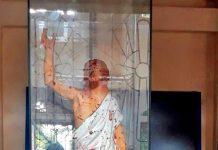
Mount Cristo Rey, rising 4,675 feet above Sunland Park, New Mexico, has served as a Catholic pilgrimage destination for nearly a century. At its summit stands a 29-foot limestone statue of Jesus Christ, with arms outstretched, overlooking both southern New Mexico and neighboring El Paso, Texas.
Each year, thousands of pilgrims traverse the rugged terrain to reach the shrine, engaging in prayer and religious devotion. The diocese argues that the mountain holds profound spiritual significance and its use extends beyond mere land ownership into the realm of protected religious exercise.
Federal Push for Border Wall Expansion
The Department of Justice has sought access to the site for months, aiming to incorporate the land into broader border enforcement efforts. On May 7, the federal government formally filed suit to take possession of the property, naming both the diocese and the treasurer of Doña Ana County.
Under eminent domain laws, the government may seize private property for public use provided “just compensation” is paid. On June 15, U.S. District Judge Kenneth J. Gonzales ruled that compensation for the land—calculated at $183,071—should be deposited into a court registry account, a standard procedure in such cases.
However, Gonzales also clarified that this step does not undermine the diocese’s right to contest the seizure itself.
Religious Freedom Claims Take Center Stage
In its legal response, the Diocese of Las Cruces contends that the planned construction of a border wall segment on Mount Cristo Rey imposes a substantial burden on religious exercise. Under RFRA, the government must demonstrate a compelling interest and use the least restrictive means when actions interfere with religious practices.
The diocese argues that the government has failed to meet this standard. It describes the border wall as “offensive to Catholic values and teachings” and characterizes it as a “physical symbol” of the dehumanization of migrants.
“Nothing could be less Catholic,” the diocese stated in its filing.
Bishop Baldacchino further described the proposed wall as a “counter-sign” to Catholic teachings, which emphasize human dignity and the moral obligation to provide essential resources such as food, shelter, and freedom of worship. The Church, he noted, has a longstanding history of advocacy for migrants, refugees, and displaced persons.
Allegations of Irreparable Harm
Beyond theological objections, the diocese warns of physical and cultural damage to the sacred site. The filing states that construction efforts would “deface” Mount Cristo Rey, potentially limiting access for pilgrims and undermining its spiritual significance.
The diocese also raised concerns about the government’s approach, describing it as “arbitrary and capricious.” It accused federal authorities of contracting construction work and initiating preliminary activities before securing legal ownership of the land.
As evidence of alleged disregard for the site’s sanctity, the diocese cited a February 4, 2026, video from El Paso Sector Border Patrol showing a large explosion near the mountain. The accompanying message referred to a “face lift” for the area—language the diocese criticized, noting that “the only face on Mount Cristo Rey is that of Christ the King.”
Additionally, the filing referenced the prior destruction of a sacred geoglyph in southwest Arizona during border wall construction, raising fears that Mount Cristo Rey could suffer a similar fate.
Canon Law and Church Governance Concerns
Bishop Baldacchino also argued that the federal government’s actions place him in direct conflict with canon law, the Catholic Church’s governing framework. He explained that any sale or transfer of diocesan property requires approval from the Vatican and consultation with church officials—procedures not accommodated under eminent domain proceedings.
“The very act of condemnation is contrary to the canonical requirements of the Catholic Church,” Baldacchino stated, emphasizing that the diocese has neither agreed to sell the land nor initiated the required processes.
He further warned that the construction of a barrier at the sacred site would “shatter the sacredness” of the location, particularly when alternative means of border enforcement may exist.
Legal Timeline Moving Forward
Judge Gonzales has set a July 3 deadline for the federal government to respond to the diocese’s filing. A court hearing is scheduled for July 23, where both sides are expected to present arguments on the contested land seizure and its broader constitutional implications.
As the case unfolds, it highlights a complex intersection of federal authority, immigration policy, property rights, and religious freedom—issues that remain at the forefront of national debate.
- Raju Hasmukh with files from OSV News
Related Images: