![Cardinal in a black cassock with red trim and red skullcap, seated in a leather chair with a microphone nearby.”] ,](https://www.gaudiumpress.ca/wp-content/uploads/2026/05/Cardinal-Muller--218x150.jpg "Cardinal Müller Urges Firm Response to SSPX and Questions Synodal Consistory Format")
















![Cardinal in a black cassock with red trim and red skullcap, seated in a leather chair with a microphone nearby.”] ,](https://www.gaudiumpress.ca/wp-content/uploads/2026/05/Cardinal-Muller-.jpg "Cardinal Muller")
Cardinal Müller calls for a firm Vatican response to SSPX, proposes a new commission, and criticizes the synodal consistory format.
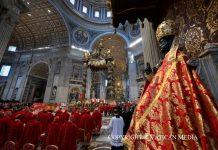
Newsroom (29/06/2026 Gaudium Press ) Cardinal Gerhard Müller used his intervention at the Vatican’s extraordinary consistory on June 26–27 to call for a decisive response to the Society of St. Pius X (SSPX), while simultaneously raising concerns about the evolving “synodal style” of Church governance.
Speaking in a concise three-minute address, the former prefect of the Congregation for the Doctrine of the Faith addressed two pressing issues before the College of Cardinals: the SSPX’s recent open letter challenging the doctrinal integrity of the Roman Church, and what he described as procedural shortcomings in the conduct of modern consistories.
A Call for Doctrinal Clarity
Müller’s remarks come amid heightened tensions following an open letter sent by the Priestly Fraternity of Saint Pius X to Pope Leo XIV and the College of Cardinals on the eve of the meeting. The letter reportedly questioned whether the Roman Church had remained faithful to Catholic doctrine—a charge Müller described as “scandalous.”
“It is our duty,” he stated, “both individually and as a college, to reject” any claim that the Church has deviated from the faith. He underscored that such accusations strike at the very heart of ecclesial unity and cannot go unanswered.
The cardinal warned that the SSPX’s planned episcopal consecrations on July 1 in Écône—if carried out without papal authorization—would constitute a clear schismatic act. In Catholic ecclesiology, episcopal consecrations without the consent of the Pope are considered a grave breach of communion with Rome.
“There must be no ambiguity,” Müller insisted, drawing a firm line between legitimate pastoral sensitivity and doctrinal compromise.
Proposal for a New Commission
Despite his firm tone, Müller also advanced a pathway for reconciliation. He proposed the establishment of a new Vatican commission modeled on the former Ecclesia Dei, which had been created in 1988 to facilitate dialogue and eventual reintegration of traditionalist groups following earlier illicit consecrations by Archbishop Marcel Lefebvre.
Such a body, he said, would aim to assist those within the SSPX who seek “full communion with the Pope,” balancing doctrinal clarity with pastoral outreach. This dual approach reflects a long-standing Vatican strategy of combining firmness on principles with openness to reconciliation.
However, Müller made clear that reconciliation has limits. “The boundary into schism is definitively crossed,” he said, “when the ministry of the Bishop of Rome… is violated.” For Müller, communion with the Pope is not merely administrative but constitutes “the visible principle and enduring foundation of the Church’s unity in revealed truth.”
To reinforce his argument, he invoked the teaching of Cardinal Stanislaus Hosius at the Council of Trent: “He is not a Catholic who is at variance with the Roman Church in the doctrine of the faith.” By applying this historical judgment to contemporary divisions, Müller framed the SSPX dispute as part of a broader and enduring question of ecclesial identity.
Critique of Synodal Practices
Beyond doctrinal concerns, Müller also turned his attention to the structure and methodology of the consistory itself. His remarks included a pointed critique of the increasingly emphasized “synodal style,” which prioritizes small-group discussions over plenary debate.
He argued that this approach risks diminishing the role of open, collective deliberation among cardinals. “The free exchange of views,” he said, should precede group work and be given greater prominence, recalling the tradition of Church councils where full assemblies engaged in direct debate.
Müller grounded his critique in a theological understanding of collegiality. While affirming the primacy of the Pope, he emphasized that it must be understood within the context of the Church as a communion. Drawing on sources ranging from Irenaeus of Lyons to the First Vatican Council, he noted that papal primacy has historically been tied to the Church of Rome as a whole, rather than to an isolated individual.
He also highlighted the dual dimensions of collegiality: an “external” collegiality between the Pope and the bishops of the world, and an “internal” collegiality within each diocese, where the bishop remains in communion with his presbyterate.
From this perspective, the College of Cardinals itself serves as an institutional expression of this collegiality, assisting the Pope in the governance of the universal Church. Müller’s intervention suggests concern that current procedural trends may obscure this foundational role.
A Moment of Tension and Reflection
The cardinal’s intervention reflects a broader moment of tension within the Catholic Church, as it seeks to balance unity, tradition, and evolving forms of governance. His dual emphasis—on doctrinal firmness toward the SSPX and on preserving robust debate within Church structures—highlights ongoing questions about authority, communion, and method.
As the Church approaches the anticipated July 1 consecrations in Écône, Müller’s call for clarity and action signals that the Vatican may soon be confronted with decisions that carry both theological and institutional consequences.
At the same time, his critique of the consistory format points to an internal debate over how the Church conducts its deliberations—a debate that may shape not only future consistories but also the wider synodal process.
In both respects, Müller’s brief but pointed address underscores the stakes facing the Church in 2026: maintaining unity in doctrine while navigating change in practice.
- Raju Hasmukh with files from Diane Montagna Substack
Related Images: