














Explore the Notre-Dame Crypt in Boulogne-sur-Mer, a vast underground site preserving nearly 2,000 years of Roman, medieval, and religious history.
Newsroom (14/07/2026 Gaudium Press ) Hidden beneath the streets of Boulogne-sur-Mer lies one of France’s most remarkable historical treasures: the crypt of the Notre-Dame Basilica. Stretching across nearly 1,400 square meters, the vast underground complex is widely regarded as the largest crypt in France and among the largest in Europe. Yet its significance extends far beyond its impressive dimensions. Within its galleries and painted vaults, visitors encounter a rare historical continuum that spans almost two thousand years, from Roman antiquity to the great religious revivals of the 19th century.
The story of the site begins long before Christianity took root in northern France. During the Roman era, Boulogne-sur-Mer was known as Gesoriacum and later Bononia, serving as a strategic port linking the Empire with the coast of Britain. Remains of Roman foundations and masonry can still be seen within the crypt’s underground passageways, providing tangible evidence of the city’s importance in antiquity and establishing the deep historical foundations upon which later generations would build.
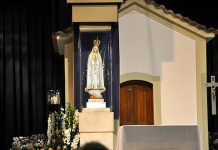
According to local tradition, the cult of Our Lady of Boulogne originated in the 7th century, around 633 or 639. The tradition recounts the miraculous arrival of a statue of the Virgin Mary carried ashore in a boat without sail or oars. The event inspired the construction of an early sanctuary in the upper town and marked the beginning of a devotion that would transform Boulogne into one of medieval Christendom’s most significant Marian pilgrimage destinations.
The sanctuary’s importance expanded considerably during the late 11th century. Around 1090, Saint Ida of Boulogne, mother of the future Crusader leader Godfrey of Bouillon, commissioned the construction of a stone church and a Romanesque crypt. This medieval crypt remains the historical core of the underground network seen today. Over the following centuries, the complex was enlarged and modified, reflecting the growing prestige of the pilgrimage site. Between the 13th and 16th centuries, successive expansions reshaped the church, and in 1556 it was elevated to cathedral status following the destruction of Thérouanne and the reorganization of diocesan territories in the region.
The cathedral was not only a religious center but also a setting for events of European significance. On January 22, 1308, Isabella of France, daughter of King Philip IV, known as Philip the Fair, married King Edward II of England within the sanctuary. The occasion further enhanced the church’s standing. Tradition holds that Philip the Fair presented the shrine with the celebrated Reliquary of the Holy Blood, an exquisite work of enameled goldsmithing. More than seven centuries later, this treasured object remains preserved within the crypt’s treasury.
For hundreds of years, the pilgrimage to Our Lady of Boulogne flourished, attracting generations of worshippers seeking spiritual protection and divine intercession. This long continuity of devotion, however, came to an abrupt end during the upheavals of the French Revolution.
In 1790, revolutionary authorities suppressed the Diocese of Boulogne. Three years later, in 1793, the revered statue of Our Lady was destroyed by fire, although two fragments were successfully preserved. The cathedral itself suffered an equally tragic fate. Declared national property, it was sold and ultimately demolished in 1798, erasing a monument that had stood at the heart of local religious life for centuries.
Yet the story of the sanctuary did not end with its destruction. In 1820, Abbot Benoît-Agathon Haffreingue purchased the ruins with the ambition of restoring Boulogne’s historic place of worship. Beginning in 1827, he launched the construction of the present-day basilica, a monumental undertaking that would continue until its completion in 1866.
During the early stages of construction, workers made a remarkable discovery: the buried Romanesque crypt had survived beneath the ruins. Excavated and protected beneath a new vault in 1829, the crypt was subsequently restored and opened to visitors in 1839. Around this ancient nucleus, an extensive network of galleries gradually emerged, creating the sprawling underground complex visible today.
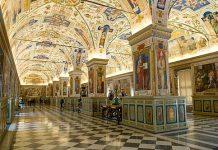
The 19th century added a distinctive artistic dimension to the crypt. Thousands of square meters of walls and vaults were decorated with paintings illustrating biblical narratives, saints, and episodes connected to the history of Our Lady of Boulogne. These artworks transformed the underground spaces into a visual chronicle of faith and devotion, complementing the archaeological remains preserved within the structure.
Following a major restoration and renovation campaign lasting two years, the crypt reopened to the public in 2015, ensuring the preservation of its unique heritage for future generations.
Today, the Notre-Dame Crypt stands as an extraordinary historical archive beneath the cobblestones of Boulogne-sur-Mer. Roman stones coexist with the 11th-century crypt, the treasured reliquary associated with the royal wedding of 1308, and the grand galleries created during the 19th-century reconstruction. Together, these layers form a rare and compelling testament to the city’s past.
More than the remains of a vanished cathedral, the crypt represents the enduring memory of a pilgrimage tradition that shaped Boulogne for over a millennium. It preserves not only architectural and artistic treasures but also the spiritual legacy of countless pilgrims who journeyed here seeking the protection of Our Lady of Boulogne. In doing so, it offers a remarkable window into the intertwined history of faith, culture, and community across nearly twenty centuries.
- Raju Hasmukh with files from Tribune Chretienne
Related Images: