





The Palmarian Church has used the SSPX excommunications to revive its claims, despite both movements remaining outside the One Holy Catholic Apostolic Church.
Newsroom (22/07/2026 Gaudium Press ) The latest intervention from the Palmarian Church following the excommunications affecting the Society of Saint Pius X (SSPX) is a reminder of one of the great ironies of contemporary Catholic history: a schismatic movement founded on alleged apparitions, illicit episcopal consecrations, and a self-proclaimed papacy is now attempting to capitalize on the difficulties of another movement long associated with conflict over ecclesiastical authority.
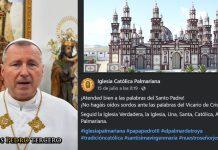
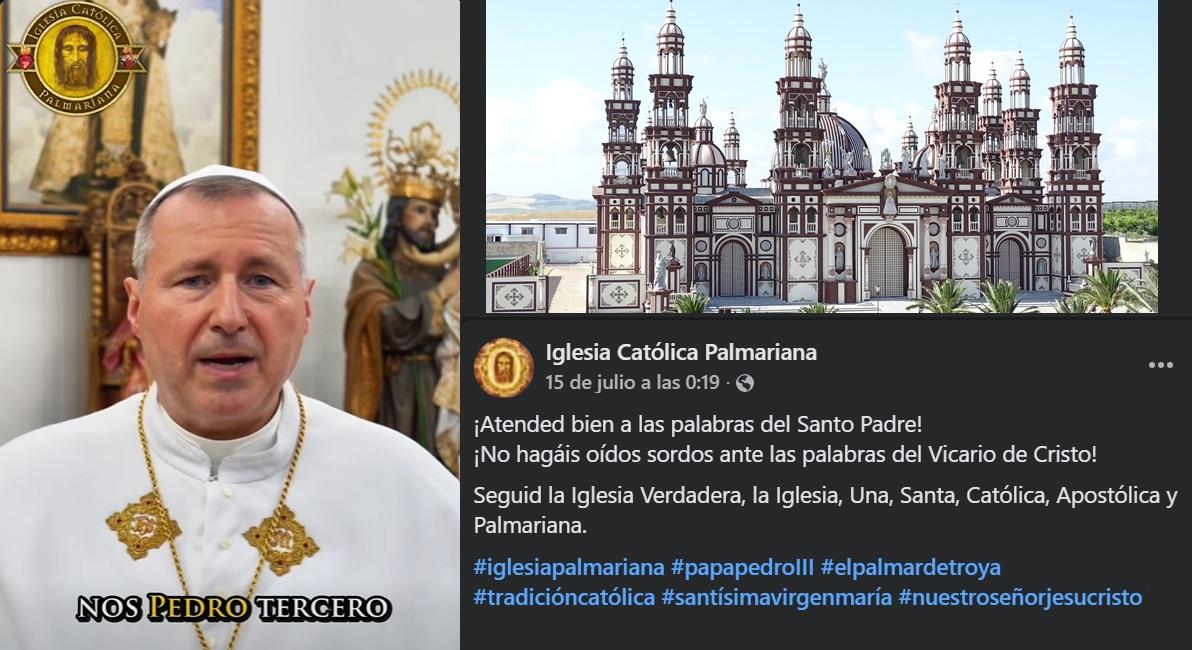
In a 14-minute message distributed through social media, Joseph Odermatt, who styles himself as Pope Peter III, presented the Palmarian Church as the sole custodian of authentic Catholicism. His argument rested on a familiar premise: that Rome lost its legitimacy and that the true Holy See was transferred to El Palmar de Troya, a small town in Andalusia, Spain.
The claim, however, represents a direct rejection not only of the Roman Catholic Church but also of the authority of Pope Leo XIV, whom Catholics recognize as the legitimate successor of Saint Peter. While the SSPX and the Palmarian Church differ profoundly in doctrine and organization, both movements have spent decades defining themselves in opposition to the authority of the Holy See.
The Palmarian Attack on the SSPX
Odermatt’s address focused heavily on followers of Archbishop Marcel Lefebvre, founder of the SSPX. According to the Palmarian leader, the recent excommunications merely confirmed a situation that had existed for decades. He argued that the SSPX had already been condemned by Clemente Domínguez Gómez, the founder of the Palmarian movement who assumed the papal name Gregory XVII.
The speech revisited familiar Palmarian narratives surrounding Archbishop Ngô Đình Thục, the Vietnamese prelate who illicitly ordained and consecrated Domínguez and several associates in 1976. Odermatt maintained that Thục recognized the authenticity of El Palmar de Troya and understood the gravity of the crisis facing the Church.
He also repeated longstanding Palmarian allegations regarding Lefebvre, claiming that the French archbishop ignored heavenly appeals connected to El Palmar and compromised his position through negotiations with Cardinal Joseph Ratzinger in the years leading up to the 1988 episcopal consecrations.
For Odermatt, the SSPX embodies a contradiction: recognizing papal authority while frequently resisting it. Yet the criticism highlights an uncomfortable reality for the Palmarians themselves. If the SSPX has often lived in tension with Rome, the Palmarian Church went much further, establishing an entirely separate hierarchy, separate sacraments, separate saints, separate doctrines, and its own rival line of claimants to the papacy.
From Apparition Site to Rival Vatican
The origins of the movement lie in the reported Marian apparitions of 1968 at El Palmar de Troya. The claims attracted pilgrims and generated stories of visions, miracles, stigmata, and supernatural phenomena.
The central figure soon became Clemente Domínguez Gómez, an office clerk who emerged as the movement’s principal visionary. Under his leadership, the message of El Palmar evolved from concern about developments in the Church into an uncompromising rejection of the post-Vatican II era.
Church authorities never accepted the alleged apparitions. The Archbishop of Seville condemned the movement and prohibited Catholic religious activity at the site. Rather than submit to ecclesiastical authority, the movement increasingly moved toward separation.
The decisive break came after Archbishop Ngô Đình Thục ordained and consecrated Domínguez and his associates without authorization. Those involved were excommunicated, and the movement acquired the episcopal structure necessary to sustain itself independently.
The Birth of a Parallel Church
After the death of Pope Paul VI in 1978, Domínguez claimed that Christ had personally crowned him pope in a vision. Taking the name Gregory XVII, he declared that the Holy See had been transferred from Rome to El Palmar de Troya.
The result was the creation of a parallel ecclesiastical structure that mirrored the Catholic Church while rejecting its authority. Cardinals were appointed. New saints were canonized. New doctrines were proclaimed. The movement eventually produced its own biblical text and developed increasingly distinctive teachings.
At the center of the system stood the doctrine that the true pope was no longer in Rome.
That claim remains the defining error of the Palmarian movement. Catholic unity rests on communion with the successor of Saint Peter. By denying the legitimacy of the Roman pontiff and establishing rival popes, the Palmarian Church placed itself outside that communion.
Turmoil, Isolation, and Decline
The history of the Palmarian Church has been marked by controversy, internal conflicts, expulsions, and frequent leadership crises.
Following Domínguez’s death in 2005, Manuel Alonso Corral became Peter II without a conclave. He was succeeded by Gregory XVIII, whose rule was characterized by increasing isolation from the outside world and harsh restrictions on members and their families.
The most dramatic episode occurred in 2016 when Gregory XVIII abdicated and left the movement entirely. The departure of a reigning Palmarian pope dealt a major blow to the group’s credibility and generated widespread media attention.
Joseph Odermatt, now Peter III, has attempted to modernize the movement’s public presence through websites and social media campaigns. Nevertheless, the sect is believed to number only a few thousand adherents, a small remnant compared with its earlier years.
An Attempt to Profit From Ecclesiastical Turmoil
Odermatt’s latest message appears aimed at attracting Catholics unsettled by disputes involving the SSPX and traditionalist circles. By presenting the Palmarian Church as a refuge from confusion, he seeks to transform another group’s crisis into a validation of Palmarian claims.
Yet the fundamental problem remains unchanged.
The SSPX emerged from resistance to reforms and disputes over obedience. The Palmarian Church emerged from alleged apparitions, illicit consecrations, and the creation of a rival papacy. Both movements have histories rooted in conflict with ecclesiastical authority.
For Catholics, however, the issue is ultimately straightforward. The Church did not move from Rome to a small town in Andalusia. The Holy See was not transferred through private revelations. The papacy was not inherited through self-proclaimed visionaries.
While the Palmarian Church presents itself as the guardian of authentic Catholicism and the SSPX continues to wrestle with its complex relationship to Rome, the Catholic Church recognizes only one legitimate pontiff: Pope Leo XIV, successor of Saint Peter and Bishop of Rome. From that perspective, the latest Palmarian intervention is less a solution to ecclesiastical division than another chapter in the long history of schism speaking to schism.
- Raju Hasmukh with files from Infocahtolica
Related Images: