



Premonstratensians celebrated Holy Mass at Bayham Abbey for a second year, restoring Catholic worship to the historic site after 500 years.
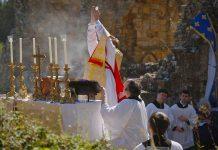
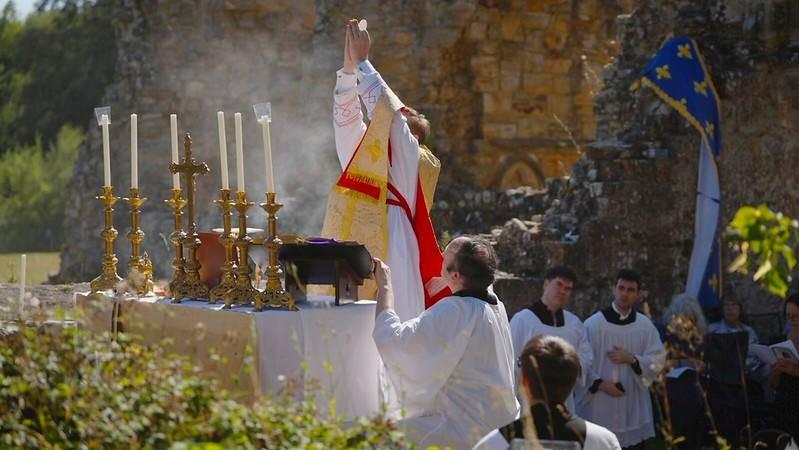
Newsroom (22/07/2026 Gaudium Press ) For only the second time since the Anglican Reformation, Holy Mass has been celebrated at the ruins of Bayham Abbey, restoring Catholic worship to a site that had remained silent for nearly 500 years.
The liturgy took place on July 11 and was celebrated according to the traditional Roman Rite as used by the Premonstratensians, also known as the Norbertines. Father Stephen Morrison, O.Praem., presided over the Mass amid the remains of the historic abbey, once home to a thriving community of canons regular.
The occasion carried deep historical and spiritual significance. Bayham Abbey, founded by the Premonstratensians in 1208, was among approximately 30 Norbertine houses established in England. The abbey was suppressed in 1525 by Cardinal Wolsey, years before the wider Dissolution of the Monasteries initiated under King Henry VIII. During the reign of Elizabeth I, the site passed into secular ownership, ending centuries of religious life at the location.
In his homily, Father Morrison reflected on the privilege of offering the Holy Sacrifice once again on ground that had been consecrated by generations of religious worship. He recalled a time when the Divine Office echoed through the abbey and as many as three Masses were celebrated there each day.
The Mass also coincided with an important anniversary for the order. July 11 marked the 900th anniversary of Apostolicæ Disciplinæ, the papal bull through which Pope Honorius II formally approved the Order of Canons Regular of Prémontré. The convergence of the anniversary and the return of worship to Bayham Abbey underscored the enduring legacy of the Norbertine tradition.
Throughout his homily, Father Morrison emphasized themes of continuity, faith, and renewal. He spoke of the Church’s enduring witness across centuries and highlighted how periods of decline and upheaval can become opportunities for spiritual growth. Concluding his remarks with an invocation to Saint Norbert, founder of the order, he encouraged the faithful to cherish the Mass and seek holiness in their own time and circumstances.
The day’s program extended beyond the Eucharistic celebration. Participants attended a Gregorian chant workshop and lectures exploring the history of Bayham Abbey and the Premonstratensian Order. A family rosary was also offered, and the gathering concluded with the veneration of a relic of Saint Norbert.
Father Morrison used the occasion to highlight ongoing evangelization and catechetical efforts within the Archdiocese of Southwark. He praised the lay volunteers whose collaboration with English Heritage made the event possible and described their efforts as a blessing. He also noted that the Norbertine canonry and parish in Peckham was proud to contribute to wider efforts of re-evangelization throughout the archdiocese.
The revival of worship at Bayham Abbey has been driven largely by the dedication of lay volunteers. The initiative was led by Liz Corcoran, a diocesan volunteer with the Agency for Evangelization and Catechesis and a member of the Southwark Charismatic Renewal Team. Corcoran organized the first Mass at the ruins in July of the previous year and helped coordinate this year’s celebration.
Her efforts were supported by a broad network of collaborators, including Father Morrison, English Heritage, Dr. Matthew Ward, the Schola Gregoriana in Cambridge, Alan Gardener and the Latin Mass Society, Dr. Mary Alexander, and Father Ed Tomlinson.
Reflecting on her involvement, Corcoran said the experience deepened her understanding of England’s Catholic heritage. She described the event not only as a formative spiritual experience but also as an important opportunity for evangelization.
According to Corcoran, the public nature of the event attracted both practicing Catholics and curious visitors. In addition to faithful attendees and young families, local residents and passersby stopped to observe the celebration. Many accepted informational leaflets and expressed a sincere interest in learning more about the faith and the history behind the event.
Corcoran, who identifies as a charismatic Catholic, acknowledged that she had little prior experience with this style of liturgical celebration. Nevertheless, she described her participation in organizing the Mass as a source of great joy and gratitude. She also praised English Heritage for welcoming the use of the historic site for its original purpose and expressed hope that the celebration would return again next year.
For many participants, the restoration of the Mass to Bayham Abbey represented more than a historical commemoration. It served as a visible sign of continuity between past and present, bringing Catholic worship back to a place where generations of Premonstratensians once prayed, preached, and celebrated the sacraments. Against the backdrop of centuries-old ruins, the gathering transformed a monument of England’s religious past into a setting for renewed faith and evangelization.
- Raju Hasmukh with files from Infocatholica
Related Images: