











Vatican warns UN that persecution of Christians worsened in 2025, affecting over 388 million believers amid global conflict and rising extremism.
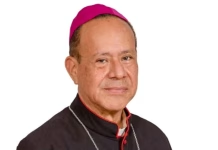
Newsroom (26/02/2026 Gaudium Press) At the United Nations this week, the Vatican delivered a stark warning: the persecution of Christians has become one of the world’s most widespread and troubling human rights crises. Speaking before the Human Rights Council on February 25, Monsignor Daniel Pacho, the Holy See’s Undersecretary for the Multilateral Sector, described the accelerating trend of violence and discrimination against Christians as a “deteriorating global reality.”
According to the humanitarian organization Open Doors, more than 388 million Christians worldwide now face high levels of persecution — equating to over 14% of all Christians. “This unfortunate situation has deteriorated further in 2025 due to the exacerbating factors of conflict and extremism,” Pacho told the assembly.
Pope Leo XIV: Faith Under Siege
Since his election, Pope Leo XIV has made defense of persecuted believers a hallmark of his papacy. In his January address to the Diplomatic Corps accredited to the Holy See, the pontiff lamented the worsening global landscape, warning that in many regions, “religious freedom is seen more as a privilege than a fundamental human right.”
Pope Leo cited poignant examples: extremist assaults in Bangladesh, jihadist incursions across the Sahel and Nigeria, and the brutal attack on Saint Elias parish in Damascus, alongside the persistent insurgency in Cabo Delgado, Mozambique. These, he said, exemplify how Christians “suffer high or extreme levels of discrimination, violence and oppression because of their faith.”
But beyond physical violence, Leo pointed to a more insidious challenge — what he termed “a subtle form of discrimination” spreading even in historically Christian regions like Europe and the Americas. He warned that believers increasingly face legal and cultural restrictions that prevent them from exercising or articulating their faith in public life, often under the pretext of political correctness or social conformity.
A “Polite” Persecution in the West
Addressing diplomats in Geneva, Monsignor Pacho expanded on the Pope’s warning, highlighting the rise of what he called “polite persecution” — a sophisticated form of marginalization that silences believers through social and ideological pressure rather than violence. This phenomenon, he said, attacks the freedom of Christians to defend life, family, and human dignity under the guise of tolerance.
“It is crucial to address this phenomenon in Western societies,” Pacho urged. “Even where Christians comprise the majority, they are being subtly restricted in living and proclaiming the Gospel.”
The Crisis of Human Rights and “New Rights”
Pacho’s remarks also touched on a broader concern: the credibility crisis within the modern human rights system. He warned that growing “reinterpretations” of foundational rights, coupled with the selective endorsement of some freedoms over others, are eroding the moral coherence that once underpinned international law.
He pointed to the proliferation of what the Vatican terms “new rights” — claims related to abortion, assisted suicide, gender identity, and sexual orientation — as contributing to this erosion. These, he argued, are often elevated at the expense of more fundamental liberties like freedom of conscience, religion, and the right to life.
“It is evident that a paradox is being observed,” Pacho said, quoting Pope Leo XIV, “wherein fundamental rights are being restricted under the guise of so-called new rights.” When rights become self-referential and detached from truth or nature, he continued, the very framework of human rights “loses its vitality and creates space for force and oppression.”
A Call to Reaffirm Religious Liberty
For the Vatican, the defense of religious freedom remains inseparable from the defense of human dignity itself. Pacho concluded his intervention by reaffirming the Church’s conviction that human rights must rest on objective truth and universal moral law, not shifting cultural currents.
“The protection of conscience and belief is the cornerstone of civilization,” he said. “Without it, societies cannot flourish nor uphold justice.”
As Pope Leo XIV continues to amplify the plight of persecuted Christians, the Vatican’s message at the UN echoed as both a warning and a plea — a call for the world to remember that the light of faith, once extinguished in the name of tolerance, darkens the path for all humanity.
- Raju Hasmukh with files from Crux Now
Related Images: