





A decree in Maceió, Brazil, imposes excommunication on priests celebrating the traditional Latin Mass outside one authorized chapel.
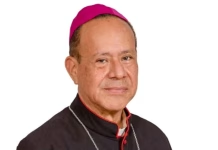
Newsroom (26/02/2026 Gaudium Press) In a striking development within the Catholic Church, Archbishop Carlos Alberto Breis Pereira of Maceió, Brazil, has declared that any priest who celebrates the traditional Latin Mass outside the one location authorized by his archdiocese commits schism and incurs automatic excommunication. The decision, which surfaced this month through the publication Paix Liturgique, has fueled intense debate about canon law, papal authority, and the future of the old liturgy within the modern Church.
The decree arrives amid heightened global tension surrounding traditionalist movements, particularly in light of continuing discussions over new episcopal consecrations associated with the Lefebvrian community. Yet, the Brazilian controversy proceeds in almost the opposite direction—tightening restrictions rather than loosening them—by enforcing a remarkably narrow limit on where the old rite may be celebrated.
One Authorized Mass for Nearly Two Million Catholics
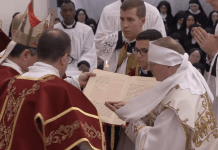
Within the vast Archdiocese of Maceió, stretching across roughly 8,500 square kilometers and home to nearly 1.8 million people, there exists just one authorized celebration of the ancient liturgy. It takes place each Sunday at 10 a.m. in the Chapel of St. Vincent de Paul, located in the Santa Casa de Misericordia hospital. The Mass is offered by Father Cícero Lenisvaldo Miranda da Silva, a diocesan priest.
This singular authorization, according to the archdiocesan note, was granted under the norms of Traditionis Custodes, Pope Francis’s 2021 motu proprio regulating the use of pre–Vatican II liturgical books. The text of the decree, dated February 11 and signed by the Judicial Vicar, reiterates that this dispensation—approved by both the archbishop and the Holy See—does not extend to any other religious or secular venue. In short, “this liturgy is not authorized in any other place, religious or secular, nor in any civil association.”
Harsh Penalties and Questionable Canonical Basis
The same document invokes canons 751 and 1364 §1 of the current Code of Canon Law to justify automatic excommunication for any priest who violates this restriction. It asserts that the unauthorized celebration of the old rite constitutes “an act of public schism.” However, as Paix Liturgique points out, neither of these canons defines such celebrations as schismatic in themselves. While canon law indeed provides for automatic excommunication in cases of genuine schism, it nowhere suggests that offering Mass in the older form would, by itself, create such a situation.
This expansive interpretation has raised eyebrows among canonists and traditional Catholics alike. The notion that even a private Mass celebrated according to the pre–Vatican II Missal could amount to public schism “defies imagination,” observed the report. Given the gravity of excommunication and the ecclesial separation it implies, critics argue that such a penalty demands much clearer theological and canonical justification.
Theological and Ecclesial Implications
For observers within the Catholic intellectual world, the move in Maceió represents an extreme extension of the logic introduced by Traditionis Custodes. That document proclaimed that the liturgical books revised by Popes Paul VI and John Paul II are “the sole expression of the lex orandi of the Roman Rite.” From this premise, Paix Liturgique argues, one might conclude that the older liturgy no longer expresses the Church’s faith—a conclusion that traditionalist groups strongly reject as inconsistent with Catholic tradition.
The underlying theological issue is profound: if the Church were to claim that her ancient liturgy no longer expresses her faith, it could imply that the faith itself has changed. As the same commentary notes, such an idea would seem irreconcilable with the Church’s continuity through the ages—from Saint Augustine to Saint Teresa of Ávila and beyond.
Awaiting Official Confirmation
Although the decree has circulated widely across social networks, the Archdiocese of Maceió has not officially published it on its website. For that reason, caution remains advisable while interpreting its final status. Still, there are signs that the decision may have been discussed with higher authority. Archbishop Breis Pereira met with Pope Francis on January 12, leading some to speculate that he might have informed the Holy Father of his intended course of action in advance.
The timing of the decree’s appearance is also notable: it emerged one day before a separate statement from Cardinal Víctor Manuel Fernández addressing the canonical situation of the Society of Saint Pius X—another document invoking schism and excommunication, though for vastly different reasons. Whether coincidence or not, the convergence of these proclamations underscores how questions of liturgy, authority, and ecclesial unity continue to test the Church across doctrinal and geographical lines.
- Raju Hasmukh with files from Infocatholica
Related Images: