













Vatican outlines Anglican Ordinariate patrimony, affirming its beauty, pastoral culture and family focus as a lasting gift within Catholic communion.
Newsroom (27/03/2026 Gaudium Press ) When the Dicastery for the Doctrine of the Faith quietly convened the bishops of the Personal Ordinariates in early March, few outside that circle expected a programmatic text to emerge. Yet from those closed-door conversations in Rome has come a document that both consolidates and projects the identity of the Anglican Ordinariates within the wider Catholic Church.
Formally titled Characteristics of the Anglican Heritage as Lived in the Ordinariates Established Under the Apostolic Constitution Anglicanorum Coetibus, the text distils how the bishops themselves understand the patrimony entrusted to them, and how it is being lived in parishes that stretch from Inverness to Devon, Edmonton to Orlando, Perth to Sydney to Guam—and beyond. Far from a mere internal memorandum, it amounts to a considered Roman endorsement of the Ordinariates’ distinctive spiritual culture as a “precious gift […] and a treasure to be shared.”
A Roman green light for Anglican patrimony
The immediate backdrop is telling. From March 1 to 3, the Bishop Ordinaries met at the Dicastery for the Doctrine of the Faith at the invitation of its Prefect, Cardinal Víctor Manuel Fernández, who asked them to describe “the lived experience of the patrimony at the heart of their Ordinariates” and how Anglican elements have been received and integrated within Catholic communion. On March 2, Pope Francis received Bishop David A. Waller and Bishop Steven Joseph Lopes in private audience, accompanied by Cardinal Fernández, underscoring that these reflections were unfolding under the closest Roman scrutiny.
The new text insists that there is, despite vast geographic dispersion, a recognisable common profile. Ordinariate communities, it states, display “a core shared identity” rooted in “a common path of following Christ that has led them into full communion with the Catholic Church”. That journey has brought with it what Pope Saint Paul VI once called a “worthy patrimony of piety and usage” from the Anglican world, a patrimony that Pope Saint John Paul II first accommodated through the Pastoral Provision in 1980 and that Pope Benedict XVI structurally secured in 2009 with Anglicanorum Coetibus, calling it “a precious gift […] and a treasure to be shared.”
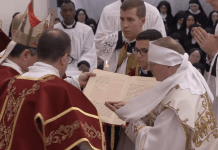
Crucially, the document frames the Ordinariates not as a historical repair-job but as a theological sign. Drawing on a homily delivered by Cardinal Fernández at Bishop Waller’s episcopal ordination in Westminster Cathedral in June 2024, it presents the Ordinariates as a concrete instance of the Church’s capacity to inculturate the one Gospel in diverse settings. “For the Church is one, and the Gospel is one,” the Cardinal observed, “but in the process of inculturation, the Gospel is expressed in a variety of cultures. In this way, the Church acquires a new face.” Within that logic, the Ordinariates constitute “one of the faces of the Church”, in which the Catholic faith is “inculturated among people who experienced the Gospel in the context of the Anglican Communion”.
The text goes further, stating that as those communities entered into full communion, “the Catholic Church […] was enriched.” That assertion is more than a flourish. It deliberately answers recurring questions about whether the Ordinariates were a transitional concession for former Anglicans or a stable component of the Church’s life. By affirming mutual enrichment, the Dicastery signals that the Anglican patrimony is being received as a lasting contribution to Catholic identity rather than as a problem to be managed.
A distinctive ecclesial ethos
At the heart of the document is a set of characteristics that, in the bishops’ own judgement, define the Ordinariate patrimony. The first is a distinctive “ecclesial ethos”, marked by “the broad participation of both clergy and laity in the life and governance of the Church”. This pattern, shaped in the Anglican tradition, is not presented as an alternative polity but as a particular way of inhabiting Catholic structures.
This ethos is described as consultative and collaborative, grounded in relationships that shape the life of each Ordinariate. It carries with it a particular aptitude for welcoming converts into Catholic communion while honouring the singularity of their spiritual histories. That welcome is framed by “a living sense of tradition” that seeks fidelity to what has been received while acknowledging “the place of organic development”. The combination suggests a culture comfortable with both continuity and adaptation, wary of rupture but equally resistant to nostalgia.
Beauty as an instrument of mission
Perhaps the most vivid thread woven through the text is the role of beauty. The bishops stress that beauty is prized “not as an end in itself, but insofar as it has the power to lead us to God”; as such, it carries “an inherent evangelising power”. Liturgy, sacred music and sacred art are thus not mere refinements but are treated as privileged means by which people are drawn into communion with God.
This aesthetic sensibility is rooted in the Anglo-Catholic tradition, where dignified ceremonial, resonant language and rich musical heritage have long functioned as a form of theology in action. The document’s language makes clear that such practices are now being claimed as resources for the Church’s missionary work more broadly. Beauty, it argues, invites “full participation, body and soul, in the work of the Savior,” who is hailed in the text with biblical titles: “the image of the invisible God” and the “refulgence of [the Father’s] glory”.
From sanctuary to street: a theology of the neighbourhood
Yet the bishops are at pains to insist that this emphasis on beauty does not stop at the sanctuary door. A third characteristic they identify is “direct outreach to the poor”, described as a “defining element of the patrimony”. In their account, “beauty in worship and holiness of life are brought to bear in the concrete realities of the neighborhood”, embodying an incarnational theology that moves from altar to street.
The document invokes the example of Saint John Henry Newman, whose funeral drew crowds into the streets of Birmingham not only because of his intellectual stature but because he was remembered as the priest who had served the poor in their need. In citing Newman, the bishops implicitly argue that Anglo-Catholic concern for the marginalised—articulated famously in appeals like F. Weston’s “Our Present Duty” in 1923—is not an optional extra but integral to the patrimony now embedded in the Ordinariates.
A liturgical rhythm “almost monastic”
Another hallmark, according to the text, is a pastoral culture in which worship and daily life are closely intertwined. While that aspiration is hardly unique to the Ordinariates, what distinguishes their practice is a liturgical rhythm described as “almost monastic”, drawn from English spiritual tradition.
Central is the communal praying of the Divine Office, presented not as the preserve of clergy and religious but as “the prayer of the whole People of God”. This regular, shared office shapes the life of parishes, forming communities in a cadence of psalmody and scripture that structures time and undergirds pastoral activity. In this way, the Ordinariates’ liturgical practice does not simply adorn parish life; it determines its pattern and pace.
The family, Walsingham and the “domestic church”
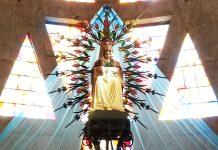
The document devotes particular attention to the family, describing it as “the domestic church” and highlighting parents as the first educators in the faith. Here, the bishops link their vision to the Shrine of Our Lady of Walsingham, often called “England’s Nazareth”. That image does important work: just as Nazareth was, in Pope Saint Paul VI’s phrase, the “school of the Gospel” where the mystery of the Son of God is contemplated within the Holy Family, so the home is portrayed as the primary place where faith is learned, practised and handed on.
From this follows a strongly parish- and family-centred approach to formation. Parish life in the Ordinariates is described as intentionally supportive of parents’ “sacred responsibility” to hand on the faith, and as accompanying families “as they grow together in Christ”. The bishops outline an “organic approach to formation” that is rooted in parish and home and that places “lifelong intellectual formation” at the centre for all members of Christ’s Body, not just for a clerical or academic elite.
Scripture, preaching and the unity of word and worship
The patrimony, the bishops argue, also includes a robust preaching tradition “grounded in Scripture”, with an explicit conviction that “nourishing people intellectually is an integral part of nourishing their souls”. Homiletics here is not reducible to moral exhortation; it is an exercise in catechesis and theological reflection that seeks to engage mind and heart together.
In this context, the theme of beauty resurfaces in a different key. The document insists that “encountering Christ in the splendor of the liturgy and in the proclamation of the Word” are “two dimensions of the same encounter”. In other words, the preached Word and the enacted Word belong together. This is lived, the bishops say, on a foundation of Tradition—especially the Fathers of the Church—and an appreciation for reason “in harmony with and in service of faith”. The Ordinariate style of preaching is thus presented as both intellectually serious and liturgically integrated.
Personal accompaniment: spiritual direction and confession
Rounding out the list of traits is a pronounced emphasis on spiritual direction and the Sacrament of Penance. The bishops describe an inherited approach to cura animarum that “prioritises giving each person time and accompanying them as they encounter Christ the Good Shepherd”. References to scriptural images of the shepherd seeking out the lost sheep reinforce the sense of a ministry centred on patient, individual accompaniment rather than programmatic uniformity.
This stress on personal pastoral care fits coherently with the other characteristics outlined: a consultative ecclesial ethos, a family-centred vision, a monastic-tinged liturgical rhythm and an incarnational concern for the poor. Together they sketch a pastoral style in which structures serve relationships and sacramental life is closely tied to the concrete circumstances of believers.
The Incarnation as the organising principle
The document’s closing pages seek to gather these disparate threads—dignity of the person, beauty, rich liturgical expression, outreach to the poor, reverence for the domestic church—into a single theological centre: the mystery of the Incarnation. The bishops state that all these elements “flow from this same source”: the Son of God, “our only Savior” and “Mediator before the Father”, who became incarnate, suffered, died and rose “so we too may walk in newness of life”.
On this reading, the Ordinariate patrimony is not a bundle of aesthetic preferences or historical peculiarities but a particular way of receiving and living the one Catholic faith in light of the Word made flesh. It is “a living reality”, the text insists, that “looks to the future in the transmission of the faith to future generations”. As the Ordinariates “grow organically”, they are said to offer “a unique reflection of the face of the Church” and a distinctive share in her identity as “one, holy, catholic, and apostolic”.
For Bishop David Waller, newly installed Ordinary of Our Lady of Walsingham, the process that produced the document is as significant as its contents. In comments to the Catholic Herald, he underlined that it “emerges from a meeting of the Ordinariate bishops with the superiors of the Dicastery for the Doctrine of the Faith”, and that those superiors “gave considerable time to listening to reports of the life of the Ordinariates in their specific local contexts and, in particular, the distinctive elements of the Anglican patrimony and how these contribute to the transmission of the Faith”. He characterised the text as “the initiative of Cardinal Victor Manuel Fernández and a clear indication of the Holy See’s understanding of and commitment to the ongoing witness of the Ordinariates as particular Churches within the Catholic Church.”
In effect, Rome has offered the Ordinariates both a mirror and a mandate: a mirror in which they can recognise the contours of their own life, and a mandate to continue offering that life as a gift to the wider Church.
- Raju Hasmukh with files from Vatican.va and Catholic Herald
Related Images: