




















Nine Tamil Nadu police officers sentenced to death for torturing Dalit Christians Jeyaraj and Benniks during 2020 lockdown.
Newsroom (07/04/2026 Gaudium Press ) In a landmark judgment that has sent ripples across India, a Madurai court in Tamil Nadu has sentenced nine police officers to death for the custodial killings of P. Jeyaraj and his son J. Benniks—two Dalit Christians who became symbols of police brutality and systemic injustice in the country. The court’s verdict, delivered after nearly six years of legal proceedings, marks one of the most severe punishments ever imposed on Indian law enforcement officials for custodial violence.
The victims, Jeyaraj, 58, and his son Benniks, 31, were arrested on June 19, 2020, at the height of India’s COVID-19 lockdown. Their alleged crime was keeping their small shop open beyond permitted hours—a charge later proven entirely baseless. Investigations revealed that their business operated within legal hours, exposing the arrest as arbitrary and vindictive.
Once detained at the Sathankulam police station in southern Tamil Nadu, the two men endured seven hours of relentless torture. Witness testimony during the trial recounted shocking scenes of beatings, humiliation, and sustained physical abuse. Among the most horrifying details to surface was that the victims were forced to clean their own blood from the station floor in a futile attempt to conceal evidence of torture.
Both men succumbed to their injuries soon after. Benniks died on June 22, 2020, followed by his father the next day, at the government hospital in Kovilpatti. Their deaths triggered widespread outrage, with thousands protesting across the state and beyond, demanding justice and an end to police impunity.
The court, in its ruling, described the case as “a clear and disturbing example of custodial violence,” explicitly identifying the officers’ direct responsibility. Inspector S. Sridhar was singled out as the principal aggressor, with the remaining officers convicted for their active roles in both the violent acts and the subsequent cover-up. The charges included murder, grievous bodily harm, destruction of evidence, and falsification of official records.
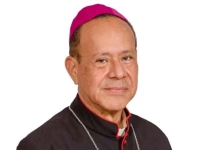
Father P. Z. Devasagaya, former national secretary of the Office for Scheduled Castes and Backward Classes within the Catholic Bishops’ Conference of India, welcomed the verdict but urged systemic change. Speaking to AsiaNews, he said, “Although this has been called a ‘very rare’ case, deaths in police custody continue to occur. Too often, those responsible evade justice.”
He added, “As a Catholic, I am opposed to the death penalty, but I acknowledge the importance of this verdict in holding those sworn to protect citizens accountable. The deaths of Jeyaraj and Benniks exposed an inhumane and brutal side of law enforcement. We hope this judgment will prompt lasting reforms.”
The case has reignited debate about India’s handling of custodial deaths, which disproportionately affect poor and marginalized communities, including Dalits. Human rights advocates have long argued that deep-seated caste bias and institutional culture of violence make accountability almost impossible.
In Tamil Nadu alone, several similar cases have surfaced in recent years, highlighting a pattern of abuse and cover-ups within the police system. Activists say the Madurai court’s decision should serve as a legal and moral precedent, signaling that the state will no longer tolerate torture behind police station walls.
“Many Dalits have died in custody,” Fr Devasagaya concluded, “but very few voices have stood up for them. This verdict must lead to clear guidelines and reforms within the police system to ensure that the accused—no matter their background—are treated with dignity and justice.”
The sentencing marks a rare victory for accountability in India’s criminal justice system, even as debate continues over the appropriateness of the death penalty. For the families of Jeyaraj and Benniks, and for Dalit communities across the country, the judgment stands as a painful yet historic acknowledgment of truth long overlooked.
- Raju Hasmukh with files from Asianews.it