























Indigenous leaders and Catholic scholars confront the Doctrine of Discovery, its legacy, and paths toward justice at a landmark Edmonton symposium.
Newsroom (10/06/2026 Gaudium Press) As Indigenous communities across Canada and the United States continue their struggle for self-governance and control over ancestral lands, renewed attention has centered on the historical and legal framework often cited as a root cause of dispossession: the “Doctrine of Discovery.”
The doctrine, commonly traced to a series of 15th-century papal documents, established the premise that European Christian explorers could claim sovereignty over lands they “discovered,” regardless of the presence of Indigenous populations. Though never a single formal policy, it became embedded in legal, political, and cultural systems that justified colonization and the marginalization of Indigenous peoples.
For many Indigenous leaders, its legacy is not merely historical—it is ongoing.
“I have thought of the ‘Doctrine of Discovery’ as gum underneath my shoes — wherever I go, it is there,” said Grand Chief Edward John of the Tl’azt’en Nation in British Columbia. “And I thought one day, I am going to change my shoes and wear our moccasins and, dang it, there is gum there, too.”
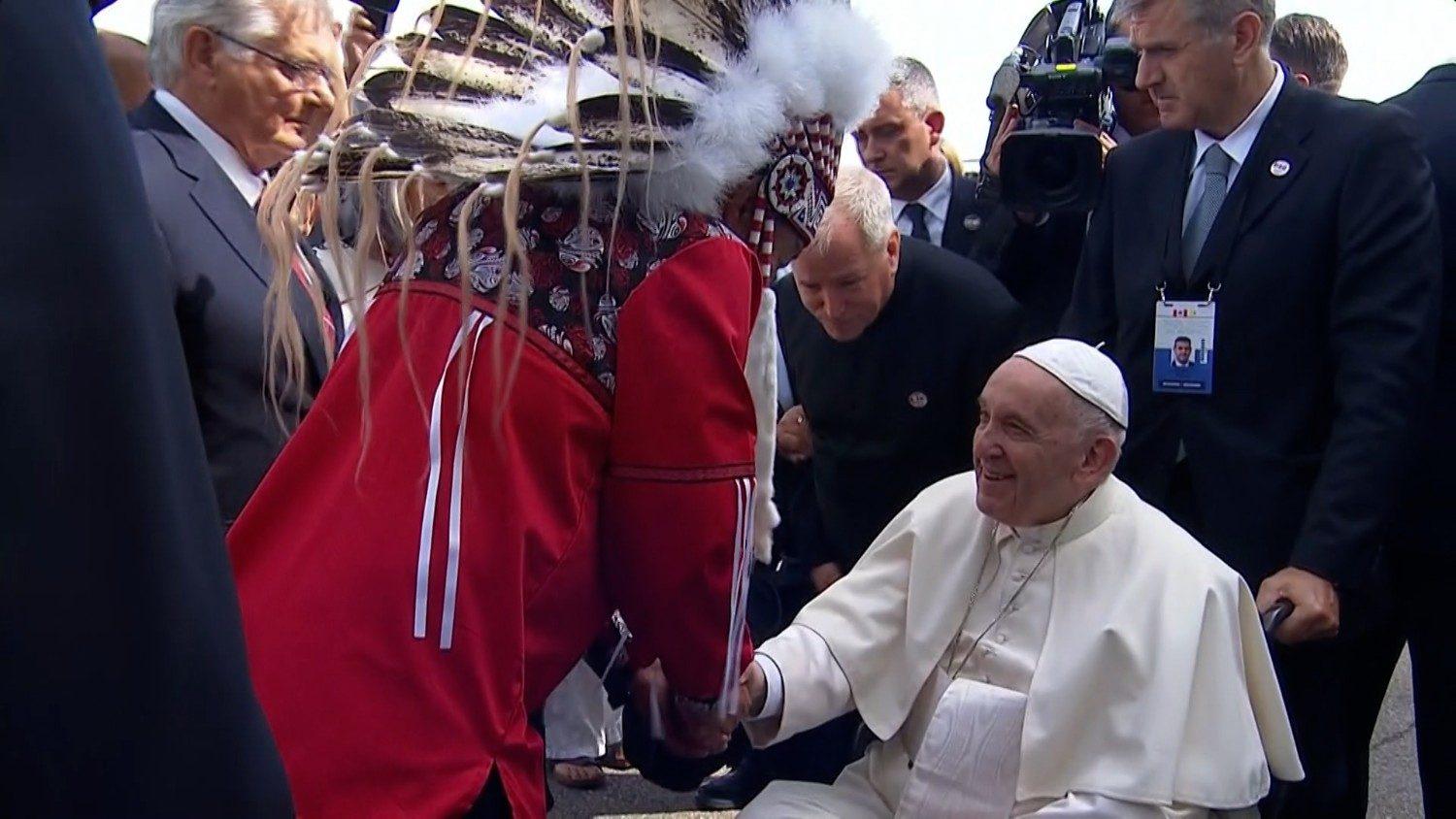
John was among a group of Indigenous scholars, activists, Catholic bishops, and theologians who gathered in Edmonton from May 26–29 for a “knowledge-sharing symposium” examining the doctrine’s enduring effects. Hosted at St. Joseph Seminary, the meeting brought together approximately 40 participants, half of them Indigenous leaders from Canada and the United States, alongside church representatives from several countries.
A Turning Point for the Church
The symposium followed a significant development in 2023, when the Vatican issued a formal statement repudiating the “Doctrine of Discovery.” The declaration, released by two Vatican dicasteries, rejected concepts that fail to recognize the inherent rights of Indigenous peoples and clarified that papal texts historically cited to justify colonization “have never been considered expressions of the Catholic faith.”
The Edmonton gathering aimed to build on that shift. Archbishop Donald J. Bolen of Regina, one of the primary organizers, said participants were selected for their commitment to “the pursuit of justice” and their ability to contribute to dialogue rooted in both scholarship and lived experience.
Given the diversity of perspectives, Bolen anticipated “rigorous conversation” and opportunities for mutual learning, as well as the identification of shared goals for advancing justice and reconciliation.
Legacy of Dispossession
For many Indigenous participants, the doctrine remains deeply embedded in contemporary legal systems. Chief Wilton Littlechild, a prominent expert in Canadian law and treaty rights, emphasized that the doctrine continues to influence decisions that limit Indigenous sovereignty.
Littlechild noted that during his tenure on Canada’s Truth and Reconciliation Commission, countless testimonies linked the doctrine to the loss of Indigenous lands, the erosion of self-determination, and the exploitation that followed—including the creation of residential schools.
Participants also stressed the importance of returning to traditional methods of dialogue. Littlechild described the symposium as an opportunity to embrace “the old-time way of gathering,” where knowledge keepers and experts learn collectively and share wisdom across cultural and institutional boundaries.
Debating History—and Its Meaning
While there was consensus about the doctrine’s impact, participants differed in their interpretations of its origins and legal coherence.
Steven Newcomb, a Shawnee-Lenape scholar, argued that papal documents such as Dum Diversas (1452), Romanus Pontifex (1455), and Inter Caetera (1493) formed the ideological foundation of a system of domination imposed by European colonizers. He called for a more explicit repudiation, urging Pope Leo XIV to formally revoke the 1493 decree.
Others offered a more nuanced view. Douglas Lind, a professor at Virginia Tech, contended that what is now labeled the “Doctrine of Discovery” was never a single unified doctrine. Instead, it evolved through a range of political, philosophical, and legal ideas—including an 1823 U.S. Supreme Court decision that embedded the concept in American law. Lind argued that secular legal developments ultimately had a more enduring impact than papal pronouncements.
Yet for advocates like Sarah Augustine, executive director of the Coalition to Dismantle the Doctrine of Discovery, these distinctions do not diminish the doctrine’s real-world consequences.
“Nuances in how the theory was articulated do not change the impact,” she said, pointing to the ongoing marginalization of Indigenous communities.
A Continuing Struggle
Participants repeatedly underscored that the doctrine is not an abstract historical concept but an active force shaping Indigenous realities today. It influences land disputes, environmental conflicts, and efforts to revitalize Indigenous languages and governance systems.
“The ‘Doctrine of Discovery’ created a logic, a paradigm for creating law and policy that exists to this day,” Augustine said. She described a system that continues to produce inequality—categorizing societies into “winners and losers, rich and poor.”
Cardinal Michael Czerny, speaking via video message, cautioned attendees against selectively interpreting history to suit particular narratives. He warned that such bias can affect not only church officials but also scholars and advocates, potentially hindering genuine understanding and reconciliation.
Looking Ahead
Despite differing viewpoints, the symposium concluded with a shared commitment to continued dialogue and collaboration. Participants pledged to meet again—both in person and online—and to educate their communities about the doctrine’s legacy and ongoing harm.
Many also highlighted the importance of spiritual and communal pathways forward, emphasizing faith, solidarity, and mutual respect as essential components of reconciliation.
For Indigenous leaders and their allies, the work is far from complete. But the Edmonton gathering marked a significant step in confronting the past—and shaping a future grounded in justice, recognition, and restored relationships.
- Raju Hasmukh with files from OSV News
Related Images: