









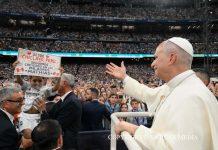

By backing Parolin, Pope Leo has signaled that the Vatican’s stance—rooted in humanitarian principles and a vision for peace—will not waver, even under pressure
Newsroom (09/10/2025, Gaudium Press ) In a rare public clash, Israel’s government has sharply criticized the Holy See’s assessment of its military actions in Gaza, prompting a measured yet resolute response from Pope Leo XIV. The diplomatic exchange, unfolding over the past week, underscores deepening tensions over the ongoing conflict in the Holy Land.
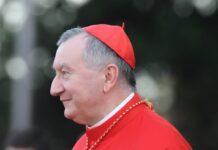
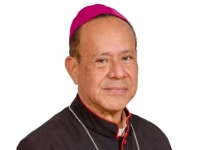
On Tuesday, October 7, 2025, Pope Leo XIV, exiting the papal residence at Castel Gandolfo, faced a flurry of questions from journalists. While his comments on avoiding American political matters drew attention, a brief yet significant remark addressed Israel’s condemnation of an interview by Cardinal Secretary of State Pietro Parolin. “I prefer not to comment further, but the cardinal expressed the Holy See’s opinion in this matter very well,” Leo stated, firmly aligning himself with Parolin’s position.
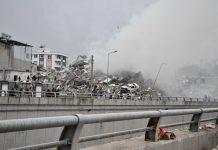
The controversy stems from an interview Parolin gave on Monday, marking the second anniversary of Hamas’ October 7, 2023, attacks. Speaking to Vatican media, Parolin condemned the Hamas assault as an “inhuman massacre,” citing its brutal violence against civilians. However, he also labeled Israel’s military response in Gaza as a “massacre,” arguing that it disproportionately targets a “largely defenseless population” in an area reduced to rubble. “A simple look at aerial images is enough to understand what Gaza looks like today,” Parolin said, lamenting the international community’s failure to halt the violence. He echoed Pope Leo’s July 20 appeal for adherence to humanitarian law, respect for civilians, and an end to collective punishment and forced displacement.
Israel’s embassy to the Holy See swiftly issued a statement on Tuesday, denouncing Parolin’s remarks as undermining efforts to end the war and combat antisemitism. The embassy criticized the cardinal’s use of “massacre” to describe both Hamas’ attack and Israel’s actions, arguing it creates a “problematic moral equivalence” between a terrorist group’s actions and a democratic state’s right to self-defense. “We hope that future statements will reflect this important distinction,” the statement read.
Parolin’s choice of words marks a notable shift for the Holy See, which has historically been cautious in its language. Last month, the cardinal avoided using “genocide” to describe Israel’s actions, noting that such claims required careful study. His recent remarks signal growing Vatican concern over the humanitarian toll in Gaza, where, according to Leo, approximately 67,000 Palestinians have been killed over the past two years.
Israel’s criticism of Parolin met a firm response from Pope Leo, whose defense of his Secretary of State effectively rebuffed the embassy’s rebuke while avoiding further escalation. Leo’s broader comments on Tuesday emphasized peace, a recurring theme since his election on May 8, 2025. “Two years ago, 1,200 people were killed in a terrorist attack,” he said. “We must think about how much hatred exists in the world and begin to ask ourselves what we can do.”
The Holy See remains a steadfast advocate for a two-state solution. In July, Archbishop Gabriele Caccia, the Vatican’s U.N. representative, reiterated support for “secure and internationally recognized borders” and highlighted the Vatican’s formal recognition of both Israel (1993) and Palestine (2015). This position was reaffirmed during Leo’s September meeting with Israeli President Isaac Herzog, where the Holy See’s commitment to Palestinian self-determination was underscored.
In the region, Cardinal Pierbattista Pizzaballa, Latin Patriarch of Jerusalem, has emerged as a key voice for peace. While avoiding partisan advocacy, Pizzaballa has called for “new leadership with vision” to resolve the conflict. Following reports of a potential peace deal last weekend, he urged realism, writing to the Diocese of Jerusalem: “The cessation of hostilities is only the first step on a treacherous path.” Grounding his message in faith, Pizzaballa emphasized resilience and love over confrontation, stating, “Our denouncing is not an offence to any party but a call to dare a different path.”
The exchange between Israel and the Holy See highlights the delicate balance of diplomacy and moral critique in a conflict with profound human costs. By backing Parolin, Pope Leo has signaled that the Vatican’s stance—rooted in humanitarian principles and a vision for peace—will not waver, even under pressure.
- Raju Hasmukh with files from Catholic Herald
Related Images: