


















Germany’s bishops unveil new priestly formation rules prioritizing personal maturity, dialogue, and lifelong development within Church life.
Newsroom (28/04/2026 Gaudium Press ) The German Bishops’ Conference (DBK) has introduced a new national framework for priestly formation that places the maturation of personality at its core, marking a shift beyond the traditional emphasis on acquiring discrete skills. Published Tuesday, the “Ratio Nationalis Institutionis Sacerdotalis” outlines a vision of priestly development as a lifelong, dialogical process rooted in theological reflection and real-world context.
The framework defines formation as an ecclesial practice aimed at fostering both individual growth and sustained discipleship in Jesus Christ. It emphasizes that vocation is not a fixed state but a dynamic journey shaped through relationships with Christ, with others, and within the Church community.
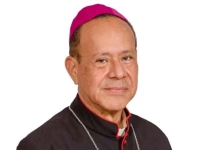
Bishop Michael Gerber, chairman of the DBK’s Commission for Vocations, highlighted the central role of dialogue in this process. “The development of a dialogical existence is essential for a priest,” he said, explaining that candidates must cultivate self-awareness and continuously integrate new experiences into their personal development.
Responding to Past Failures
The new guidelines were developed through a broad participatory process that included input from an advisory board of individuals affected by clerical misconduct. The framework explicitly acknowledges the need to incorporate lessons from past failures, particularly those related to human immaturity and abuse within the clergy, which have had long-lasting consequences for victims.
By foregrounding psychological insight and personal maturity, the bishops aim to address systemic weaknesses that have contributed to misconduct in the past.
A Relational Vision of Priesthood
The document underscores the importance of priests maintaining a “sensitivity to the people of God,” while also encouraging the faithful to understand the Church’s sacramental structure. It calls for a balanced relationship between the ordained priesthood and the common priesthood of all believers, drawing on the theology of the Second Vatican Council.
Gerber framed this as essential for the Church’s future: “The Church of the future needs qualified priests who, together with the diverse members of the people of God, can shape the present in Church and society in the face of great challenges.”
Structural Changes in Formation
Building on the Vatican’s 2016 “Ratio fundamentalis,” the German framework introduces several structural adjustments. These include more decentralized training models, such as alternating between seminary life and parish work, as well as joint formation opportunities with other pastoral professions.
The framework also mandates broader participation of women at all levels of formation and calls for a strengthened role for psychology in evaluating and supporting candidates.
Approach to Sexuality and Celibacy
While debates over sexuality have previously stirred controversy in Church guidelines, the German framework addresses homosexuality only indirectly, referencing Vatican norms in a footnote. Instead, it focuses more broadly on the integration of sexuality within a celibate life, describing this as a lifelong task.
Candidates are expected to discern whether celibacy can be lived with authenticity and freedom. The document notes that if celibacy is experienced primarily as coercion, self-alienation, or persistent strain, it may indicate that priesthood is not the individual’s calling.
Among the formal requirements for admission to seminary is a willingness to embrace celibate life and participate fully in communal living.
Alignment with Vatican Norms
The updated framework replaces Germany’s previous 2003 regulations and was confirmed by the Vatican’s Dicastery for the Clergy on March 11. Its revision follows the universal norms introduced by Pope Francis in 2016, which established a binding global standard for priestly formation.
Incorporating both Vatican directives and synodal discussions from within Germany, the new framework reflects a broader effort to align priestly training with contemporary pastoral realities while addressing internal challenges facing the Church.
- Raju Hasmukh with files from https://katholisch.de/