

























Manila’s archbishop launches a biodiesel initiative using recycled cooking oil as the Philippines grapples with fuel shortages linked to the U.S.-Israel war on Iran.
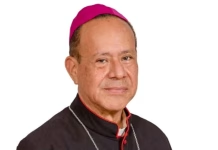
Newsroom (27/04/2026 Gaudium Press ) In an unconventional response to a deepening energy crisis triggered by the U.S.-Israel war on Iran, Cardinal Jose Advincula of Manila is mobilizing thousands of Catholics to turn household waste into fuel.
In a circular released on April 26, Advincula called on the archdiocese’s 3.3 million faithful to collect used cooking oil for conversion into biodiesel—a renewable alternative to traditional fossil fuels. The initiative comes as the Philippines faces acute vulnerability due to its reliance on imported oil, with 95 to 98 percent of its supply sourced from the Middle East.
Government data indicates the country had just 52 days’ worth of oil reserves as of April 21, prompting officials to explore emergency measures such as fuel rationing. Against this backdrop, the Catholic Church’s grassroots effort is emerging as both a symbolic and practical intervention.
“Biodiesel is a renewable, biodegradable fuel manufactured domestically from vegetable oils, animal fats, or recycled restaurant grease,” according to the U.S. Department of Energy. Often blended with petroleum diesel, it offers a pathway to reduce dependence on imported fuel while lowering emissions.
Advincula framed the initiative as both an environmental and moral responsibility. “In the face of growing global challenges related to energy supply and environmental sustainability,” he said, used cooking oil can be transformed into a cleaner fuel that reduces greenhouse gas emissions by up to 80 percent compared to conventional diesel.
The program, led by the Archdiocese of Manila’s Ministry on Integral Ecology, aims to establish a structured collection system across households, parishes, schools, and institutions in the archdiocese’s seven cities. Each parish is tasked with setting up designated collection points, while parishioners are encouraged to store used oil in clean, sealed containers free of contaminants.
Collected oil will undergo a multi-step process—pre-treatment, transesterification, and purification—before being redistributed as biodiesel. Contributors will be able to access the processed fuel, with a small donation requested to offset operational costs.
For Advincula, the initiative is rooted in Catholic teaching. Citing Laudato Si’, Pope Francis’ 2015 encyclical on the environment, he emphasized the faithful’s “vocation to be protectors of God’s handiwork.”
“Through this simple act, we live out our Christian responsibility to care for God’s creation,” he said. “This initiative not only addresses environmental concerns but also contributes, in our own way, to easing pressures on energy resources.”
Though newly formalized, the effort builds on nearly two decades of groundwork. Lou Arsenio, coordinator of the ecology ministry, said similar recycling efforts date back to the late 2000s, including a partnership with the Technological University of the Philippines. At the time, the ministry even operated a vehicle running on a 10 percent biodiesel blend derived from used cooking oil.
The earlier program eventually stalled due to logistical setbacks, including the loss of key collaborators. It has since been revived with the help of Filipino engineer Ed Brisenio, who refined biodiesel conversion technology during the COVID-19 pandemic. After five years of experimentation, his system is now fully operational, with his own vehicle running on a 30 percent biodiesel mix.
“With this crisis, this is the solution,” Arsenio said. “We get to address many problems.”
The ministry envisions each of Manila’s 87 parishes collecting two to three gallons of used cooking oil monthly. While the total impact remains uncertain, Arsenio pointed to potential benefits for jeepney drivers—many of whom belong to low-income communities and are especially vulnerable to rising fuel costs.
Beyond immediate relief, the initiative reflects a broader push toward sustainable energy and community resilience. Arsenio underscored that environmental stewardship is inseparable from social justice.
“When you talk about ecology, you are actually dealing with the life and livelihood of every person,” she said. “As Catholics, it is part of our mission to protect Creation.”
She also expressed hope that similar programs could take root globally, particularly in regions facing both poverty and energy insecurity.
“Everyone uses cooking oil,” she noted. “If we do this globally, we reduce the demand for fossil fuels—especially diesel. This is part of the transition the world is aiming for.”
- Raju Hasmukh with files from Crux Now