














Bangladesh’s new clergy stipend plan sparks division among Catholic leaders, who fear political pressure despite historic state support for all faiths.
Newsroom (26/02/2026 Gaudium Press ) When Bangladesh’s new government quietly placed an unusual item on the agenda of a Feb. 21 cabinet meeting, it knew it was making history. For the first time since independence, the Muslim-majority nation would extend a monthly allowance to all religious clergy, regardless of faith tradition — from imams in village mosques to priests in Christian parishes.
Yet even before the details of the plan were fully made public, a debate inside the country’s small Catholic community laid bare the delicate fault lines of church-state relations in a nation still recalibrating its democracy after a tumultuous year.
At the center of the controversy stands a simple but loaded question: Can a Church that insists its clergy “dedicate their lives to God” accept a government stipend without risking its spiritual independence?
A historic pledge from a new government
The proposal emerged from a cabinet meeting chaired by Prime Minister Tarique Rahman, who took office just days earlier on Feb. 17, following landmark elections that ended a long era of one-party dominance.
Mahdi Amin, one of Rahman’s advisers, told reporters that the meeting had focused on delivering on key campaign promises. Among them was a pledge to provide a monthly honorarium and festival allowances to “all religious leaders of various mosques, including those of other religions.”
The plan, Amin indicated, would be rolled out quickly. While he did not disclose the amount of the honorarium, he said implementation would begin “in some places before Eid,” referring to Eid al-Fitr, the major Islamic festival expected in the third week of March.
The policy carries obvious political weight. In a country where Islam is the predominant faith and religious leaders hold considerable social influence, state support to clergy is far more than a budget line. It is a symbolic gesture of recognition — and, critics worry, a potential lever of control.
What makes this initiative even more notable is its universal scope. Rather than focusing solely on Muslim clerics, the government has pledged allowances for “all” religious leaders, extending the offer to minority communities such as Christians, Hindus, and Buddhists.
A small Church at a crossroads
Christians in Bangladesh are a tiny minority, numbering roughly 600,000 in a population of about 170 million. Catholics form the largest share of that community and have long punched above their weight through schools, hospitals, and social services.
According to the 2019 Bangladesh Catholic Directory, the Church’s presence is organized into eight dioceses comprising 119 parishes and 52 sub-parishes. The directory records 233 diocesan priests and 176 missionary priests working in the country. Not all serve in parishes; many are engaged in education, health care, and youth formation, and often serve in remote or marginalized communities.
For these priests, financial security is rarely guaranteed. Their livelihoods typically depend on modest stipends from their dioceses and religious congregations, supplemented in some cases by support from overseas partners. In that context, a predictable monthly allowance from the state could, on the surface, appear as a welcome relief.
But for at least one prominent Church leader, the implications of such support eclipse its immediate material benefit.
Bishop draws a firm line on state money
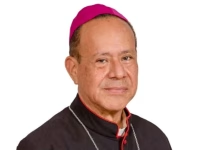
Bishop Sebastian Tudu of Dinajpur, who chairs the Clergy and Religious Commission of the Catholic Bishops’ Conference of Bangladesh, has emerged as the most prominent voice of caution.
Speaking to EWTN News, Tudu declined to directly attack the government’s initiative. Instead, he drew a clear boundary for the Church. He said the Catholic Church would not accept the monthly allowance on principle.
“Our Catholic clergy are not salaried, they dedicate their lives to God, so we do not want to receive any kind of monthly salary from the government,” the bishop said.
Behind that brief statement lies a longstanding Catholic concern: that financial dependency on the state can undermine the Church’s capacity to speak freely, especially on issues like human rights, corruption, or political violence.
Tudu warned that accepting the stipend could open the door to subtle, or not-so-subtle, pressure from political authorities. “In the future there may be some kind of pressure from the government or politically or they may try to use us,” he said, capturing fears that what begins as support could turn into leverage.
His stance reflects a preference for clear institutional distance from the state, particularly in a country where governments have, in the past, been accused of using patronage networks to secure loyalty and silence dissent.
A contrasting voice from Dhaka
If Bishop Tudu speaks the language of caution, Father Albert Rozario, vicar general of the Archdiocese of Dhaka, has chosen a different register: gratitude, encouragement, and cautious optimism.
Rozario publicly applauded the initiative and explicitly thanked the new government. “We have got a new government; we congratulate the new government,” he told EWTN News.
“It was an election announcement for us who work in the Church as religious priests. In proof of that, Prime Minister Tarique Rahman has announced this monthly allowance. I personally congratulate the government,” he said.
His remarks suggest that, at least for some Catholic leaders, the stipend is not primarily a threat but an opportunity — a sign that the new administration intends to include religious minorities in the national project and recognize their contributions to society.
Rozario urged the faithful to pray for and support the government “so that the government can govern the country beautifully, harmoniously, and fairly and can take the nation forward.”
At the same time, he did not present the Church as a passive beneficiary. He coupled his praise with clear expectations: “As citizens of this country, we want the government to establish the rule of law, to resolve the problems in the country,” he said.
He went further, identifying concrete priorities:
-
Addressing corruption, both past and present.
-
Tackling the rising prices of goods, which he called “the main problem of the people.”
These comments reveal a vision of the Church as a constructive civil-society partner: ready to welcome inclusive policies, but equally prepared to articulate the demands of ordinary citizens to those in power.
Fault lines inside the Church
The contrast between Bishop Tudu and Father Rozario does not necessarily indicate open conflict within the Bangladeshi Church. But it does spotlight differing instincts on how to navigate proximity to political power at a moment of national transition.
Tudu’s position leans toward a strict separation between Church and state financial ties, rooted in concern for the long-term independence of clergy and institutions. Rozario’s tone is more pragmatic, emphasizing engagement, gratitude, and a shared national agenda, even if the structural questions of financial dependence remain unresolved.
For parish priests and religious working in often under-resourced settings, the debate is not theoretical. A government stipend could relieve pressure on parish finances or free up local resources for pastoral and social work. But it could also create expectations — from officials or communities — that Church leaders will temper criticism or endorse certain policies in exchange for sustained funding.
The Church now faces a complex discernment: how to remain close to the people and to national life without becoming a client of the state. The bishops’ conference, and Rome by extension, may eventually have to articulate a unified policy on whether clergy may accept such funds individually or through their institutions.
A country remade by protest
The timing of this policy initiative cannot be separated from Bangladesh’s recent political upheaval.
In 2024, a student-led mass uprising toppled former Prime Minister Sheikh Hasina, whose Bangladesh Awami League had governed for 15 years. Her tenure drew mounting criticism over alleged authoritarianism, weakened democratic institutions, and shrinking space for dissent. Under pressure from the streets and amid a legitimacy crisis, Hasina fled to neighboring India, where she remains.
Into this vacuum stepped an interim government led by Nobel Peace Prize laureate Muhammad Yunus. His administration, tasked with stabilizing the country and preparing new elections, banned the Awami League from contesting polls under intense public pressure, cutting the once-dominant party out of the formal political process.
Elections were held on Feb. 12. The result was a reshaped political landscape. The Bangladesh Nationalist Party (BNP) emerged as the dominant force, winning 209 of 297 contested parliamentary seats. The Islamist party Bangladesh Jamaat-e-Islami and its alliance captured 77 seats. The National Citizens Party, a youth-led movement born out of the 2024 uprising, secured six seats, symbolizing the enduring influence of the protest generation.
Tarique Rahman, a leading BNP figure, was sworn in as prime minister on Feb. 17. His government now faces a dual mandate: to restore public trust in institutions and to signal this is not simply a rotation of elites but the beginning of a more inclusive era.
In that context, a stipend for religious leaders — including minorities — can be read as an attempt to build a broad social coalition, reassure skeptical communities, and project an image of fairness and national unity.
Church-state relations in a new era
For Bangladesh’s Catholic community, the clergy allowance proposal arrives at a moment when the rules of engagement with the state are being rewritten.
Under previous governments, minorities often navigated a fragile space: recognized as part of the national fabric, yet vulnerable to marginalization and sporadic violence. Now, with a new ruling coalition and a recent history of mass protest, there is both risk and opportunity.
If the Church refuses state funds, it will strengthen its claim to moral independence and prophetic witness, particularly if it later challenges the government on human rights or governance issues. But it may also be perceived by some as aloof or ungrateful, especially if other religious groups embrace the offer.
If, on the other hand, parts of the Church accept the allowance, it could improve the material stability of clergy and signal a desire to cooperate in nation-building. Yet the price could be subtle self-censorship, or a gradual softening of critique when the government fails to live up to its own standards.
For now, Bishop Tudu’s clear rejection and Father Rozario’s warm endorsement of the initiative — albeit framed more as praise than as a policy decision — capture the tension. The conversation they have begun is likely to reverberate through chancery offices, parish councils, and seminaries across the country.
The government, too, will be watching. Its response to religious leaders who hesitate or decline the stipend will offer early clues about whether this new order can tolerate principled distance as well as enthusiastic partnership.
In a nation still emerging from protest and political rupture, the question is no longer only who governs, but how. Bangladesh’s experiment with paying its clergy — and the Catholic Church’s response — may prove to be an early test of whether a new balance between faith and power is possible.
- Raju Hasmukh with files from CNA
Related Images: