





















Bangladesh Catholic bishop slams Sheikh Hasina’s death sentence for 2024 protest crackdown as unfair and politically motivated, while Church opposes capital punishment amid divided reactions.
Newsroom (18/11/2025 Gaudium Press) A senior Catholic bishop in Bangladesh has sharply criticized the death sentence handed down to ousted Prime Minister Sheikh Hasina, calling the verdict “one-sided,” an abuse of power, and politically motivated, while reiterating the Church’s longstanding opposition to capital punishment.
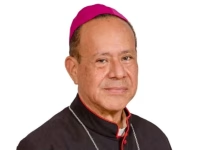
Bishop Ponen Paul Kubi, CSC, secretary of the Bangladesh Catholic Bishops’ Conference and head of the Mymensingh Diocese, told Catholic News Agency (CNA) on November 17 that the ruling by Bangladesh’s International Crimes Tribunal (ICT) lacked fairness. “The verdict was one-sided,” Bishop Kubi said. “The accused had no lawyer, and the current government used political power to give this verdict.”
He described the decision as regressive, warning: “If we judge in a hurry and give a verdict as we wish, we are no longer living in civilization; we have gone back to the primitive era.” Emphasizing the Catholic Church’s consistent stance, the bishop added, “The Catholic Church has never supported the death penalty. I think that even if Sheikh Hasina committed a crime, she should be punished in a way that is remedial.”
The 453-page verdict, delivered on November 17, 2025, and broadcast live on state television, found Hasina, 78, guilty on three of five charges of crimes against humanity. These included ordering the deployment of drones, helicopters, and lethal weapons against protesters, as well as failing to prevent mass killings during the violent suppression of student-led demonstrations in July and August 2024.
Hasina and her former home minister, Asaduzzaman Khan Kamal, were both sentenced to death in absentia. Former Inspector General of Police Chowdhury Abdullah Al-Mamun received a five-year prison term after cooperating as a state witness.
The protests began over controversial job quotas for government positions but rapidly escalated into a broader anti-government uprising, culminating in Hasina’s flight to India on August 5, 2024. A United Nations fact-finding mission estimated at least 1,400 deaths, though local activists claim the toll exceeds 2,000.
Hasina, who has remained in exile in India, rejected the tribunal’s ruling through a statement posted on her Awami League party’s Facebook page. She labeled the verdicts “distasteful, biased, and politically motivated,” asserting they were issued by “a rigged tribunal established and presided over by an unelected government with no democratic mandate.”
Public reactions in Bangladesh were deeply polarized. Supporters of the banned Awami League staged protest marches in several regions, decrying the sentence as vindictive. In contrast, celebratory “joy marches” erupted in Dhaka and other cities, with participants distributing sweets. “We will be completely happy only when Sheikh Hasina comes to the country and is hanged,” said Tarif Hasan, a Dhaka University student who joined one such march, in remarks to CNA.
Professor Asif Nazrul, law adviser to the interim government led by Nobel laureate Muhammad Yunus, hailed the death sentence as “the greatest achievement in establishing justice” and “another victory day for the July Uprising.”
The interim administration has formally requested India’s cooperation in extraditing Hasina and Khan Kamal to face the tribunal. A public hearing on the case is scheduled, and national elections are anticipated in February 2026.
The ICT, originally established under Hasina’s government in 2010 to prosecute 1971 war crimes, has faced longstanding criticism from human rights groups for failing to meet international fair trial standards. The verdict comes amid heightened security concerns and ongoing political instability in the South Asian nation.
- Raju Hasmukh with files from CNA News
Related Images: