










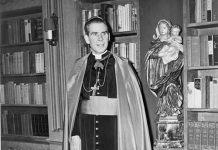


Cardinal Dominique Mathieu meets Pope Leo XIV after fleeing war-torn Tehran amid deadly strikes that killed Iran’s supreme leader.
Newsroom (12/03/2026 Gaudium Press ) When Cardinal Dominique Mathieu walked into the Apostolic Palace on March 11 to meet Pope Leo XIV, it was after weeks of turmoil that had shaken Iran—and the Church within it—to its core. The 62-year-old Archbishop of Tehran-Isfahan, who shepherded a community of barely 2,000 Roman Catholics amid mass protests and military escalation, had been forced to leave his post after the closure of the Italian Embassy in Tehran, where his residence is located.
For days, his fate was uncertain. The world had lost track of the cardinal after the joint U.S.-Israeli airstrikes on February 28 that killed Iran’s Supreme Leader Ali Khamenei and several senior officials. The attacks set off retaliatory strikes across the region, with Iran targeting U.S. and allied positions in the Gulf and Israel. Against the backdrop of chaos, Italy shuttered its diplomatic mission, prompting the cleric’s sudden exit.
Cardinal Mathieu, a Belgian-born Franciscan who joined the Order of Friars Minor Conventuals in 1983, was extracted alongside embassy staff and Italian nationals during a tense overland crossing into Azerbaijan. From there, he boarded a flight to Rome, touching down over the weekend. His arrival ended several anxious days during which Church officials and his small Iranian flock feared for his safety.
In a brief note sent to the Belgian Catholic outlet Cathobel on March 9, Mathieu expressed sorrow over his departure. “I left not without regret and sorrow for our brothers and sisters in Iran,” he wrote. “While waiting to return, pray for the conversion of hearts to inner peace.” His words echoed a pastoral tone that has defined his ministry throughout his tenure in the region.
The evacuation stemmed directly from Italy’s diplomatic withdrawal. Foreign Minister Antonio Tajani announced on March 5 that the embassy would temporarily close as conditions worsened. A convoy of roughly 50 Italians—including clergy and staff tied to the Church’s Tehran operations—was escorted to Baku, while Italian officials stressed that “channels with Tehran remain open.”
Tehran’s Cathedral of the Consolata, which houses the archdiocesan offices and the cardinal’s residence, sits within the embassy compound. Its location made any separation between Church and diplomacy impossible once the evacuation began.
Cardinal Mathieu’s leadership in Iran has often been defined by caution and a vocal rejection of violence. Appointed archbishop in 2021 and made a cardinal by Pope Francis in 2024, he repeatedly warned that regional rivalries were eroding the fragile coexistence built over generations. “It is troubling to hear the idea of ‘obtaining peace by force,’ where violence becomes the only means of addressing conflicts,” he told OSV News last July, after a 12-day war between Israel and Iran. He described rising nationalism and rearmament as forces that “build more barriers than bridges.”
His meeting with Pope Leo XIV on Wednesday coincided with another flashpoint in the broader regional conflict: the death of Father Pierre al-Rahi, a Maronite Catholic priest killed by Israeli artillery fire in southern Lebanon. During his general audience, Pope Leo mourned the priest’s death and offered prayers for the people of Lebanon. “Father Pierre was a true shepherd,” the pontiff said, reflecting on the Arabic meaning of El Raii—“the shepherd.” “As soon as he heard that some parishioners had been wounded in a bombing, he rushed to help them without hesitation. May the Lord grant that the blood he shed be a seed of peace for beloved Lebanon.”
Cardinal Mathieu, fluent in five languages including Arabic and long respected for his quiet diplomacy, has often spoken of the need for peace “born of dialogue, not vengeance.” His forced absence from Tehran highlights both the human cost of the widening conflict and the vulnerability of small faith communities caught in its crossfire.
For now, Vatican officials have not indicated when or if Mathieu will return to Iran. But his message remains steadfast: that amid the ruins of conflict, the Church’s mission—anchored in compassion and reconciliation—cannot be silenced, even by war.
- Raju Hasmukh with files from CNA and Catholic Standard
Related Images:


