









![Cardinal in a black cassock with red trim and red skullcap, seated in a leather chair with a microphone nearby.”] ,](https://www.gaudiumpress.ca/wp-content/uploads/2026/05/Cardinal-Muller--218x150.jpg "Tradition, Authority, and Division: An Interview on the Society of St. Pius X and Vatican II")

Pope Leo XIV urges global peace and spiritual renewal during Angelus, addressing conflicts in the Middle East and floods in Brazil.
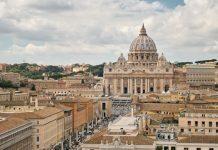
Newsroom (02/03/2026 Gaudium Press ) Addressing thousands gathered in St. Peter’s Square on Sunday, March 1, 2026, Pope Leo XIV delivered a message that intertwined spiritual transformation with an urgent call for peace in the world’s troubled regions. Reflecting on the day’s Gospel reading of the Transfiguration (Mt 17:1–9), the Pope invited Christians to rediscover divine light amid human suffering and to carry faith as a source of renewal throughout Lent.
A Vision of Transfiguration and Hope
In his Angelus address, Pope Leo XIV described the Transfiguration as a “radiant picture” of divine revelation, where Christ stands between Moses and Elijah — the embodiment of the Law and the Prophets. “The Word made flesh stands between the Law and the Prophets: he is living Wisdom,” the Pope said, emphasizing that every divine word finds its fulfillment in Jesus.
Drawing parallels between the Transfiguration and Christ’s baptism, the pontiff reflected on the moment when the Father’s voice declared, “This is my beloved Son.” The “bright cloud” of the Holy Spirit, he explained, symbolized the abundance of God’s presence made visible to humanity through the splendor of His Son.
“The disciples behold the human splendor of God,” Pope Leo XIV said, noting that Peter, James, and John witnessed “a humble glory” revealed not to the world’s crowds, but within the intimacy of faith.
This scene, he added, foreshadows the light of Easter — a light that emerges through death, resurrection, and the transformation of suffering. “While evil reduces our flesh to a commodity or an anonymous mass, this same flesh shines with the glory of God,” he affirmed. “The Redeemer thus transfigures the wounds of history, enlightening our minds and hearts.”
In a tone of pastoral exhortation, the Pope invited believers to consider whether they still perceive “the true face of God with a gaze of wonder and love.” He described the Father’s answer to modern despair — through Christ who restores meaning in an age of disbelief and isolation. The Holy Spirit, he said, “redeems us from the loneliness of agnosticism by offering us everlasting communion.”
As Lent continues, Pope Leo XIV urged the faithful to follow Mary, “teacher of prayer and Morning Star,” as a guide through faith and conversion.
Appeal for Peace in the Middle East and Beyond
Following the Angelus prayer, Pope Leo XIV turned his message toward escalating global conflicts. His concern centered on the Middle East and Iran, where tensions have recently mounted. “Stability and peace are not achieved through mutual threats, nor through the use of weapons,” he said, “but only through reasonable, sincere, and responsible dialogue.”
Expressing deep alarm over what he described as “a tragedy of immense proportions,” the Pope appealed to all parties to “assume the moral responsibility of halting the spiral of violence before it becomes an unbridgeable chasm.” He called on the international community to renew the spirit of diplomacy and to prioritize the well-being of peoples “who yearn for peaceful existence founded on justice.”
Turning to South Asia, the pontiff lamented recent clashes between Pakistan and Afghanistan, issuing an urgent plea for dialogue and reconciliation. “Only peace, a gift of God, can heal the wounds between peoples,” he said, urging prayer for all regions experiencing conflict.
Prayers for Brazil and Greetings to Pilgrims
Beyond geopolitical appeals, Pope Leo XIV also expressed solidarity with the victims of devastating floods in Brazil’s Minas Gerais state. “I pray for the victims, for the families who have lost their homes, and for all those involved in rescue efforts,” he said, extending spiritual closeness to the afflicted communities.
The Pope then greeted diverse groups of pilgrims gathered in Rome — from Cameroon, Romania, Slovakia, the United States, Spain, and multiple regions of Italy — acknowledging their presence as a sign of unity in faith. Notably, he mentioned the Cameroonian community in Rome, accompanied by the President of their Episcopal Conference, whom he hopes to visit in April.
Closing his Angelus address, Pope Leo XIV imparted a warm blessing upon all present and those following worldwide: “I wish everyone a happy Sunday.”
- Raju Hasmukh with files from Vatican News
Related Images: