









President Obiang calls Pope Leo XIV’s visit historic, reaffirming Equatorial Guinea’s role as a Christian stronghold in Central Africa.
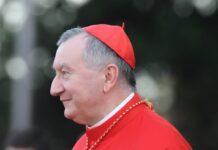
Newsroom (21/04/2026 Gaudium Press ) President Teodoro Obiang Nguema Mbasogo of Equatorial Guinea has hailed Pope Leo XIV’s Apostolic Visit as a defining national moment, underscoring the country’s enduring identity as a “stronghold for Christianity” in Central Africa.
Speaking at the presidential palace during the Holy Father’s meeting with authorities, civil society representatives, and members of the diplomatic corps on April 21, President Obiang framed the visit as both a spiritual milestone and a source of national pride. The three-day Apostolic journey, part of a broader 11-day tour across four African nations, marks Pope Leo XIV’s first visit to Equatorial Guinea.
“It is a special privilege for our people to receive His Holiness Leo XIV, to whom we extend a warm welcome to these African lands of Equatorial Guinea,” President Obiang said. “We are filled with deep joy and feel honored to host His Holiness today.”
The President emphasized the symbolic and pastoral significance of the Pope’s presence, describing it as a moment of unity and renewal for a nation where Catholicism has deep historical roots. He expressed hope that the Pontiff and his delegation would experience the country’s hospitality and feel at home during their stay.
“It is our wish, and that of all the people of Equatorial Guinea, that His Holiness the Pope and the distinguished delegation accompanying him enjoy our traditional Equatoguinean hospitality,” he said.
Framing the visit in spiritual terms, President Obiang described the Pope as the visible head of the Catholic Church whose presence brings “joy, indulgence, and peace,” strengthening the faith of believers. He noted that the visit comes at a time marked by global instability, political and economic crises, and uncertainty that transcend borders.
“This visit represents for us, the people of Equatorial Guinea, a recognition of our faith and Christian devotion as a flock of Christ,” he said, highlighting the importance of religious continuity in a rapidly changing world.
Equatorial Guinea’s Christian tradition spans more than 170 years, with over 90 percent of the population identifying as Catholic. President Obiang pointed to this legacy as central to the nation’s identity, asserting that the papal visit reinforces its role in the region.
“For this reason, the visit of His Holiness to the Republic of Equatorial Guinea represents a stronghold for Christianity in Central Africa,” he stated.
The President also drew parallels with the historic 1982 visit of Pope John Paul II, describing Pope Leo XIV’s presence as a continuation of a spiritual lineage that has shaped the country’s Catholic identity for decades.
“We are convinced that, just as his predecessor, His Holiness Pope John Paul II, did during his pastoral visit to this country in 1982, so too today we welcome the presence of His Holiness Pope Leo XIV,” he said.
Looking ahead, President Obiang expressed hope that the visit would bring renewed blessings, strengthen faith, and reinforce peace and progress within the country.
“We hope for the Holy Father’s blessings upon the people of Equatorial Guinea to reaffirm their faith and Christian devotion in an environment of peace, prosperity, and progress,” he noted.
He also conveyed gratitude for the inclusion of Equatorial Guinea in the Pope’s wider African itinerary, which includes Algeria, Cameroon, and Angola. The President said the visit would not only deepen spiritual life but also strengthen ties with the Holy See and the local Catholic Church.
“We are deeply grateful that you have chosen our humble country for your first apostolic and pastoral journey to the African continent,” he said, adding that the visit would “renew faith and reaffirm internal peace preserved for more than five decades.”
The Pope’s itinerary reflects both pastoral outreach and symbolic engagement with communities across the country. On April 22, Pope Leo XIV is scheduled to travel to Mongomo, where he will celebrate Mass at the Basilica of the Immaculate Conception and visit the Pope Francis Technology School.
Later that day, he will continue to Bata, where his agenda includes a prison visit, prayers at a memorial dedicated to victims of the March 7, 2021 explosion, and an encounter with young people and families at Bata Stadium.
The Apostolic Journey will conclude on April 23 with a final Mass at Malabo Stadium, marking the culmination of a visit that leaders say will leave a lasting imprint on the nation’s spiritual and social landscape.
- Raju Hasmukh with files from ACI Digital
Related Images: