

















Philippine court dismisses case vs bishop and leaders opposing Nueva Vizcaya mining project, citing lack of jurisdiction and legal grounds.
Newsroom (25/06/2026 Gaudium Press ) A local court in northern Philippines has dismissed a forcible entry complaint filed against a Catholic bishop, a priest, and several community leaders involved in protests against a contentious mining exploration project in Nueva Vizcaya province, marking a significant development in a dispute that has drawn national attention.
In a nine-page decision released on June 24, the court ruled that the complaint lacked sufficient legal basis and fell outside its jurisdiction. The case had been brought against Bishop Jose Elmer Mangalinao of Bayombong, Father Christian Dumangeng, and multiple community representatives accused of participating in barricades that impeded the operations of North Luzon Mineral Resources Corporation (NLMRC).
Legal Grounds for Dismissal
The court determined that the plaintiff failed to demonstrate a clear legal right warranting injunctive relief. It further concluded that the complaint was improperly filed as a forcible entry case, noting that the nature of the relief sought was more aligned with an injunction.
Forcible entry cases typically center on disputes over physical possession of property. However, the court found that the complaint instead aimed to halt activities linked to the barricades rather than to recover property, a key distinction that undermined the case.
Additionally, the decision cited a certification from the Philippine government’s Indigenous affairs agency stating that the area covered by the mining exploration permit lies outside officially recognized ancestral domain lands. While significant, this finding did not fully address the broader concerns raised by project opponents.
Roots of the Conflict
The dismissed case is part of an ongoing conflict over a 4,456-hectare mining exploration project being conducted by NLMRC in several villages within Kasibu, a mountainous municipality in Nueva Vizcaya, located north of Manila on the island of Luzon.
Opposition to the project has come from a coalition of residents, church organizations, and some Indigenous leaders. Critics have raised concerns about potential risks to watersheds, local livelihoods, and nearby communities, arguing that the environmental and social stakes extend beyond formal land classifications.
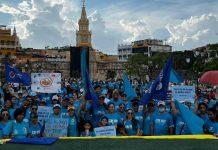
In May, residents established barricades to block the transport of fuel, equipment, and mineral samples associated with the exploration activities. These actions became the focal point of the legal complaint filed by Rosario Camma, who identified himself as the overall chieftain of the Bugkalot-Ilongot Indigenous Cultural Communities.
While some members of the Bugkalot-Ilongot communities supported the complaint, others aligned with the opposition, highlighting divisions within Indigenous groups over the project’s implications.
Church Involvement Draws Attention
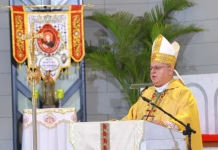
The inclusion of a Catholic bishop and priest among the defendants elevated the case’s visibility nationwide. Bishop Mangalinao has consistently defended his involvement, framing it as part of his pastoral mission to accompany communities facing uncertainty and concern.
In a statement following the ruling, Mangalinao described the outcome as more than a legal victory.
“This outcome is not only a legal victory,” he said. “It is a victory for truth, justice, and the collective efforts of communities who courageously stand to protect our land, water, and future generations.”
Earlier in the week, the bishop clarified that his presence at the barricades was primarily spiritual. He said he visited affected communities to celebrate Mass, pray with residents, and offer support.
“I went as their bishop to offer the Holy Mass, to pray with them, and to remind them that their concern for the land, the water, and their children’s future is one the Church shares and blesses,” he said.
In a homily delivered on June 21, Mangalinao framed the dispute as a matter of environmental stewardship and moral responsibility. He emphasized that speaking out was not optional in the face of potential harm.
“I could have chosen not to speak up, but if I do not speak up, my sin would be great before God,” he said.
Continuing Debate Over Environmental and Social Impact
Despite the court’s dismissal, the underlying tensions surrounding the mining project remain unresolved. Opponents continue to argue that the issue goes beyond questions of ancestral domain to include environmental protection, community welfare, and the adequacy of consultation processes.
Mangalinao expressed hope that the ruling would reinforce efforts to defend communities and ecosystems affected by extractive industries.
“Let this moment remind us that defending our watersheds, our environment, and our people’s livelihood is not a crime: it is a shared moral responsibility,” he said.
He reiterated the Church’s long-standing teaching on environmental stewardship, underscoring that natural resources should be protected for future generations.
“We believe, as the Church has always taught, that the earth is not ours to exhaust but ours to steward,” he added.
Broader Implications
The case highlights the complex intersection of legal frameworks, Indigenous rights, environmental concerns, and religious advocacy in development disputes. While the court’s decision resolves the immediate legal question, it leaves open broader debates about how projects like NLMRC’s exploration should proceed amid community opposition.
For now, the ruling stands as a notable moment for those resisting the mining project, affirming that their actions, at least in this instance, do not constitute a criminal offense under the charges brought against them.
- Raju Hasmukh with files from EWTN News
Related Images: