











This ordination reflects broader challenges for China’s estimated 12 million Catholics, divided between the state-sanctioned church and underground communities loyal to the Vatican
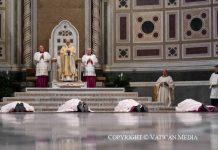
Newsroom (15/10/2025, Gaudium Press ) In a ceremony marked by strict security and symbolic gestures of unity, Auxiliary Bishop Ignatius Wu Janlin was ordained this morning at Xujiahui Cathedral, underscoring the fragile dynamics between the Vatican and Beijing under their provisional agreement on bishop appointments.
As reported earlier by Gaudium Press, Wu, 55, a native of Shanghai’s Chongming district, was elected by the city’s clergy on April 28 amid the papal interregnum following Pope Francis’s death. The Vatican Press Office confirmed today that Pope Leo XIV approved the appointment on August 11, framing it “within the framework of the Provisional Agreement between the Holy See and the People’s Republic of China.” This marks another step in the 2018 accord, which aims to unify episcopal nominations but has faced criticism for conceding influence to Chinese authorities.
The ordination was presided over by Bishop Shen Bin, who has emerged as a key figure in the diocese since his unilateral installation by Beijing in April 2023—an action later regularized by Pope Francis in July of that year to preserve church unity. Shen, president of the Chinese Bishops’ Council (a body not recognized by the Holy See), was joined by co-concelebrants including Bishop Yang Yongqiang of Hangzhou, Bishop Li Suguang of Nanchang, and Bishop Xu Honggen of Suzhou.
According to a terse statement on the official website of the Chinese Catholic Patriotic Association, Father Yang Yu read the council’s ratification of Wu’s election. The event drew around 600 attendees, comprising priests, religious sisters, nuns, and diocesan representatives. However, details remain sparse: No speeches from Shen or Wu were disclosed, and local sources described rigorous entry protocols, including mandatory surrender of mobile phones to prevent recordings or leaks.
Notably absent was Bishop Thaddeus Ma Daqin, Shanghai’s other auxiliary bishop, whose exclusion highlights ongoing internal divisions. Ordained in 2012 with Vatican approval, Ma, now 57, publicly resigned from the Patriotic Association during his consecration to prioritize pastoral duties—a bold move that led to his confinement in Sheshan Seminary ever since. Though isolated, Ma maintains a WeChat account for occasional spiritual posts.
Wu’s rise is rooted in practical control: Following the 2013 death of Bishop Aloysius Jin Luxian, he effectively administered the diocese, navigating its complexities under state oversight. For many local Catholics, the ordination evokes melancholy, given the Chinese Communist Party’s heavy hand in ecclesiastical affairs.
Yet, in a poignant bid for reconciliation, Ma extended congratulations via WeChat, emphasizing fraternal solidarity. “I am pleased to learn that Bishop Shen Bin ordained Fr. Wu Jianlin as auxiliary bishop this morning,” he wrote. “I firmly believe that, with this valuable collaborator, Bishop Shen will be able to guide the various works of the Catholic Church in Shanghai towards ever greater development, for the even greater glory of the Lord. I am certain that the new bishop, with a renewed spirit, will be able to serve us faithful with commitment and dedication.”
Ma invoked Shanghai’s rich Catholic heritage to underscore his message, quoting Wu Yushan, the first Chinese Jesuit priest ordained in 1688: “May he be a good shepherd in good health for many years, in the morning toward the southeast, in the evening toward the northwest.” He concluded with lines from Xu Guangqi, the 17th-century mandarin and convert considered Shanghai Catholicism’s founder: “May the grace of the Lord abound upon us and extend without end.”
This episode reflects broader challenges for China’s estimated 12 million Catholics, divided between the state-sanctioned church and underground communities loyal to Rome. While the Vatican seeks dialogue, critics argue such appointments risk eroding pastoral independence. As Wu assumes his role, his tenure will test whether unity can bridge ideological divides in one of Asia’s most vibrant Catholic hubs.
- Raju Hasmukh with files from asianews.it
Related Images: