

















Nine Catholics seek bail in Rajasthan High Court after arrest over clash during disrupted Eucharistic service amid rising tensions.
Newsroom (21/05/2026 Gaudium Press ) Nine Catholic laypeople arrested earlier this month in India’s western state of Rajasthan have approached the Rajasthan High Court seeking bail after lower courts rejected their petitions. The arrests stem from a confrontation during a disrupted Eucharistic celebration, raising concerns among church leaders about the treatment of minority communities and the enforcement of law.
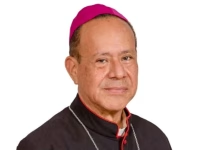
Bishop Devaprasad John Ganava of Udaipur diocese expressed strong disappointment over the continued detention of the accused. “It is highly disappointing that our people have been in judicial custody for over a fortnight now without having committed any offense,” he told UCA News on May 21. According to the bishop, bail applications had already been filed in two lower courts but were denied. The High Court is expected to hear the latest appeal on May 26.
The nine individuals, all lay members of the Catholic community, were booked on multiple charges, including rioting and attempted murder, along with allegations of wrongful restraint, breach of peace, and illegal religious conversion. Church officials argue that these charges are unfounded and that those detained were attempting to defend a place of worship from disruption.
The incident occurred at a parish substation in Kalinjara village, located in Banswara district. Father Arvind Amliyar, the parish priest of Bandaria parish, described how a group of approximately 13 Hindu activists entered the premises during a Eucharistic celebration. According to him, the group began filming the service, particularly during the Holy Communion, and alleged that religious conversion activities were taking place.
“They entered during Communion and started filming it on their mobiles, and then began alleging religious conversion activity,” Amliyar said. He added that the group also made claims that a cow had been killed for a community feast—an accusation that can provoke strong reactions in India, where the cow holds religious significance in Hinduism.
Parishioners reportedly tried to prevent the intrusion and filming, leading to a physical scuffle. In the aftermath, police arrested four Catholics on May 1, including a retired government school teacher, followed by five more arrests the next day. Authorities identified at least 15 parishioners as suspects in connection with rioting, while also naming several unidentified individuals.
Church leaders and local clergy have raised concerns about the broader atmosphere following the arrests. Father Amliyar said that many parishioners are living in fear as police continue to search for additional suspects. “Our people are terrified and unable to stay at home as police keep coming to search for them. The women and children are scared,” he said.
An unnamed Church official indicated that others who have not yet been arrested are preparing to seek pre-arrest bail. However, they are waiting for the High Court’s decision on the currently detained individuals before proceeding with their own legal appeals.
The case unfolds against the backdrop of broader legal and political tensions in Rajasthan and across India. The state is governed by the Bharatiya Janata Party (BJP), led nationally by Prime Minister Narendra Modi. Rajasthan is among 13 states—most of them under BJP rule—that have enacted stringent laws regulating religious conversion.
These laws criminalize conversions deemed to involve coercion, inducement, or fraud, but have been criticized by Christian groups, who argue they are often used to target minority communities. The constitutional validity of such anti-conversion legislation has been challenged in India’s Supreme Court. However, the laws remain in force as the court has not issued a stay on their enforcement.
Christians represent a very small minority in Rajasthan, accounting for approximately 0.15 percent of the state’s nearly 70 million people. Hindus constitute about 88 percent of the population.
For church leaders, the arrests highlight what they see as an imbalance in enforcement. Bishop Ganava pointed out that those who allegedly disrupted the religious service have not faced similar action. “It is unfortunate that the laypeople who tried to stop the intruders from interrupting the Holy Communion are behind bars while those who violated the law are roaming free,” he said.
As the High Court prepares to hear the bail plea, the case continues to draw attention to the intersection of religious freedom, law enforcement, and communal tensions in India. The outcome may have broader implications for how similar incidents are addressed in states with stringent conversion laws and deeply diverse religious communities.
- Raju Hasmukh with files form UCA News
Related Images: