








Moscow Archbishop Paolo Pezzi resigns after 18 years, sparking questions over health, canon law, and the Church’s next steps in Russia.
Newsroom (05/05/2026 Gaudium Press ) The resignation of Archbishop Paolo Pezzi as metropolitan of the Archdiocese of the Mother of God in Moscow has set off a wave of speculation about the real reasons behind the move and the future leadership of Russia’s Catholic community. While the Holy See cited canon 401 §2 and the archdiocese said Pezzi stepped down for health reasons, commentary from the Church and external observers has left the explanation contested and incomplete.
A resignation before retirement age
The Vatican announced on May 2 that Pope Leo XIV had accepted Pezzi’s resignation, even though the archbishop was still well below the customary retirement age of 75. The timing was notable because the archdiocese had already published Pezzi’s May schedule two days earlier, including a four-day visit to Nizhny Novgorod, suggesting he remained publicly active. The archdiocese later said Pezzi had served for more than 18 years and that the faithful should pray for him and for the transition ahead.
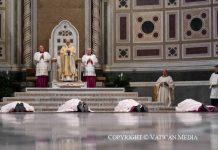
According to the archdiocese’s own statement, canon law allows a diocesan bishop to resign when illness or another grave cause makes him less fit to govern. The same statement said no explanation had been offered for what specific illness or cause might have prompted the decision. That lack of detail has fed uncertainty, especially because Pezzi had recently presided over Easter Triduum celebrations without visible signs of weakness.
Public silence and speculation
Pezzi has not issued a standalone statement to the faithful or given interviews beyond the reported remarks attributed to him at Mass, where he is said to have linked the resignation to his health. Peter Anderson, writing on his blog, highlighted that the archbishop’s condition had not been publicly described in detail and that the cause remained unclear in light of the formal canon-law language. At the same time, over the past year observers had noticed increasing difficulty with walking and, at times, speaking.
The atmosphere around the resignation was further complicated by Russian state media coverage. RIA Novosti reported first on Pezzi’s failure to sign a declaration supporting persecuted Christians in Ukraine, then later carried an explanation from Father Kirill Gorbunov that Pezzi was not authorized under Catholic Church rules to make official statements about other countries. The sequence suggests a separate political context surrounding the resignation.
Interim administration in Moscow
With the see now vacant, the Holy See appointed Auxiliary Bishop Nikolai Dubinin as apostolic administrator ad nutum Sanctae Sedis, giving him temporary governance of the archdiocese until a new bishop takes canonical possession. The archdiocese described this as the normal transitional arrangement during a vacancy, though in this case the Holy See chose direct appointment rather than leaving the matter to local election procedures. Dubinin, 52, is identified as the only remaining Russian-born Catholic bishop in the Russian Federation.
The broader personnel landscape in the Russian Catholic hierarchy is as follows, Bishop Joseph Werth of Novosibirsk and Bishop Kirill Klimovich of Irkutsk are both 73, Bishop Clemens Pickel of Saratov is 64, and Auxiliary Bishop Lipke has served only 15 months as bishop. In that context, Dubinin’s citizenship, language, and familiarity with local procedures are practical advantages.
Canon law and precedent
The resignation of Archbishop Paolo Pezzi is being viewed as part of a broader trend in the Church, where bishops stepping down for health or other serious reasons has become increasingly common. Vatican norms emphasize that such resignations should be handled with dignity, gratitude, and support for the bishop involved.
When a bishop resigns, an apostolic administrator temporarily takes over the diocese, while some church bodies continue operating and others pause their work. During the vacancy, the bishop’s name remains in the Eucharistic prayer, and priests may celebrate Mass for the election of a new bishop.
In Moscow, the resignation marks a period of transition under Bishop Nikolai Dubinin. The archdiocese is now awaiting the appointment of a permanent successor.
- Raju Hasmukh with files from Infovaticana
Related Images: