






















Bishop Erik Varden’s Vatican reflection revisits St. Bernard’s On Consideration, exploring spiritual discernment, humility, and leadership in the Church.
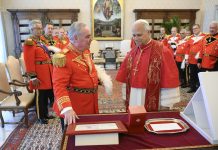
Newsroom (27/02/2026 Gaudium Press ) At the Vatican’s annual Spiritual Exercises, Bishop Erik Varden delivered his tenth and final reflection under the vaulted stillness of the Apostolic Palace. Before Pope Leo XIV, the Cardinals of Rome, and the heads of Dicasteries, the Cistercian prelate drew his audience into the meditative depths of St. Bernard’s De Consideratione—On Consideration—a work written nine centuries earlier yet cuttingly relevant to the modern Church.
St. Bernard of Clairvaux, the twelfth-century abbot, originally penned On Consideration not as an abstract treatise but as a letter to a monk who had once lived beside him in the cloister—a man named Bernardo dei Paganelli. That same Bernardo, ordained already for the Church of Pisa, entered Clairvaux in 1138. Seven years later, in a turn of divine providence, he became Pope Eugene III.
Consideration and the Search for Truth
In his reflection, Bishop Varden explained Bernard’s essential distinction: while contemplation gazes upon divine truths already known, consideration seeks truth in human contingencies—the shifting terrain of earthly concerns where God’s will can be harder to discern. For Bernard, consideration is “thought searching for truth,” a discipline of the mind and heart that ventures into uncertainty to find divine order.
Bernard offered Eugene no blueprint for Church reform, no new institutional structures. Instead, he advised the pope to surround himself with souls marked by holiness and discernment. The renewal of the Church, he insisted, begins in the quality of its servants. Those who lead must gather around them men and women “of proven sanctity, ready obedience, and quiet patience…catholic in faith, faithful in service; inclined towards peace and desirous of unity.”
These collaborators, Bernard wrote, are recognized not by ambition but by prayerful humility. They trust more in God’s providence than their own industry, and their presence leaves a quiet, sanctifying trace—“their arrival is peaceful, their departure unassuming.” The Church that operates in this way mirrors the harmony of angelic ranks: every act, however mundane, oriented toward the glory of God.
The Spiritual Horizon of Leadership
To see earthly responsibilities rightly, Bernard taught, is to read them through the lens of eternity. In this turn of thought, Bishop Varden observed, Bernard unites governance with grace: practical wisdom begins in divine vision. “To consider in this way,” he wrote, “is not to go into exile, but to return home.”
Bernard’s own consideration of God—“omnipotent will, benevolent virtue, unchangeable reason”—presents a vision of the Creator as supreme blessedness, who desires to share His very divinity with His creatures. God expands the human heart to receive Him; He justifies, enlightens, and preserves it unto immortality. For bishops and prelates, Bernard urges, these truths must come first. From such grounded reflection, practical governance finds its proper order and blessing.
A true shepherd, Bernard concludes, must be principled, holy, and austere—yet never cold. He should be “the Bridegroom’s friend,” sharing the joy of divine friendship with others. Authority, rightly lived, becomes a participation in Christ’s humility and delight.
The Burden and the Yoke
Drawing on Augustine’s metaphor of the episcopal office as a sarcina—a soldier’s pack—Bishop Varden reflected on the paradox of pastoral weight. Augustine knew, from his North African loneliness, how fearsome such a burden could be. Yet he also knew its mystery: the Cross borne with love becomes radiant. “If you love it,” Augustine wrote, “it will be light. If you hate it, it will be heavy.”
Varden reminded his listeners that the Cross is never forced upon us; it is entrusted. The same luminous burden, when embraced in love, becomes the gentle yoke Christ promised to His friends. St. Bernard’s declaration in the Life of St. Malachy still rings true: “Yours, good Jesus, is the deposit entrusted to us—yours the treasure hidden in our care.”
Returning to the Center
Bishop Varden’s Lenten meditation, steeped in monastic discipline yet incisively pastoral, invited today’s Church leaders to rediscover the spiritual discipline of consideration: the humble search for divine logic in human complexity. It is, he suggested, not nostalgia for monastic quiet but a call to integrity—an invitation to let contemplation inform action.
In a time when institutions wrestle with reform and faith faces new frontiers, On Consideration still speaks: leadership, if it begins not with ambition but with prayer, will always have the strength to bear its own sarcina in joy.
- Raju Hasmukh with files from Vatican News
Related Images: