










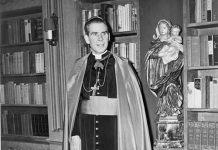


Speaking at the start of the bishops’ fall plenary meeting, Bätzing rejected calls to withdraw the April 2025 handout, which proposes blessings for same-sex and unmarried couples
Newsroom (23/09/2025, Gaudium Press ) The German Catholic Church faces renewed scrutiny over its pastoral guidance on blessings for irregular couples, as Bishop Georg Bätzing, chairman of the German Bishops’ Conference (DBK), staunchly defended the document Segen gibt der Liebe Kraft (Blessings Strengthen Love) during a press conference in Fulda on September 22, 2025. Speaking at the start of the bishops’ fall plenary meeting, Bätzing rejected calls to withdraw the April 2025 handout, which proposes blessings for same-sex and unmarried couples, despite pointed criticism from Pope Leo XIV in his first major interview since his election in May 2025.
Bätzing emphasized that the document, approved by the Joint Conference—a collaborative body of the DBK and the lay-led Central Committee of German Catholics (ZdK)—aligns with the Vatican’s December 2023 declaration Fiducia Supplicans. “We have made moderate additions to this document for our pastoral situation and praxis in Germany,” he stated, noting that no formal rituals were published, leaving the form of blessings to pastoral workers. He added that the guidance was developed transparently with the Dicastery for the Doctrine of the Faith, asserting, “There is no reason to withdraw it.”
The controversy intensified after Pope Leo XIV’s remarks, published on September 18, 2025, in an interview with Crux. The pontiff criticized Northern European blessing practices, specifically targeting rituals for “people who love one another”—a phrase associated with Germany’s Synodal Way. “This goes specifically against Fiducia Supplicans, which says we can bless all people but does not look for a way of ritualizing some kind of blessing,” he declared. German Catholic commentators, including Guido Horst in a September 19, 2025, op-ed for Die Tagespost, interpreted this as a direct rebuke of the German approach, urging Bätzing to choose between local guidelines and unity with Rome.
The German document, issued on April 23, 2025, shortly after Pope Francis’ death on April 21, drew criticism for its timing, though the DBK clarified it was dated April 4, when Francis was still alive. The four-page Segen gibt der Liebe Kraft responded to a March 2023 Synodal Way resolution, approved by a 38-9 vote among bishops, calling for “blessing ceremonies for couples who love each other,” including same-sex and remarried couples. While the handout avoids prescribing liturgical rituals, conservative critics, such as the lay group New Beginning, argued in May 2025 that its tone encourages a “ritual practice,” contradicting Fiducia Supplicans’ insistence on spontaneous, brief blessings lasting “a few seconds” without approved texts.
Germany’s 27 dioceses, serving 20.9 million Catholics—about 25% of the population as of 2023—have responded unevenly. A katholisch.de survey from August 2025 found that roughly 50% of dioceses have adopted or adapted the guidance, while five—Augsburg, Eichstätt, Passau, Regensburg, and Cologne, representing 18.5%—have rejected it. In July 2025, Bätzing endorsed the handout’s implementation in his Limburg diocese (600,000 Catholics), while Rottenburg-Stuttgart (1.8 million Catholics) released a collection titled We Love Each Other—What a Blessing!, featuring lengthy prayers that critics argue defy Vatican guidelines. Conversely, Cologne’s Cardinal Rainer Maria Woelki, a Synodal Way critic, declared in July 2025 that Fiducia Supplicans suffices, with Vicar General Msgr. Guido Assmann emphasizing the need for non-liturgical blessings.
The debate reflects broader challenges. Germany’s Catholic Church saw 522,000 formal departures in 2023, and only 29 priests were ordained in 2024, a historic low. Public support for same-sex blessings is high—70% of Catholics backed them in a 2021 survey by Berlin and Münster universities, with 83% of Germans supporting same-sex marriage, legalized in October 2017. Yet weekly Mass attendance remains at 9%, and the Vatican, per August 2025 reports, is closely monitoring Germany for schismatic risks. As the Synodal Way, launched in 2019, continues to push reforms, the blessings controversy underscores a delicate balance between local adaptation and global doctrine in one of the world’s largest Catholic communities.
- Raju Hasmukh with files from The Pillar
Related Images:


