







Franciscan friar Augusto Ramírez Monasterio’s 1983 martyrdom reveals faith’s power against Guatemala’s violence and the unbroken seal of confession.
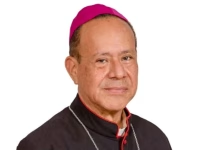
Newsroom (03/02/2026 Gaudium Press ) At first glance, the official photograph of Venerable Augusto Ramírez Monasterio shows a serene Franciscan friar smiling gently in a small garden, hands folded within his brown habit. Known across Guatemala simply as “Fray Augusto,” the image suggests peace—but its timing tells another story. Taken just after hours of brutal torture in June 1983, the photograph captures not serenity but courage. It was only on January 22, when Pope Leo XIV recognized him as a martyr, that the world glimpsed the depth of his sacrifice.
Franciscan Father Edwin Alvarado, vice postulator for Augusto’s sainthood cause, told OSV News that military officials had forced the friar to sign a false statement claiming he had been “treated well.” “The photo was taken after his torture,” Alvarado said. “He placed his hands inside his habit so no one could see the burns.” The image, later sent to Father Giovangiuseppe Califano in Rome, became—ironically—the most truthful record of the priest’s ordeal.
Faith amid a nation at war
In 1983, Guatemala was in the grip of a savage civil conflict. Under President Efraín Ríos Montt’s military regime, entire Indigenous Mayan villages were wiped out, and priests who sided with the poor were hunted as enemies of the state.
Father Alvarado, then a 17-year-old postulant arriving from peaceful Costa Rica, learned quickly how dangerous the robe of St. Francis could be. “When I opened my suitcase, the man at the airport said, ‘Here, you pay for this with your life,’” he recalled. Days later, the young postulant heard news that a priest had been murdered—the thirteenth killed that year. It was Fray Augusto.
A pastor of joy and music
Born in Guatemala City in 1937, Augusto Ramírez journeyed through Nicaragua and Spain before his ordination in 1967. He returned home to pastor the parish of San Francisco el Grande in Antigua Guatemala, dedicating his ministry to youth, the sick, and the poor.
Friends remembered him as energetic and playful, known for a quick wit and a contagious laugh that sometimes filled the church more readily than song. He taught music, especially the vocal technique “Solfa,” to local teens, building community through harmony. Once, he nicknamed an unruly choir member “Paco Satanás”—“the only Satan that worked in the Church,” the man still recalls with affection.
Behind the humor, however, stood a priest of extraordinary devotion. Parishioners said he would spend hours in the confessional, listening patiently to every soul who came forward. “He did everything in ministry,” Father Alvarado said, “but where he spent most of his time was seated at the confessional.”
Torture for silence
The trial of Fray Augusto began with compassion. A former guerrilla commander sought reconciliation through confession and asked the friar’s help in applying for a government amnesty. Wanting to guide the man back into society, Augusto accompanied him to a municipal office to obtain identification papers. They never expected betrayal.
Recognized by local authorities, the man and his children were arrested, as was Father Augusto. The group was delivered to the military, where the priest was blindfolded, tied, and interrogated. Torturers demanded that he reveal what the man had confessed. When he refused, citing the sacred seal of confession, they burned his hands, feet, and flesh in cruelty meant to break his vows. He did not yield.
Though he was eventually released—after signing a coerced statement and posing for the infamous photo—the government had marked him for death. Months later, on November 7, 1983, he was kidnapped and killed by police during what the regime called an “escape attempt.” For Father Alvarado and many others, his refusal to breach the confessional seal defines his sainthood. “It tells us,” Alvarado said, “that the worth of confession can demand even a priest’s life.”
The path to beatification
More than four decades later, the Church prepares to honor the friar formally. Pope Leo XIV’s recognition of his martyrdom came as the universal Church observed the World Day for Consecrated Life on February 2. As Father Alvarado coordinated with the Archdiocese of Santiago de Guatemala and Vatican officials, he noticed a poignant coincidence: the only available Saturday for the beatification was November 7—the exact date of Fray Augusto’s death, now transformed into celebration.
The moment, he said, felt providential. “I don’t know how it happened, but it is a Saturday. So we confirmed the date.” On that 43rd anniversary, the man whose photo once hid the wounds of torture will be honored not as a victim, but as a witness—a friar who smiled through agony, hands folded in peace, having already given everything he had to protect a single confession.
- Raju Hasmukh with files from OSV News
Related Images: