











Cardinal Bychok presents a Ukrainian soldier’s cross and flag to Pope Leo XIV, urging truth, peace, and hope at Vatican Consistory discussions.
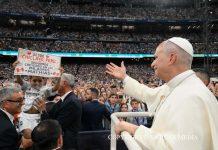
Newsroom (26/06/2026 Gaudium Press ) As the war in Ukraine continues to exact a heavy toll, Cardinal Mykola Bychok brought a deeply personal and symbolic message to Vatican City, presenting Pope Leo XIV with a cross and national flag entrusted to him by a Ukrainian soldier who spent three years on the front line.
The gesture took place on June 24, following the Wednesday General Audience, just days before the Extraordinary Consistory scheduled for June 26–29. For Cardinal Bychok, Bishop of the Eparchy of Saints Peter and Paul of Melbourne, Australia, the moment was both spiritual and profoundly representative of his homeland’s suffering and resilience.
Describing the encounter, the Ukrainian-born cardinal emphasized the gravity of the gift. The items—a cross and a Ukrainian flag—had belonged to a war veteran who specifically requested they be delivered to the Pope. Acting as an intermediary, Cardinal Bychok conveyed not only the objects themselves but also a message from those who have experienced the war firsthand.
“I stressed that this flag and cross are a huge sign for Ukraine,” he said, highlighting their symbolic weight. The presentation underscored a call for the Holy Father to continue speaking “the truth about the war in Ukraine” and to remain a beacon of hope for those enduring its consequences.
The cardinal also used the moment to express gratitude for the Catholic Church’s ongoing support. He spoke of those most affected by the conflict—soldiers, veterans, civilians, those missing in action, and prisoners of war—many of whom carry deep physical and psychological scars.
“It was a sign of hope for Ukraine,” Cardinal Bychok explained, adding that the gesture affirmed a shared belief that the country is not alone. “We are with God, and the whole Catholic Church is with us.”
His visit to Rome coincides with the Extraordinary Consistory, a high-level gathering of cardinals convened by Pope Leo XIV. Among the central themes expected to be addressed are global conflicts, divisions, and the Church’s role in fostering peace. The meeting also reflects on the Pope’s encyclical Magnifica humanitas, alongside four key discussion topics, including war and reconciliation.
For Cardinal Bychok, the Consistory represents a critical opportunity. “We Ukrainians tried to raise this topic a few times over the last few years,” he said, noting that the discussion now taking place at the highest level of the Church signals a significant development.
He expressed cautious optimism about the outcomes, emphasizing the importance of dialogue among the global College of Cardinals. “We will see the fruits of the discussions,” he said, underscoring both hope and realism in the face of ongoing conflict.
In reflecting on the Ukrainian Church’s potential contribution to these discussions, Cardinal Bychok highlighted both the moral clarity and practical experience his country brings. Ukraine, he said, remains firm in defending its sovereignty, shaped by the sacrifice of “thousands and thousands” who have given their lives for the nation’s future.
At the same time, he acknowledged the enduring toll of war. The trauma experienced by soldiers and civilians alike continues long after leaving the front lines. “For them it’s difficult to live in a quiet situation,” he noted, pointing to the psychological wounds that persist alongside physical devastation.
Even when the war ends, he warned, new challenges will emerge. “Fresh wounds will open,” he said, emphasizing the need for sustained support and long-term healing.
Despite these hardships, the cardinal pointed to examples of resilience and solidarity that could offer valuable lessons to the wider world. Since the beginning of the full-scale invasion, the Catholic Church globally has mobilized resources—from basic necessities such as food and water to specialized support for trauma recovery.
International cooperation has also played a key role. Experts from countries with prior experience of conflict have been engaged to share best practices, while the Ukrainian Church itself has developed strategies for coping with displacement, grief, and rebuilding.
One particularly striking example is the response to mass displacement. Millions of Ukrainians were forced to flee their homes, both internally and abroad. Yet, as Cardinal Bychok noted, unlike in many previous conflicts, large-scale tent encampments were largely avoided.
“That is a really good example that when we are together, we can do many good things,” he said, pointing to the collective efforts that enabled more dignified forms of shelter and community support.
These experiences, he argued, position the Ukrainian Church as a valuable contributor to global conversations about conflict and recovery. The lessons learned—how to live through war, support the traumatized, and rebuild communities—extend beyond national borders.
“It will be a huge benefit, not only for Ukraine, but for the whole civilized world,” Cardinal Bychok concluded, framing his country’s suffering not only as a tragedy but also as a source of insight for building peace in a fractured world.
- Raju Hasmukh with files from Vatican News
Related Images: