














Discover the meaning of the Communion of Saints—how all believers, in Heaven, Earth, and Purgatory, are united in love and prayer.
Newsroom (11/01/2025, Gaudium Press) — On this day, we celebrate all the millions of people who have reached Heaven, even if they are unknown to us. A saint is one who has entered Heaven; some have been canonized and are therefore proposed by the Church as examples of Christian life.
But what is the so‑called “Communion of Saints”?
Can one be a great missionary without ever leaving the convent?
St. Thérèse of the Child Jesus was honoured by the Popes as the Patroness of Missions, even though she never left the Carmelite cloister — which might seem a contradiction. However, if we understand what the Communion of Saints is, we will see that this title was, in truth, a genuine act of justice.
The saint wrote in her autobiography that she desired to be, at once, an apostle, a martyr, a crusader, a priest, a catechist, a cloistered nun, a helper of the sick… she wanted to be everything for the good of souls. Such a desire to do good for all could not be fulfilled naturally but only through supernatural means. At a certain moment in her life, having been instructed in the doctrine of the Communion of Saints, she understood that her role in the Church would be like that of the “heart,” which influences all members through the life‑giving flow of love for God.
“I believe in the Communion of Saints”
This is what we profess every Sunday at Mass or when beginning the recitation of the Rosary.
The Communion of Saints is a dogma of Faith, made explicit since the first century of Christianity. It allows, for instance, that we offer spiritual help to Christians living in other countries, thousands of kilometers away. The doctrine explains that the members of the Church throughout the world, though they may know little or nothing of one another, are united by a spiritual bond that transcends both distance and time. Through the Communion of Saints, we are so united that our actions and intentions can influence the fidelity — or infidelity — of our brothers and sisters in the Faith, in the present, the past, and the future.
By this communion, an act of virtue, self‑denial, or generosity can become assistance for a young man falling into sin; in the same way, a sinful act can negatively affect the members — the very body — of the Mystical Christ.
The Communion of Saints transcends our earthly reality
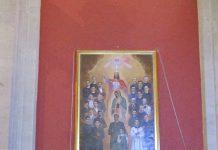
This communion is not limited to Christians still on earth — members of the Church Militant — because the Church also includes all those already saved in Paradise: the Church Triumphant.
Through the Communion of Saints, we receive help from those who have died and are saved, enjoying divine glory. They can intercede for us, for just as a person who loves Jesus and Mary wishes to help others spiritually and materially, so too do those already in Heaven long to assist those still on earth. They await our prayers so they may continue from Heaven to aid those still journeying on earth.
For this reason, the Church believes and professes this connection through devotion to and intercession of the saints.
We too hope that, once saved, we may help our relatives and friends walk the paths of truth and goodness.
The root of the Communion of Saints lies in the virtue of charity, which “is kind and selfless” (cf. 1 Cor 13:4‑5).
Already the first Christians held “everything in common” (Acts 4:32), both spiritual and material goods. Thus, the Communion of Saints also has a material aspect, by which Christians are called to share their resources in service of those most in need.
Furthermore, the Communion of Saints extends to those enduring the blessed flames of Purgatory. These souls, being purified, await their entrance into eternal union with God and Mary Most Holy. Through this communion, we can help them be purified more quickly and thus join the saints in Heaven.
How can we best help souls through the Communion of Saints?
The Communion of Saints is the most powerful means of apostolate. Even if we feel we lack gifts to do good to others, if we live holy lives and burn with love for God, we can give immense spiritual help to Christians throughout the world — for by practicing virtue, we remain in grace and fulfill God’s commandments.
Virtue keeps us from sin and prevents us from being obstacles to divine grace for the Universal Church, or for a specific nation, city, or community. On the contrary, practicing virtue makes us true “lightning rods” of divine grace, benefiting the entire Church.
There is also an active way to help our brothers and sisters in Faith: through the reception of the Sacraments, especially the Eucharist.
In fact, the Communion of Saints refers not only to the union among holy persons but also to the communion of holy things.
In Latin, communio sanctorum holds this double meaning — “communion of saints” and “of holy things.”
Therefore, the Liturgy, using this Latin play on words, proclaims: “Sancta Sanctis” — “The holy things for the holy.”
Living the Communion of Saints
We can thus offer a prayer to God for souls most tempted by sin, for Christians persecuted for their Faith, for their sanctity and fidelity to vocation, and for priests and the Pope.
It also pleases God to offer sacrifices — physical or moral suffering we must endure — or even voluntary renunciations of lawful pleasures, such as delicious food or rest.
Yet there is an even higher act: receiving Holy Communion itself.
To explicitly and fervently offer our Eucharistic communion for Christians across the world and for souls in Purgatory is to practice the most sublime form of fraternal charity.
The prayers and merits we gain in the Eucharist benefit the entire world because of the “common treasury” of all the merits of the saints, the Blessed Virgin, and Christ’s Passion on the Cross.
This treasury draws down divine grace upon every soul on earth and in Purgatory.
The Biblical foundation of the Communion of Saints
This dogma of Faith, professed in the Creed, is based on one of St. Paul’s most beautiful passages, where the Apostle compares the Church to a human body:
“As the body is one and has many members, and all the members, though many, are one body, so it is with Christ… The body does not consist of one member but of many… If one member suffers, all suffer together; if one is honoUred, all rejoice together. Now you are the body of Christ and individually members of it.” (1 Cor 12:12‑27)
From the beginning, Christians have interpreted this text in the sense of the Communion of Saints. Hence, the Fathers teach that “the Church is the communion of all the saints” — of Heaven, earth, and Purgatory, from every corner of the world, every tongue and people.
The Communion of Saints makes the Church truly Universal — Catholic.
Whoever lives deeply united to this article of Faith can accomplish wonders in the order of grace, convert peoples, and aid persecuted Christians and saints.
Faith in the Communion of Saints places in the Catholic’s hands the true rudder of history.
By Marcos Eduardo Melo dos Santos
Compiled by Gustavo Kralj
Related Images: