

















Washington drops law forcing priests to break Seal of Confession after legal battle. Settlement protects religious freedom, ensures child safety measures.
Newsroom (14/10/2025, Gaudium Press ) In a significant retreat from a divisive legislative push, the State of Washington has formally abandoned its attempt to mandate that Catholic and Orthodox priests report child abuse confession, a measure that threatened to upend one of Christianity’s most sacred tenets. The announcement, detailed in a joint settlement on September 30, 2025, resolves a high-stakes legal battle that had drawn national scrutiny, with federal courts and the U.S. Department of Justice weighing in against what critics decried as an assault on the First Amendment. On October 10, 2025, the Washington Attorney General’s Office filed stipulations agreeing not to enforce the requirement for disclosures learned solely through confession.
At the heart of the controversy was Senate Bill 5375, a child protection measure introduced by Democratic Sen. Noel Frame of Seattle and enacted by Democratic Gov. Bob Ferguson in May 2025. The law expanded mandatory reporting requirements for clergy, compelling them to disclose admissions of abuse heard during the sacrament of confession—even as it exempted attorneys, therapists, and substance abuse counselors from similar obligations. Noncompliance could have resulted in misdemeanor charges, up to 364 days in jail, fines up to $5,000, and potential civil lawsuits, placing priests in an untenable dilemma between divine duty and secular penalty.
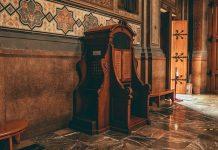
The Catholic Church in Washington, led by the state’s five dioceses, viewed the bill not as a safeguard for vulnerable children but as a direct infringement on the Seal of Confession—a vow of absolute confidentiality rooted in canon law and upheld for nearly 2,000 years since the early Church Fathers. “The confessional is a sacred space where the penitent encounters God’s mercy through the priest, who acts in persona Christi,” explained Archbishop Paul Etienne of Seattle in a pastoral letter circulated last year. “To pierce this seal would eviscerate the sacrament itself, deterring souls from seeking healing and forgiveness.” As part of its longstanding commitment to Safe Environment protocols, the Church already mandates that priests and all personnel report suspected abuse to law enforcement and child protection agencies outside the confessional—policies enforced across the Archdiocese of Seattle and the Dioceses of Spokane and Yakima, including background checks and training for parishes, schools, and ministries. The Church had supported the law’s broader goal of strengthening minor protections but sought only a narrow exemption for the sacrament.
The Orthodox Christian community, including the Orthodox Church in America (OCA) and the Greek Orthodox Archdiocese, echoed this alarm. In their federal lawsuit, Orthodox Church in America v. Ferguson, they argued that the law would “chill religious practice” by fostering distrust among the faithful, potentially reducing participation in confession—a cornerstone of Eastern Christian spirituality. “This isn’t mere privacy; it’s the inviolable mystery of repentance,” said Fr. John Vitko, a litigator for the OCA, during oral arguments in Tacoma’s Western District court.
Opposition coalesced swiftly. On May 29, 2025, the lead Catholic plaintiffs—Archbishop Paul D. Etienne, Bishop Joseph J. Tyson of Yakima, and Bishop Thomas A. Daly of Spokane—filed Etienne v. Ferguson in the Eastern District of Washington, represented by the Becket Fund for Religious Liberty, First Liberty Institute, and WilmerHale. Orthodox plaintiffs pursued parallel action in the Western District with the Alliance Defending Freedom (ADF). Both cases invoked the Religious Freedom Restoration Act (RFRA) and the First Amendment’s free exercise clause, contending that the state lacked a compelling interest to justify targeting religious rites while sparing secular confidences. A Becket motion for a preliminary injunction followed on June 5.
Federal judges moved decisively. U.S. District Court Chief Judge David G. Estudillo issued a preliminary injunction in Spokane on July 18, 2025—days before the law’s scheduled effective date of July 27—halting enforcement statewide and lambasting the measure as “a stark example of viewpoint discrimination.” The ruling bought time, but the pressure mounted: The U.S. Department of Justice filed statements of interest in August, signaling that the measure risked federal civil rights violations and could set a perilous precedent for other states.
By late September, with appeals looming and public opinion tilting against the state—polls showed 62% of Washingtonians opposing the confessional mandate—the Ferguson administration (now led by Attorney General Bob Ferguson, who succeeded Inslee as governor) sought an off-ramp. The settlement, finalized on September 30, commits the state to permanent non-enforcement and dismissal of all related charges. No damages were awarded, but the agreements include a joint declaration affirming the Seal of Confession’s protected status under federal law.
Legal advocates hailed the outcome. “Washington was wise to walk away from this draconian law and allow Catholic clergy to continue ministering to the faithful,” said Mark Rienzi, president and CEO of Becket. “This is a victory for religious freedom and for common sense. Priests should never be forced to make the impossible choice of betraying their sacred vows or going to jail.” John Bursch, ADF vice president of appellate advocacy, added: “Washington tried to single out priests for harsher treatment than lawyers or shrinks—that’s not child protection; that’s religious animus. The First Amendment demands neutrality, and today’s victory restores it.”
For Washington’s faith leaders, the saga underscores a deeper tension between child welfare and ecclesiastical autonomy. “Preventing abuse and upholding the sacred seal of confession are not mutually exclusive—we can and must do both,” said Jean Hill, executive director of the Washington State Catholic Conference. “That’s why the Church supported the law’s goal from the beginning and only asked for a narrow exemption to protect the sacrament. We’re grateful the state ultimately recognized it can prevent abuse without forcing priests to violate their sacred vows.” Bishop Thomas Daly, who had pledged civil disobedience if the law took effect, called the settlement “a merciful reprieve from state overreach.” In a statement released through the diocese, he reflected on the human stakes: “We’ve seen too many scandals in the Church; no one disputes the urgency of protecting the innocent. But true reform flows from grace, not coercion—forcing a breach here would only drive wounds underground.”
Orthodox voices expressed parallel gratitude. Metropolitan Tikhon of the OCA, in a homily delivered last Sunday, described the threat as “a modern echo of ancient persecutions,” urging the faithful to “redouble our commitment to confession as the path to Paschal joy.” Their suit had highlighted empirical risks, citing studies from the U.S. Conference of Catholic Bishops showing that mandatory reporting laws in other jurisdictions had not demonstrably increased abuse disclosures from penitents, who often fear reprisal.
The case, while resolved, leaves lingering questions about legislative momentum. Similar bills have surfaced in California, New York, and Maryland, prompting preemptive lawsuits from religious coalitions. Advocates like Frame defend the original intent: “No one should hide behind a booth while children suffer,” she said in a May op-ed. Yet with Washington’s concession, the tide may have turned, reinforcing judicial skepticism toward laws that entangle church and state. As Hiram Sasser, executive general counsel for First Liberty Institute, noted: “It is a credit to the Attorney General of Washington, the Governor, and the Archbishop and Bishops that they were able to come together and find common ground under the First Amendment to protect religious liberty while seeking to eradicate the scourge of sexual abuse. I hope we can all learn from their noble examples.”
As autumn leaves fall over the Evergreen State, priests in both Catholic and Orthodox traditions can once again hear confessions without the specter of handcuffs. In a nation frayed by cultural divides, the episode serves as a quiet affirmation: Some silences, forged in faith, remain beyond the reach of statute.
- Raju Hasmukh
Related Images: