




















Vatican experts gather to explore ethical AI design, highlighting Church’s moral role in shaping technology for the common good.
Newsroom (03/03/2026 Gaudium Press )The Vatican has deepened its engagement in the global debate over artificial intelligence, gathering leading thinkers, clergy, and technologists to explore how humanity might guide innovation with moral clarity. The seminar, titled “Potential and Challenges of Artificial Intelligence,” took place on Monday, March 2, at the Salone San Pio X in Rome, organized by the Secretariat for the Economy and the Labour Office of the Apostolic See (ULSA).
The event unfolded under the “appreciation and encouragement” of the Pope, underscoring the Vatican’s growing concern for a technological world abundant in means but, as Albert Einstein once warned, “confused about its ends.”
Professor Pasquale Passalacqua, Director of ULSA, opened the proceedings by noting that Pope Leo XIV, informed of the initiative by Monsignor Marco Sprizzi, welcomed the effort as a step toward “deeper awareness in this highly relevant and complex field.” Journalistic duties fell to Alessandro Gisotti, Deputy Editorial Director of the Dicastery for Communication, who moderated the discussion.
Navigating a VUCA World
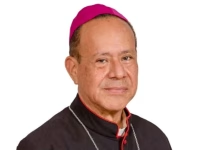
Among the speakers, Bishop Paul Tighe, Secretary of the Dicastery for Culture and Education, invoked the acronym VUCA — Volatility, Uncertainty, Complexity, and Ambiguity — to describe a global environment increasingly transformed by technologies like ChatGPT, which exploded into public use in 2022.
Tighe warned that AI’s development cannot be seen as neutral. “It unfolds amid geopolitical rivalries, commercial pressures, and personal ambitions,” he said, pointing to the example of Anthropic, a U.S. company founded on ethical AI principles but reportedly pressured to relax them for military and surveillance purposes.
Citing the Vatican document Antiqua et nova, Tighe argued that what society most needs now is the “wisdom of the heart” — an ability to unite knowledge and compassion in decision-making. The Church, he added, possesses both moral authority and the convening power to unite diverse experts, positioning it as a crucial partner in the ethical governance of AI.
Technology’s Politics and Power
Father Paolo Benanti, a Franciscan friar and professor at both the Pontifical Gregorian University and Luiss Guido Carli University, turned to the political dimensions of emerging technologies. He called for a new “ethics of technology”—one that recognizes that every technological system inherently embodies values and hierarchies.
“When a technological artifact impacts a social context,” Benanti explained, “it acts as a configuration of power and a form of order.” His concerns extended to how algorithms distribute visibility in the digital world, where the reach of an article may depend less on its quality than on the logic of search engine placement. This, he concluded, represents a “mediation of power” that increasingly shapes public discourse.
Benanti, notably the only Italian member of the UN Committee on Artificial Intelligence, highlighted that discussions on these moral questions now reach from the Holy See to the United Nations, demonstrating the universal urgency of ethical governance in the digital era.
Algorithms and Human Bias
The theme of transparency and fairness was developed further by Professor Corrado Giustozzi, lecturer at Rome’s Campus Bio-Medico University. Giustozzi examined the very architecture of machine learning, focusing on how bias can become embedded in the algorithmic design process.
If data used to train a model are incomplete or prejudiced, he warned, the system’s decisions will be similarly distorted — leading to “erroneous or discriminatory” outcomes. The training phase, therefore, is not merely technical but moral, determining whether AI serves equity or entrenches inequality.
A Church Open to the Future
Moderator Gisotti concluded that the seminar itself represented a “commitment of the ecclesial community” — an act of participation in the world’s moral reckoning with digital power.
The Vatican, through this and similar initiatives, positions itself as a conscience amid technological transformation: an institution without military or commercial interests, advocating instead for an “ethical design” of systems that place the human person, not the algorithm, at the center.
Just as Einstein’s words remind us of humanity’s risk of confusion in an age of limitless capability, the Holy See seeks to restore clarity — a vision rooted in conscience, compassion, and the collective good.
- Raju Hasmukh with files from Vatican News