












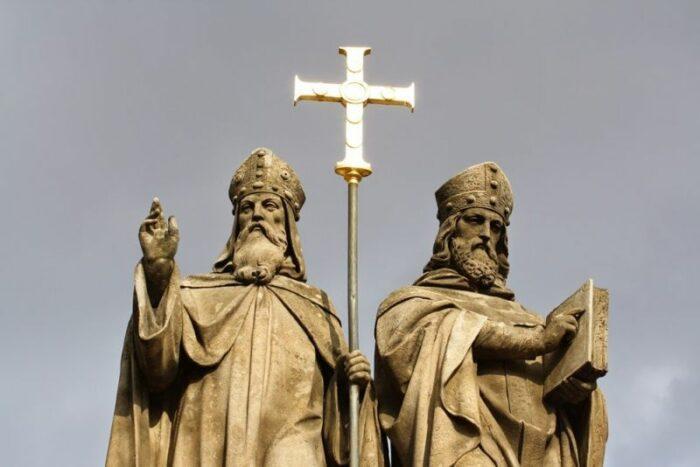
In the 9th century, two noblemen evangelized the nations of Eastern Europe and were given the glorious title of ‘Apostles of the Slavs’: the brothers Saint Cyril and Saint Methodius were proclaimed co-patrons of Europe, together with Saint Benedict.
Newsdesk (18/03/2026, Gaudium Press) The sons of a noble family, they were born in Thessalonica, an important city in Greece evangelized by Saint Paul. Among his epistles, the Apostle wrote two to the Thessalonians. Both studied in Constantinople, where they distinguished themselves for their virtues. Saint Methodius became governor of a region in Macedonia, southern Greece, and Saint Cyril took part in an embassy to Baghdad, Iraq. Inspired by divine grace, they resigned from their high offices and were ordained priests.
The creators of the Cyrillic alphabet
In 863, a prince of Moravia, in what is now Czechoslovakia, asked Byzantium for missionaries who spoke the local language. Photius – Patriarch of Constantinople, who later rebelled against the Pope – recommended two brothers to him, who within a few months devised a new alphabet, evenutally called Cyrillic – after Cyril – to represent the Slavic languages spoken in those regions.
Their apostolate bore much fruit, and various peoples, who were still barbarians, received Baptism. Summoned by Pope Adrian II in 869, they travelled to Rome and were consecrated as bishops; the Pontiff permitted them to celebrate Mass in Slavonic. Until then, it had been recited only in Latin or Greek. Saint Cyril died shortly afterwards, in Rome, at the age of 42.
Saint Methodius was appointed Bishop of Sirmium, in present-day Serbia, and in 870 he travelled to Swabia, in southern Germany, to carry out his apostolic work. However, he was arrested by evil men, incited by prelates who contested his jurisdiction and refused to accept the Liturgy in the Slavonic language. He was only released three years later, following the intervention of Pope John VIII.
Summoned to Rome in 880, the Pontiff appointed him Archbishop of Great Moravia, which today corresponds to the Czech Republic, Slovakia and north-western Hungary. He gave his soul to God in 885, at the age of 59.
The written expression of a people’s thought
Regarding these two men of God, Dr Plinio Corrêa de Oliveira commented:
“It is interesting to observe the role of these holy founders of peoples. God sends men from His right hand to carry out works that establish a people. In other words, they take people who are like a nebula, something completely inorganic, without a life of their own, and transform them into a people with all their constituent elements.
“Let us see what they did to bring the nations into being. First, they taught the Moravians to write, devising a new alphabet for them, called Cyrillic. That is to say, the people were so illiterate that they did not even have their own written characters to express the language they spoke. […]
“They gave written expression to the thoughts of a people. Their role as founders goes even further: Saints Cyril and Methodius translated the Bible and the Liturgy into Slavonic; it was a monumental literary achievement, which enabled the language of a people once so hostile to acquire all the dignity of a proper language.
“Furthermore, they established numerous Christian communities in Bohemia and Hungary—that is, settlements of people living as Christians—which would later spread out and Christianize those regions.
“Now, when it comes to semi-barbarous peoples, Christianizing is equivalent to civilizing. They were laying the foundations of civilization—and, from the outset, a Christian civilization—among peoples who were not confined to the Balkans, but extended into Central Europe, into Hungary. We see, therefore, the triumphant grace of the Faith.
Founders of the Slavonic Liturgy
“They then travelled to Rome to pledge their complete allegiance to Adrian II, which, at that time of conflict between East and West, was highly significant. They were the founders of the Slavonic Liturgy, for they obtained permission from the Pope to celebrate Mass in the Slavonic language.
“Saint Cyril died in 869; Saint Methodius returned to the East, was appointed Archbishop — the ecclesiastical hierarchy was just beginning to take shape — and became the target of violent opposition.
“We see this in the lives of almost all founders: they establish their work, enjoy triumphs, and suddenly a tremendous revolt breaks out against them. The work often collapses, at other times it does not, as happened to St. Methodius: he prevailed and died surrounded by honour. […]
“The men of God’s right hand can do anything. St. Cyril and St. Methodius were not sociologists, economists, nor psychologists, yet they were incomparably more than this: Saints of God’s right hand. They arose and everything came into being.”
By Paulo Francisco Martos
from: Noções de História da Igreja
The post St. Cyril and St. Methodius: Founders of Christian Civilization in Eastern Europe appeared first on Gaudium Press.
Compiled by Roberta MacEwan
Related Images:


