














Spain’s abortion reform begins its parliamentary path amid fierce Church opposition and rising tension before Pope Leo XIV’s June visit.
Newsroom (07/04/2026 Gaudium Press ) Spain’s government has moved decisively to include abortion access in its Constitution, a reform that both consolidates reproductive legislation and embeds deep political and moral divisions into the country’s legal charter. The Council of Ministers approved on Tuesday the constitutional amendment that obliges public authorities to guarantee “voluntary termination of pregnancy,” setting in motion a legislative process likely to ignite months of debate across Parliament, the Church, and civil society.
Critics describe the move as nothing less than enshrining “the killing of the innocent” in the nation’s foundational text, while government officials hail it as a milestone for equality and women’s rights. The timing, coinciding with the official presentation of Pope Leo XIV’s upcoming visit to Spain, amplifies the ideological charge surrounding this reform and positions the country at the crossroads of moral and constitutional conflict.
Political and Legislative Dimensions
The initiative—promoted jointly by the Ministries of Equality, Presidency, and Health—does more than maintain existing abortion laws. By embedding the right in the Constitution, the Executive effectively strengthens its permanence, making future revisions significantly harder to achieve. Minister for Equality Ana Redondo defended the measure as a matter of territorial equality, arguing that “access to reproductive healthcare must be guaranteed across all regions.” However, the reform’s reach extends beyond administrative fairness: legal scholars note it structurally consolidates a social practice that involves the termination of embryonic life at its most vulnerable stage.
The reform will now proceed to the parliamentary phase, requiring a three-fifths majority in both the Congress and Senate. Given the opposition of the conservative People’s Party (PP), which remains essential for achieving that threshold, prospects for passage are uncertain. Yet, analysts say the government’s real goal may be symbolic—placing abortion firmly at the center of public debate as the coalition faces slipping support in the polls.
Ecclesiastical Response: “An Amendment in Favor of Death”
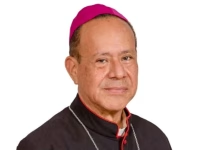
Spain’s bishops responded swiftly and forcefully. Archbishop Luis Argüello, president of the Spanish Episcopal Conference (CEE), condemned the measure as “a constitutional amendment in favor of death,” arguing that the government “could protect the right to life and support motherhood during this demographic winter, but instead uses women as an ideological pretext.”
Argüello’s statement, made public through his social media accounts, mirrors the Church’s broader stance that abortion “can never be a right.” On March 25, during the Day for Life, Spain’s bishops stressed that “there is no right to eliminate a human life,” urging instead a national alliance that protects “the poorest of the poor—the unborn.” For the Church, the reform not only compounds a moral crisis but also symbolizes a country diverging from its historic defense of life and family.
The Coincidence with the Papal Visit
The announcement coincided with the CEE’s presentation of Pope Leo XIV’s upcoming visit to Spain, officially framed under the pastoral motto “Lift up your eyes.” The overlap has intensified what observers call an already polarized moral and political climate. Next June, the Pope will arrive in a Spain roiled by cultural confrontation, where Parliament debates the constitutional status of abortion even as Church leaders denounce it as moral regression.
Sources close to the Vatican have described Spain as an “institutional time bomb,” with Infovaticana warning months ago of a brewing collision between spiritual authority and state politics. The possibility—still unconfirmed—that the Pope might address the Cortes Generales during his trip underscores the delicate balance of his mission. The history of papal diplomacy favors prudence: previous pontificates have avoided visits that could be construed as partisan, even declining trips to polarized nations such as Argentina to preserve neutrality.
A Divided Moral Landscape
For the Sánchez administration, embedding abortion rights in the Constitution reflects a vision of progress and irreversible equality. For the episcopate, it enshrines a profound loss—the legitimization of human death under the banner of liberty. “Where life should be defended, death is legislated; where the family should be supported, its reduction is promoted,” critics say, warning of societal consequences beyond the political horizon.
The convergence of the legislative debate with Leo XIV’s pastoral journey transforms Spain into a microcosm of Western moral tension: between secular rights and sacred values, between self-determination and the defense of life. As the Church prepares to welcome the Pope, many observers believe that what unfolds in these months will define not only the nation’s political agenda but also the tone of its spiritual conscience.
And as moral and political forces gather momentum—inside Parliament, within dioceses, and across public squares—one question looms large: will Spain’s constitutional reform and the Pope’s visit mark a moment of dialogue or deepen the divide between faith and law?
- Raju Hasmukh with files from Infocatholica and INfoVaticana
Related Images: