








Southern African Catholic bishops denounce Donald Trump’s attacks on Pope Leo XIV and condemn an AI image depicting the US president as Christ as blasphemous.
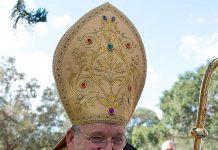
Newsroom (15/04/2026 Gaudium Press ) The escalating confrontation between the Trump White House and the Vatican has drawn an unambiguous response from Southern Africa’s Catholic leadership, who describe recent comments and imagery involving Pope Leo XIV as both deeply troubling and theologically offensive. Speaking in his capacity as President of the Southern African Catholic Bishops’ Conference (SACBC), Cardinal Stephen Brislin, Archbishop of Johannesburg, called US President Donald Trump’s verbal remarks about the pontiff “a cause for great concern,” warning that the integrity of the papacy and the faith itself must not be dragged into the arena of political score‑settling. In a parallel intervention, Bishop Thulani Victor Mbuyisa of Kokstad, who heads the SACBC’s Justice and Peace Commission, condemned an AI‑generated image depicting Trump as Christ as “blasphemous” and part of a broader, dangerous current of Christian nationalism that recasts political leaders as “political messiahs” charged with making nations “great again.”
Rejecting political narratives about the conclave
Cardinal Brislin directly rebutted insinuations that the election of Pope Leo XIV was somehow engineered as a geopolitical maneuver designed to handle the challenges posed by Donald Trump. Trump’s own remarks had suggested that Leo XIV “was elected because he was an American, and they thought that would be the best way to deal with President Donald J Trump,” a framing that effectively casts the conclave as a kind of political consultancy. Brislin, who took part in the papal conclave, insisted that this narrative bears no resemblance to what actually unfolded within the Sistine Chapel.
“One thing I can attest to,” the cardinal said, “is that those of us gathered in the Sistine Chapel did not consider any particular political leader as a factor when we elected the Holy Father.” Far from gaming out responses to specific heads of state, he explained, the cardinals “did not consider the nationality of the future pontiff” at all. Instead, the electors sought, “under the guidance of the Holy Spirit,” the person “best suited to become head of the church, who could best respond to the era we live in, and who would best serve all the peoples of the world.” In Brislin’s telling, the election of Leo XIV was not a tactic but a profoundly spiritual discernment, one of “the most profound and beautiful moments in the life of the Church,” anchored in prayer and universal responsibility rather than in the transient calculations of temporal politics.
Leo XIV’s positions as the Church’s voice, not a personal platform
The Southern African bishops also pushed back against the notion that the Pope’s public interventions—particularly those criticized by Trump—are personal opinions or partisan forays. Cardinal Brislin underscored that Leo XIV “clearly expressed the Church’s position on the main issues affecting the world,” listing among them the treatment of migrants, the climate crisis, the need for truth in an age marked by disinformation and artificial intelligence, and a firm opposition to war and military intervention. For the cardinal, the Pope’s agenda is not an idiosyncratic political program but an articulation of long‑standing Catholic teaching applied to contemporary crises.
“These are not the Pope’s personal positions,” Brislin stressed, making explicit that Leo XIV speaks as the universal shepherd, not as a freelance political actor. “It is the stance of the Catholic Church as a whole that we all represent and defend.” By choosing this language, the archbishop placed the Pope’s disputed statements within the broader continuity of Catholic social doctrine—teaching that defends migrants as bearers of human dignity, regards creation care as an urgent moral duty, insists on truthfulness in public discourse, and treats war as a tragic failure that must be resisted rather than normalized. The message to Trump and his supporters is clear: to attack Leo XIV on these fronts is to collide not only with one man, but with the consensus teaching of the Church he embodies.
AI, blasphemy and the limits of religious imagery
If Trump’s words about Leo XIV disturbed the bishops, the AI‑generated image that followed shocked them. Circulating on social media, the image depicts the US president in the likeness of Christ, effectively merging political branding with the central figure of Christian faith. The SACBC’s Justice and Peace Commission reacted with rare intensity, issuing a note signed by Bishop Mbuyisa that leaves little room for ambiguity.
“Any representation—whether by image or technological means—that attributes to a political leader the identity or likeness of Our Lord Jesus Christ is blasphemous and constitutes a grave offense against the Christian faith,” the statement declares. For Mbuyisa, this is not a question of bad taste or poor judgment; it is a violation that “trivializes the mystery of the Incarnation and the person of Christ, who is the only ‘image of the invisible God’ (Col 1:15).” The bishop connects the novelty of artificial intelligence with an enduring doctrinal boundary: no technological medium, however sophisticated, may legitimately confer divine identity on any human ruler.
“As followers of Christ, we will not allow any earthly authority, however powerful, to claim a divine identity or appropriate the symbols of the faith in a way that obscures the truth of the Gospel,” Mbuyisa insists. The statement thus treats AI not primarily as a technical issue, but as a new vector for idolatry, capable of bending sacred imagery to political ends. In this reading, the scandal of the AI portrait is not just that Trump appears as a Jesus‑like figure, but that such imagery can be rapidly reproduced, shared and instrumentalized, blurring the line between devotion, propaganda and satire in ways that risk dulling believers’ sense of the sacred.
Christian nationalism and the “political messiah”
Beyond the single incident of the AI image, Bishop Mbuyisa situates Trump’s actions within what he calls “a strong current of Christian nationalism.” According to the Justice and Peace Commission, this ideological trend encourages “the worship of political leaders” and portrays them as bearing “a salvific role for their nations,” constructing them as “political messiahs” charged with making their countries “great again.” The language deliberately echoes the slogans of Trump’s own campaign rhetoric, but recasts them as theological distortions.
The bishop “completely rejects the instrumental use of religion for political ends,” warning that such forms of Christian nationalism “distort the Gospel and threaten the integrity of Christian witness in public life.” When believers are invited to see a president as a kind of savior, he argues, allegiance to the Gospel risks being replaced by allegiance to a partisan project. The statement cautions that the appropriation of religious symbols and language can subtly shift the focus from Christ to the leader, from grace to power, and from self‑giving service to nationalistic self‑assertion.
This sweeping critique does not target only one administration, but any movement that conflates divine election with electoral success or reads national prosperity as proof of a leader’s quasi‑messianic vocation. Yet, by naming Trump explicitly, the SACBC makes clear that the American president’s behavior, rhetoric and self‑presentation—culminating in the AI image—are seen as emblematic of this problematic fusion of faith and politics.
Defending the Pope’s ministry amid a “wounded world”
In response to Trump’s attacks on Pope Leo XIV, Bishop Mbuyisa moves from critique to explicit defense of the pontiff’s role. The Justice and Peace Commission, he notes, “condemns President Trump’s attacks directed at Pope Leo XIV as he faithfully carries out his Petrine ministry, proclaiming the peace of the Risen Christ to a world wounded by personal and structural sin.” The wording deliberately evokes both the spiritual authority of the Bishop of Rome and the moral gravity of the crises he seeks to address.
Here, the Petrine ministry is described as “pastoral and prophetic” rather than political, tasked with speaking peace into a landscape marked by war, injustice and economic fragility. The bishops insist that “the ridicule by President Trump will not, therefore, deter the Church from speaking out and declaring the healing and peace of the Risen Lord into our wounded world.” In other words, criticism from even the most powerful political office on earth cannot and must not silence the conscience of the Church.
They then “repeat the message of Pope Leo XIV to President Trump and to all those who are leading the world toward the brink of a third world war and a global economic recession: ‘Enough of the idolatry of self and money. Enough of the display of power. Enough of war. True strength is shown in serving life.’” In that stark refrain, the bishops draw a sharp contrast between the pursuit of dominance and the Christian understanding of strength as service. The appeal is not limited to Washington; it is directed to all leaders whose decisions feed conflict and deepen global inequality.
A broader warning to politics and the pews
Taken together, the interventions of Cardinal Brislin and Bishop Mbuyisa amount to more than a regional protest; they form a pointed theological and political warning addressed to Catholics and non‑Catholics alike. By rejecting Trump’s narrative about Leo XIV’s election, the bishops defend the spiritual independence of the papacy from national politics and insist that the Church’s global mission cannot be reduced to an anti‑ or pro‑Trump posture. By condemning the AI image of Trump as Christ, they draw a doctrinal red line against the appropriation of religious imagery for personal glorification, especially in the age of generative technology.
Their denunciation of Christian nationalism and “political messiahs” challenges not only American culture wars but any context in which political leaders cloak themselves in religious symbolism to shield their policies from scrutiny. The SACBC’s message is that the Gospel cannot be conscripted into a partisan project without being fundamentally distorted. For believers, loyalty to Christ must remain distinct from loyalty to any president, party or nation.
Ultimately, the Southern African bishops’ response underscores a conviction that runs through Catholic tradition: that the Church must “speak truth to power,” even when that power bears the trappings of religious legitimacy. In defending Pope Leo XIV, rejecting political idolatry and calling for an end to the “idolatry of self and money,” they place themselves squarely in that prophetic lineage—insisting that in a time of artificial images and amplified outrage, true strength still lies, as the Pope’s message puts it, in “serving life.”
- Raju Hasmukh with files from Fides News, SACBC
Related Images: