





An example of detachment and humility, Saint Francis shone with poverty of spirit: his heart was free from every attachment, convinced that the scene of this world.
Newsroom (04/10/2025 12:03, Gaudium Press) — In the last gleams of the 12th century, in the bosom of a wealthy family in Assisi, a man sent by God came into the world. His mother, a devout woman named Pica, called him John, unaware that her husband, Peter Bernardone, was away in France on business. When he returned, overjoyed by his son’s birth, he named him Francesco, meaning “the little Frenchman.” And so he became known to history.
A Cheerful and Generous Youth
Francis’s childhood and youth passed in carefree abundance. As the son of rich merchants, he always had money to spare and spent it freely. Cheerful, liberal, and amiable, he was a leader among his companions, beloved for his kindness and courtesy. Though playful, he never used foul language nor offended anyone. His joy was contagious; his generosity, remarkable — he resolved never to refuse a request made “in the name of the Lord.”
This generosity, which excluded any trace of greed, was a sign of God’s predilection preparing him for a higher calling.
The Beginning of Conversion
At the height of his worldly youth, God began to reveal Himself to Francis through two vivid dreams that shook his soul. One day, while singing with friends through the streets of Assisi, he was suddenly overcome by a sweetness so divine that he could neither speak nor move. “Even if I had been cut into pieces,” he later said, “I could not have stirred from that place.”
From then on, his heart began to change. He saw himself as vile and started to despise the things he once loved. Though still not entirely detached, he began seeking only God’s counsel.
“Rebuild My Church”
Passing by the dilapidated church of San Damiano, Francis heard an inner voice urging him to enter and pray. Before the crucifix, he heard the words:
“Francis, do you not see that My house is in ruins? Go and rebuild it.”
He first took this command literally and repaired the small chapel. But in time, he understood that Christ was calling him to a greater restoration — the renewal of the entire Church.
During Mass one day, he heard the Gospel:
“Do not take gold, or silver, or copper in your belts… no bag for the journey, nor two tunics, nor sandals, nor staff” (Mt 10:9–10).
Overwhelmed, he exclaimed: “This is what I want to do with all my heart!”
From that moment, his mission became clear: to live the Gospel in perfect poverty.
Conflict with His Family
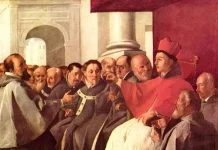
Francis’s radical choice met fierce opposition from his father, who accused him before the bishop of Assisi. Summoned to appear, Francis came, removed all his clothes, and returned them along with his money to his father’s feet, declaring complete freedom from worldly ties.
The astonished bishop, moved to tears, covered the young man with his own mantle — a gesture that symbolized divine protection and Francis’s new spiritual fatherhood.
From then on, Francis was “wedded to Lady Poverty.” He became a living image of Christ and, in the words of one author, “a transformer of the world.”
A Saint Who Transformed His Time
To understand Saint Francis, one must remember that the 13th century was marked by moral decay. Even among clergy, the love of luxury and wealth had replaced sacrifice and holiness. Society, drunk with prosperity, had lost its soul.
Francis embodied the exact opposite. His purity and love for creation inspired his famous Canticle of the Creatures, a “new sermon” to win the world back to divine love.
The Foundation of the Franciscan Order
Soon twelve men joined him, calling themselves the Friars Minor. They lived in utter poverty around the little chapel of the Porziuncola. Guided by divine inspiration, Francis went to Rome to seek papal approval for his Rule.
Pope Innocent III, who had recently dreamed of a small man supporting the crumbling Church, recognized Francis as the man from his vision and blessed his mission.
With papal approval, the Friars went out two by two, preaching the Gospel of simplicity and conversion.
The Birth of the Poor Clares and the Third Order
Among those touched by his preaching was Saint Clare, a noble young woman who embraced his spirit of poverty, founding the female branch of the Order.
Soon, laypeople too desired to live Francis’s ideals — thus was born the Third Order, whose members would include Saint Louis IX of France, Saint Elizabeth of Hungary, and Saint Elizabeth of Portugal.
Trials and the Gift of the Stigmata
Despite his triumphs, Francis suffered betrayal from within. Brother Elias of Cortona usurped leadership of the Order and transformed it into an institution of worldly prestige. Heartbroken, Francis withdrew to solitude.
There, Christ rewarded him with the stigmata, the sacred wounds of His Passion — the highest mystical grace of his life.
The Final Song to Sister Death
Worn out by illness and penance, Francis sensed his end approaching. At 42 years old, he blessed the city of Assisi and asked his brothers to sing to “Sister Death.”
He surrendered his soul to God singing, on October 3, 1226.
(Adapted from Heralds of the Gospel Magazine, no. 207.)
Compiled by Gustavo Kralj
____
1 Cf. A vida de São Francisco de Assis. Nós que convivemos com ele… Assis: Minerva, 2014, pp. 21-22.
2 JOERGENSEN, Johannes. São Francisco de Assis. Petrópolis: Vozes, 1957, p. 111.
3 Cf. A vida de São Francisco de Assis, op. cit., p. 23.
4 Ídem, p. 27.
5 Ídem, p. 28.
6 NIGG, Walter. Francisco, o Irmão Menor. In: Ohomem de Assis. Francisco e seu mundo. Petrópolis: Vozes, 1975, p. 11.
7 Ídem, p. 14.
8 Cf. JOERGENSEN, op. cit., pp. 104-105.
9 NIGG, op. cit., p. 19.
10 CROUZET, Maurice (Dir.). História Geral das civilizações. A Idade Média. 2.ª ed. São Paulo: Difusão Europeia do Livro, 1958, t. III, pp. 151-152.
11 Cf. CORRÊA DE OLIVEIRA, Plinio. Revolução e Contra-Revolução. 5.ª ed. São Paulo: Retornarei, 2002, pp. 26-27.
12 FÉLIX LOPES, Fernando. Opúsculos de São Francisco de Assis. Braga: Editorial Franciscana, 1968, p. 139.
13 JOERGENSEN, op. cit., p. 211.
14 Cf. NIGG, op. cit., pp. 34-35.
15 Ídem, p. 35.
Related Images: