












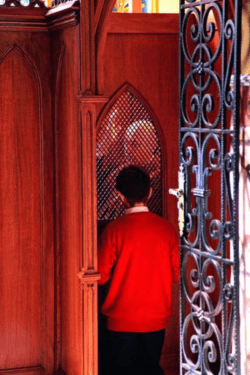
A new Vatican book by Cardinals De Donatis and Piacenza invites the faithful to rediscover the meaning and beauty of confession.
Newsroom (11/03/2026 Gaudium Press) In an age marked by moral confusion and a fading sense of sin, the Apostolic Penitentiary offers an authoritative and pastoral guide to rediscover the spiritual depth of confession. The Sacrament of Reconciliation: Biblical Foundations, Priestly Formation, and Practical Guide, edited by Cardinals Angelo De Donatis and Mauro Piacenza, seeks to help the faithful return to the transformative beauty of divine mercy.
Published by the Vatican Publishing House (108 pages, €6) and enriched with illustrations by José Corvaglia, the compact volume blends sound theology with pastoral insight. Its central question is both ancient and urgent: Why should one still go to confession today?
A Culture Adrift, a Restless Heart
The authors begin with a sober diagnosis of modern humanity. Though our age has achieved remarkable technological and social progress, man often finds himself disoriented, detached from his true dignity and identity. As Saint John Paul II observed, contemporary life is filled with struggles for power and comfort, yet this “adult and free” humanity often flees from real freedom, seeking refuge in conformity and experiencing deep loneliness.
The book recalls the reflection of Saint Maximus the Confessor, who defined philautia—disordered self-love—as the root of all passions. When man turns inward and attempts self-salvation, he loses his desire for God and his sense of direction. The human heart, yearning for freedom, inevitably discovers it cannot find it alone. Scripture speaks plainly: “Whoever does not love remains in death” (1 Jn 3:14). Yet faith responds with hope: “He forgives all your iniquity… surrounds you with kindness and mercy” (Ps 103). The God revealed in Christ is not a stern judge, but a tender Father who lifts the fallen.
Confession as Encounter, Not Moralism
One of the book’s strengths lies in its frank evaluation of why confession has declined. For too long, it was presented mainly as a moral exercise—a way to “become better,” rooted in fear of punishment or a distorted image of God. Such moralism cannot inspire true conversion; it often breeds indifference or rebellion.
The volume proposes instead to recover the sacrament as an experience of encounter—of eyes opened and hearts illumined, a passage “from darkness to light” (Acts 26:18). It is the moment when the sinner does not face an accusation but receives a merciful embrace: “To all who received Him, He gave power to become children of God” (Jn 1:12). Confession, the authors insist, is not a moral duty but a divine meeting—an intimate dialogue where one allows Christ to find and heal them.
Ten Reasons to Recover the Sacrament
The book outlines ten contemporary reasons why confession remains vital, each drawn from Scripture and experience:
-
To pass from death to life. In a world that denies God and eternity, confession restores the path to true life in Christ.
-
To renew the experience of love. Every confession invites humility and grants grace: “God resists the proud but gives grace to the humble.”
-
To gain the certainty of forgiveness. Only sacramental absolution guarantees the cleansing power of Christ’s blood.
-
To discover love in one’s misery. Divine mercy embraces fragility without conditions.
-
To recover one’s identity as a child of God. Forgiveness restores our deepest truth—being loved sons and daughters.
-
To rejoice in renewed communion. Like the prodigal son’s return, reconciliation ends in celebration: “He was dead and lives again.”
-
To heal inner wounds. Sin injures, but grace restores peace and purity of heart.
-
To redeem one’s personal history. Forgiveness does not erase the past; it transfigures it with meaning.
-
To educate the heart. Confession becomes medicine for the soul and training in virtue.
-
To remain in humility before God. It protects from the illusion of self-divinity and keeps the soul grounded in love.
Each motivation resonantly links spiritual theology with lived human experience, illuminating how confession responds to contemporary restlessness with timeless hope.
The Beauty of a New Life
The closing pages echo the words of Saint John Chrysostom: repentance raises the spiritually dead. Reconciliation, the book reminds us, is not a relic of the past but the door to renewed spiritual life. As the Second Vatican Council affirms, through the sacrament of penance, the believer “receives from God’s mercy the forgiveness of offenses and is reconciled with the Church.”
In a world filled with therapists but lacking a sense of the sacred, The Sacrament of Reconciliation reaffirms that no human expertise can replace the Holy Spirit’s healing power. Only divine love, received through confession, can restore broken time and turn sin into salvation.
The book stands as more than a theological summary—it is a spiritual appeal, a pastoral call to return to the source. To confess, even now, is to choose life, rediscovering joy, freedom, and communion in the embrace of a merciful God.
- Raju Hasmukh with files from L’Osservatore Romano (Italian)
Related Images:


