














A centuries-old cry endures: The Good Friday Reproaches, “Popule Meus,” remain among the most haunting elements of the Church’s Passion liturgy.
Newsroom (03/04/2026 Gaudium Press ) Each year, as the solemn hours of Good Friday envelop St. Peter’s Basilica, the ancient words “Popule Meus, quid feci tibi?” — “My people, what have I done to you?” — resound through the air, piercing in both tone and meaning. Known as the Good Friday Reproaches, or the Improperia, these antiphons form one of the oldest and most moving elements of the Church’s Passion liturgy, a profound examination of humanity’s rejection of divine love.
Dating back to the ninth century yet attaining a fixed place in the Roman rite only by the 14th, the Reproaches once held a central role in the Good Friday solemnities. Though they largely faded from many parishes after the reforms of the Second Vatican Council, they have never lost their place at the heart of the Vatican’s observance. In St. Peter’s Basilica, the Sistine Chapel Choir continues to chant the sequence in its full, mournful beauty, carrying the weight of centuries of reverence.
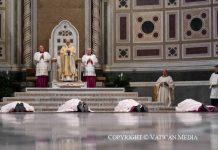
The recitation takes place during one of the most dramatic moments of the liturgy. As the faithful wait in hushed anticipation, the celebrant lifts his voice three times, each time on a higher note: “Ecce lignum crucis” — “Behold the wood of the cross.” With each invocation, the veiled crucifix is gradually uncovered, revealing the instrument of Christ’s death, now venerated as a symbol of salvation.
Once the cross is set before the altar — stripped bare in striking simplicity — the congregation is invited to kneel and venerate it. One by one, the faithful approach to kiss the crucifix, a gesture both personal and universal, echoing the paradox of sorrow and redemption that defines the day.
It is during this adoration that the Improperia begin. Sung alternately by the cantor and choir, the text unravels with heartbreak and elegance. “My people, what have I done to you? How have I offended you? Answer me.” The refrain is followed by reproaches recalling moments of divine deliverance — and humanity’s failure to recognize them. “Because I led thee out of the land of Egypt: thou hast prepared a cross for thy Savior.”
This stark contrast — between grace received and betrayal returned — forms the emotional and theological core of the Good Friday Reproaches. Their haunting melodies and penetrating poetry capture the mystery of a love met with rejection, of a God who saves yet suffers. Each verse turns the ancient narrative into a mirror, inviting reflection not just on historical events, but on the enduring human capacity to turn away from compassion.
Centuries after they first entered the Roman orders, the Reproaches endure as more than ritual. They are a lament, a dialogue between Creator and creation, echoing through generations each Holy Week. And every Good Friday, beneath the towering walls of St. Peter’s, their refrain once again calls out through time: Popule meus — “My people.”
The following is the full text of the reproaches:
Popule meus, quid feci tibi?
Aut in quo contristavi te?
Responde mihi.
(O my people, what have I done to thee?
Or how have I offended you?
Answer me.)
Quia eduxi te de terra Aegypti:
parasti crucem Salvatori tuo.
(Because I led thee out of the land of Egypt:
thou hast prepared a cross for thy Savior.)
Hagios o Theos.
Sanctus Deus.
Hagios Ischyros.
Sanctus fortis.
Hagios Athanatos, eleison himas.
Sanctus immortalis, miserere nobis.
(O holy God!
O holy God!
O holy strong One!
O holy strong One!
O holy and immortal, have mercy upon us.
O holy and immortal, have mercy upon us.)
Quia eduxi te per desertum quadraginta annis:
et manna cibavi te, et introduxi te in terram satis bonam:
parasti crucem Salvatori tuo.
Hagios …
(Because I led thee through the desert for 40 years:
and fed thee with manna, and brought thee into a land exceeding good:
Thou hast prepared a cross for thy Savior.
O holy God! …)
Quid ultra debui facere tibi, et non feci?
Ego quidem plantavi te vineam meam speciosissimam:
et tu facta es mihi nimis amara:
aceto namque sitim meam potasti:
et lancea perforasti latus Salvatori tuo.
Hagios …
(What more ought I to have done for thee, that I have not done?
I planted thee, indeed, my most beautiful vineyard:
and thou hast become exceeding bitter to me:
for in my thirst thou gavest me vinegar to drink:
and with a spear thou hast pierced the side of thy Savior.
O holy God! …)
Ego propter te flagellavi Aegyptum cum primogenitis suis:
et tu me flagellatum tradidisti.
Popule meus …
(For thy sake I scourged the firstborn of Egypt:
Thou hast given me up to be scourged.
O my people …)
Ego te eduxi de Aegypto, demerso Pharone in mare Rubrum:
et tu me tradidisti principibus sacerdotum.
Popule meus …
(I led thee out of Egypt, having drowned Pharaoh in the Red Sea:
and thou hast delivered me to the chief priests.
O my people …)
Ego ante te aperui mare:
et tu aperuisti lancea latus meum.
Popule meus …
(I opened the sea before thee:
and thou hast opened my side with a spear.
O my people …)
Ego ante te praeivi in columna nubis:
et tu me duxisti ad praetorium Pilati.
Popule meus …
(I went before thee in a pillar of cloud:
and thou hast led me to the judgment hall of Pilate.
O my people …)
Ego te pavi manna in desertum:
et tu me cedisti alapis et flagellis.
Popule meus . . .
(I fed thee with manna in the desert:
and thou hast assaulted me with blows and scourges.
O my people …)
Ego te potavi aqua salutis de petra:
et tu me potasti felle et aceto.
Popule meus …
(I gave thee the water of salvation from the rock:
and thou hast given me gall and vinegar to drink.
O my people …)
Ego propter te Chananeorum reges percussi:
et tu percussisti arundine caput meum.
Popule meus . . .
(For thy sake I struck the kings of the Canaanites:
and thou hast struck my head with a reed.
O my people …)
Ego dedi tibi sceptrum regale:
et tu dedisti capiti meo spineam coronam.
Popule meus …
(I gave thee a royal scepter:
and thou hast given a crown of thorns for my head.
O my people …)
Ego te exaltavi magna virtute:
et tu me suspendisti in patibulo crucis.
Popule meus …
(I exalted thee with great strength:
and thou hast hanged me on the gibbet of the cross.
O my people …)
- Raju Hasmukh with files from CNA
Related Images: