














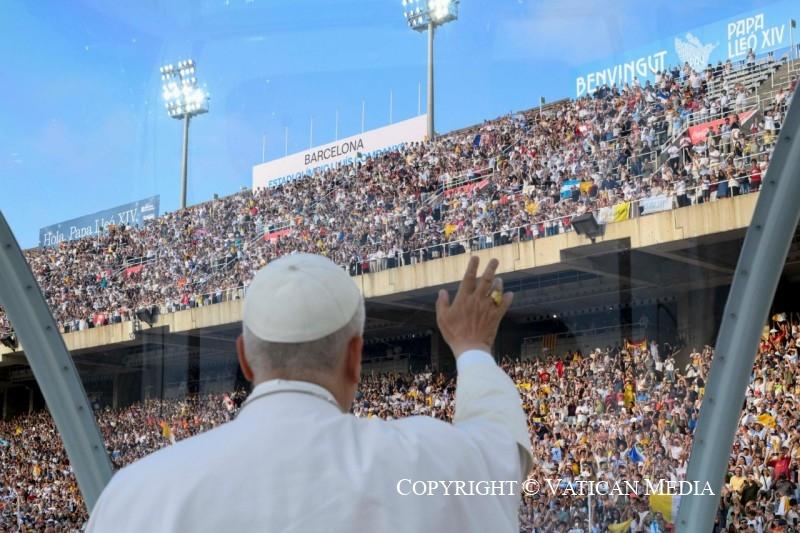
Pope addresses youth in Barcelona, urging faith, inner reflection, and hope amid societal pressure, mental health struggles, and forgiveness.
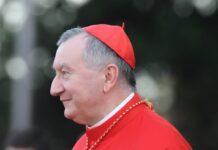
Newsroom (10/06/2026 Gaudium Press ) In a powerful and deeply personal dialogue with young people at the Lluís Companys Olympic Stadium, the Holy Father delivered a message that confronted the pressures of modern life, the reality of mental suffering, and the long, arduous path toward forgiveness. Set during a prayer vigil in Barcelona, the exchange blended testimony and pastoral reflection, offering a vision of faith rooted in “restless searching” and resilience.
A Call to Resist “the Idolatry of Performance”
The evening opened with a question from a newly baptized young person who spoke of growing up in a culture dominated by productivity, success, and self-image—only to find “immense emptiness.” Their question captured a generational dilemma: how to discern purpose and vocation in a society that encourages constant self-focus and relentless achievement.
In response, the Holy Father affirmed what he described as a “healthy sense of restlessness,” framing it not as a weakness but as a divine gift. Human beings, he said, are “made for the infinite,” and therefore no finite success can fully satisfy. This inner longing, rather than being suppressed, should be cultivated.
He sharply criticized what he called the “idolatry of profit and performance,” warning that such values function as “anesthetics” that dull conscience and obscure deeper truths. Instead, he urged young people to carve out spaces for silence, reflection, and engagement with the Gospel—practices that allow individuals to “look within” and discover meaning beyond societal expectations.
Crucially, he stressed that this search must take place within the realities of contemporary life—not outside them. Even in a world marked by injustice and distraction, he said, “the place where God makes himself present… is always in our current reality.”
Confronting Depression and the Silence Around Pain
The vigil took a sobering turn when another participant shared a personal battle with depression, describing it as a “silent illness” that had led to a suicide attempt. Their question—where God can be found in moments of overwhelming darkness—prompted one of the evening’s most poignant responses.
The Holy Father acknowledged the growing mental health crisis in societies that pride themselves on progress, suggesting that such suffering exposes “something deeply wrong” in systems that impose constant pressure and imbalance.
Drawing on the Gospel narrative of Jesus’ suffering, he reframed darkness not as abandonment but as a space where God is profoundly present. In Christ’s agony—culminating in the cry, “My God, my God, why have you forsaken me?”—he said humanity encounters a God who shares in anguish rather than standing apart from it.
He rejected simplistic interpretations that attribute suffering directly to divine will, cautioning against spiritualizing pain in ways that diminish its reality. Instead, he emphasized accompaniment: the need for communities and individuals to support those in distress, even through “a simple prayer” or quiet presence.
“God does not want suffering,” he said, “He carries it with us.”
Forgiveness as a Lifelong Journey
A third testimony, marked by profound trauma, raised questions about forgiveness. The young speaker recounted a childhood shaped by domestic violence, family breakdown, and institutional care, asking how to forgive a father who had nearly destroyed her family—and how to reconcile with God.
The Holy Father responded by first challenging the assumption that God is responsible for human violence. He pointed instead to the failures of society—cultural patterns of abuse, individualism, and disregard for dignity—as the roots of such suffering. Violence, he said, demands human accountability, not divine explanation.
On forgiveness, he offered a nuanced perspective: not a one-time act, but a gradual process marked by patience and struggle. Forgiveness, he explained, does not necessarily imply restoring relationships, especially in cases of abuse. Rather, it involves an inner transformation—moving from resentment toward compassion over time.
“We move forward in small steps,” he said, encouraging continual prayer for the capacity to forgive. This journey, he noted, may last a lifetime, requiring both personal effort and external support.
“Pilgrims in the Night”: A Homily on Faith and Uncertainty
In his homily, the Holy Father returned to the theme of spiritual searching, invoking the Gospel figure of Nicodemus as a symbol of humanity’s quest for truth. “We are pilgrims in the night,” he said, describing life as an ongoing journey marked by partial understanding and unanswered questions.
Rather than portraying darkness as failure, he reframed it as a “place for rebirth”—a moment when illusions fall away, revealing deeper truths about oneself and God. These “nights,” whether personal or societal, create space for renewal and transformation.
He urged the faithful not to judge these periods of uncertainty but to enter them with openness, continuing to ask questions and seek dialogue with God. In doing so, individuals and communities can envision a more just and compassionate society, grounded in dignity and mutual respect.
A Message for a Generation
Throughout the vigil, the Holy Father’s message was consistent: faith is not an escape from reality but an engagement with it, marked by inquiry, struggle, and hope. Whether addressing societal pressure, mental illness, or forgiveness, he emphasized the importance of perseverance and community.
In a world often defined by noise and speed, his call to “look within,” embrace restlessness, and walk together offered a countercultural vision—one that sees even the darkest moments as beginnings rather than ends.
“God does not want anything to be lost,” he concluded, “and even now desires to give us eternal life and lead us to a happiness that has no end.”
- Raju Hasmukh with files from Vatican News
Related Images: