










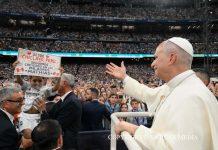
Pope Leo XIV’s visit to Angola’s Muxima Shrine is hailed by Fr. Alberto as a historic moment of grace and hope for national unity and transformation.
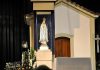
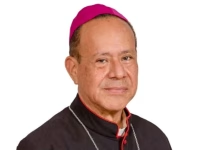
Newsroom (07/04/2026 Gaudium Press) At the heart of Angola’s deep spiritual tradition, the upcoming visit of Pope Leo XIV to the Shrine of Our Lady of the Conception of Muxima is stirring emotions that transcend mere celebration. For the faithful and for the entire nation, the event stands as what Shrine Rector Fr. Mpindi Lubanzadio Alberto has called “a historic moment of grace.”
Speaking on April 5 at the revered Marian shrine in the Diocese of Viana, Fr. Alberto expressed the depth of significance this Papal presence carries. “Since the Shrine’s existence, we have never had the presence of a Pope here,” he told ACI Africa. “It is a historic moment of grace, a moment of deep emotion, with tears in our eyes and gratitude in our hearts.”
A Defining Spiritual Chapter
The papal itinerary outlines Pope Leo XIV’s journey to Angola from April 18–21, with his visit to Muxima scheduled for April 19. There, he is expected to pray with pilgrims, celebrate the Holy Rosary, and entrust Angola to the Blessed Virgin Mary’s intercession. Fr. Alberto described the mood among Angolan Christians as one of “immense joy, honor, and hope,” especially for the thousands of “pilgrims and devotees of Mama Muxima.”
“The Pope is a pilgrim of hope in the house of Mama Muxima,” Fr. Alberto emphasized. “He comes to pray, asking for the intercession of the Mother of God so that what Angola hopes for may come to pass—praying for himself, for the people, and for all humanity.”
The Shrine’s Centuries-Old Legacy
Founded in 1599, the Muxima Shrine has long been a focal point of faith for millions. Fr. Alberto reflected that the visit “will be the first time since the foundation of the Shrine that a Pope visits Muxima. It is a unique moment in the history of the country.”
Preparation at the shrine is intensifying daily. “Muxima is currently experiencing intense days of spiritual and material preparation to welcome with dignity the successor of Saint Peter,” he said. The square where the Holy Father will pray is nearly complete, with facilities, reception areas, and logistical spaces for pilgrims now in advanced stages.
A Message Beyond Celebration
Beyond its grandeur, the priest reminded that the Papal visit is not only an occasion for national pride but also a call for deeper change. “The visit must be understood as a call to concrete transformation of society,” Fr. Alberto said, stressing that the honor of hosting the Pope carries responsibility.
“The message that the Pope will bring—of hope, peace, unity, and reconciliation—must be internalized and translated into concrete actions,” he continued. “Things do not happen automatically; it is we who must live that message.”
Anticipation of Millions
An estimated two million pilgrims are expected to gather for the visit, including participants from neighboring countries. Pope Leo XIV’s journey begins with his arrival in Luanda on April 18, followed by meetings with Angola’s President, civil authorities, and members of civil society. On April 20, he will travel eastward to Saurimo to visit a nursing home and celebrate Mass before returning to Luanda to meet bishops, clergy, and religious workers at Our Lady of Fatima Parish.
“Here come Christians, Muslims, non-believers, sinners, and even those who oppose the Church,” noted Fr. Alberto. “The Mother intercedes for all. Mama Muxima is mother of all.”
Toward a Transformed Angola
As the sacred grounds of Muxima prepare for the arrival of the successor of Saint Peter, the Rector’s words resonate as both challenge and invitation. “We can make our Muxima shine with the Pope’s visit, but the most important thing is the content,” he said. “If inside there is no peace, transformation, and encounter with God, it is useless. People must leave here transformed.”
The Pope’s footsteps in Angola promise more than a symbolic visit—they echo the call to faith renewed in action, to unity forged through hope, and to grace that endures beyond celebration.
- Raju Hasmukh with files from ACI Africa
Related Images: