


















Pope Leo XIV visits elderly home in Saurimo, Angola, urging care, dignity, and listening to elders as guardians of societal wisdom.
Newsroom (20/04/2026 Gaudium Press ) Pope Leo XIV arrived Monday in Saurimo, a city in northeastern Angola, where his first act was not ceremonial grandeur but a quiet, deliberate encounter with some of the nation’s most vulnerable: the elderly.
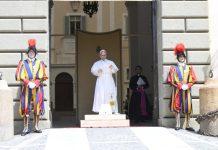
At a local care home known as “lar,” meaning “home,” the pope delivered a message that blended pastoral reflection with a pointed social appeal, urging greater attention to the dignity and voices of older generations. The visit marked one of the first engagements of his third day in Angola and echoed similar gestures he has made both in Castel Gandolfo and earlier during this African journey in Annaba, Algeria.
Greeting residents and staff gathered in the courtyard, Leo XIV expressed gratitude for what he described as a “faith-filled welcome” that “touched my heart” and brought him comfort in his mission. His remarks quickly turned to the meaning embedded in the name of the facility itself.
“It struck me to learn that you call this place ‘lar,’ which means ‘home,’” he said. “I thank God for this, and I hope that all of you are truly able to live here in a family atmosphere as much as possible.”
The home currently shelters 62 elderly residents—26 men and 36 women—many of whom, according to the facility’s director, arrived after experiencing abandonment, mistreatment, or accusations of witchcraft within their families. Built by the Angolan government through the province of Lunda-Sul, the structure serves as a refuge for those pushed to the margins of society.
“This house represents for us a place of salvation,” the director told the pope, describing the vulnerability residents faced before finding shelter there.
The pope’s visit was also a moment of affirmation for the residents themselves. One elderly man spoke openly during the encounter, calling the papal presence “a blessing of God” and a source of renewed hope.
Leo XIV used the occasion to reflect on the spiritual and relational dimensions of community life. Drawing on Christian imagery, he invoked the presence of Jesus not as distant, but as something lived in daily acts of compassion.
“Jesus loved to be at the home of his friends,” he said. “I would like to think that Jesus also lives here, in this home. Yes, he dwells among you whenever you try to love one another and help one another as brothers and sisters.”
He continued by grounding that presence in simple, human gestures: forgiveness after misunderstandings, reconciliation after small offenses, and shared prayer “with simplicity and humility.”
Yet beyond the spiritual encouragement, the pope’s message carried a broader societal critique. In Angola, he noted, the elderly are often relegated to the margins, their needs overlooked and their voices unheard.
“The care of the weakest is a very important sign of the quality of the social life of a nation,” he said. “Let us not forget that the elderly are not only in need of assistance, but first and foremost need to be listened to, because they preserve the wisdom of a people.”
He also emphasized a moral debt owed to older generations, recognizing the hardships they endured for the common good.
Saurimo itself, located roughly 945 kilometers from the capital Luanda in the diamond-rich Lunda region, provided a symbolic backdrop for the visit. Known as Angola’s main center for diamond extraction, the city also reflects stark contrasts between resource wealth and social vulnerability.
Following the visit, the pope was scheduled to continue to an open esplanade in Saurimo to celebrate Mass. The city, established as a diocese by Pope Paul VI in 1975 and later elevated to an archdiocese by Pope Benedict XVI after his 2009 visit to Angola, remains a significant center of Catholic life in the region.
In choosing to begin his day not with ceremony but with the elderly, Pope Leo XIV underscored a consistent theme of his pontificate: that the measure of a society lies in how it treats those most easily forgotten—and how carefully it listens to those who remember the most.
- Raju Hasmukh with files from CNA
Related Images: