












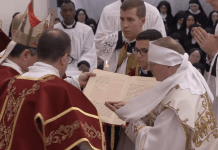
Debate over “alter Christus” reveals a decisive clash on what a priest is: sacramental mediator in Christ, or mere pastoral functionary.
Newsroom (17/02/2026 Gaudium Press ) Some expressions sound technical, almost harmless, yet they conceal true spiritual and ecclesial battles. “Alter Christus” – “another Christ” – is one of them. In Catholic language it designates the priest, above all at the altar and in the confessional, to say something far stronger than simple representation: in the key sacramental moments, the priest does not merely “act in the name of Christ” like a delegated official, but becomes a living instrument through whom Christ Himself works. In that sense, the priest disappears so that Christ may appear.
This understanding is as old as the Church’s consciousness of its sacraments, yet it remains under siege. The latest assault does not come from secular polemicists or militant atheists, but from within Catholic theology: the Italian theologian Andrea Grillo, long viewed as the intellectual architect behind Traditionis Custodes and its restrictive stance toward the Traditional Latin Mass, has published a harsh critique of Pope Leo XIV for having reminded the priests of Madrid that their identity consists precisely in “being alter Christus,” another Christ.
For Grillo, that phrase is intolerable—not because it is false in itself, but because he brands it as a “19th‑century invention,” a remnant of “clericalism” that Vatican II is said to have overcome. Behind what looks like a terminological dispute lies something far more serious: an existential and dogmatic question. What is a priest? And what is his purpose in the Church?
The letter from Leo XIV: a cathedral as catechism
The controversy began with a pastoral letter Pope Leo XIV addressed to the priests of the Archdiocese of Madrid for their presbyteral assembly, CONVIVIUM. It is not a solemn doctrinal constitution, but a personal, imagistic text—precisely the kind where a pope allows his underlying theology to surface with unusual clarity.
Leo XIV begins with a lucid reading of today’s culture. He speaks of advanced secularization, of a public discourse fractured and polarized, and of the collapse of shared moral language that for centuries helped transmit the Gospel. “Words no longer mean the same thing,” he notes, and he adds a challenge: the Gospel today meets not just indifference but “a different cultural horizon” where even the most basic proclamation can no longer be presupposed.
This is not nostalgia but realism. And yet, just when some might expect “new pastoral models” or a redefinition of priestly identity, Leo XIV turns in the opposite direction. “It is not a question of inventing new models or redefining the identity we have received,” he writes, “but of proposing anew, with renewed intensity, the priesthood in its most authentic core, being alter Christus.”
In a climate where many theologians read Vatican II as a mandate to downplay priestly uniqueness, that line landed like a slap. How can a Pope diagnose contemporary change so acutely and then answer with what critics see as “19th‑century theology”? Is this not precisely what the Council allegedly tried to move beyond?
Grillo thought so—and he set out to prove it.
Grillo’s charge: a betrayed Augustine and a distorted Vatican II
In his blog article, Grillo structures his critique like an academic indictment. He begins by noting that Leo XIV often quotes St Augustine, whose famous pastoral motto was: “With you I am a Christian, for you I am a bishop.” For Grillo, Augustine is the key witness, and the case hinges on how his thought is read.
The theologian argues that Augustine never applied “alter Christus” to priests as a distinct class. Rather, he insists, Augustine uses such language broadly of Christians and particularly of the saints. The exclusive application of “alter Christus” to ordained clergy, Grillo claims, is a late‑modern construction arising in the 19th century and popularized by Popes Pius X, Pius XI, Pius XII, with a brief revival under John Paul II and Benedict XVI—a passing theological fashion without ancient roots.
If that thesis holds, Leo XIV would be guilty of a serious distortion: invoking Augustine to defend a doctrine Augustine never taught. Worse, Grillo accuses him of betraying the spirit of Vatican II, which, in his reading, “recovered” the original Augustinian vision of a Church in which all the baptized are equally “alter Christus,” with no “sacralized” distinction between clergy and laity.
To seal his case, Grillo cites Augustine’s commentary on Revelation in The City of God (XX,10): “We consider all the faithful priests because they are members of the one Priest.” From there he draws a sweeping conclusion: a Church in which “alter Christus” refers not to the baptized or the saints but to ordained ministers is a Church conceived as an “unequal society” and “perfect society,” a model he associates with Catholicism between 1870 and 1950. Returning to such “tones and styles,” he says, would be a regression even for the priests of Madrid.
The implication is stark: Leo XIV stands accused of dragging the post‑conciliar Church back into an alleged pre‑conciliar, clericalist mindset—nostalgic, hierarchical, and out of step with a more egalitarian, baptism‑centered ecclesiology.
What Grillo omits: a sacramental architecture
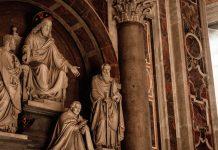
Yet an attentive reading of the papal letter reveals that Grillo’s critique is built on a selective silence. He focuses narrowly on the words “alter Christus,” then passes over the broader catechesis that Leo XIV builds around that phrase—especially the rich metaphor of Madrid’s cathedral, which the Pope uses as a kind of sacramental blueprint for priestly identity.
Leo XIV invites his priests to contemplate the cathedral piece by piece.
He begins with the façade, which “indicates, suggests, invites,” without placing itself at the center. So too the priest: visible, but never protagonist; present, but always pointing beyond himself toward God. He is meant to be the threshold, not the destination.
The threshold itself marks a boundary: “It is not fitting that everything enter the interior, for it is a sacred space.” Here Leo XIV roots the evangelical counsels—celibacy, poverty, obedience—in the priest’s very state of life: “being in the world, but not of the world.” The priest is called to embody that threshold: close to the world, yet clearly oriented to what lies beyond it.
The columns represent the Apostles, the solid foundation of Tradition. The priest does not sculpt his own doctrine; he stands under a weight that precedes and shapes him. Tradition is not raw material for reinvention, but the living structure he must bear and transmit without mutilation.
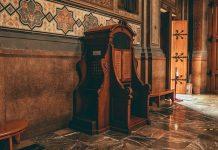
Then the Pope points to the confessional and the baptismal font, “discreet but fundamental” spaces where grace regenerates the People of God. These are not symbolic corners but the very channels through which Christ’s saving work touches concrete lives. The priest’s hands there are not merely expressive hands; they are sacramental hands.
Finally, the altar: “Through your hands, the sacrifice of Christ is made present in the highest action entrusted to human hands.” Here the theology becomes unmistakably sharp. The priest is not presiding over a community’s self‑expression; he is the minister through whom Christ renews His sacrifice, making Calvary sacramentally present.
Behind each image lies a clear, classic Catholic conviction: the priest is not simply a baptized believer with leadership tasks, but one configured to Christ in such a way that Christ Himself acts through him in the sacraments.
Sacramental grace versus functionalism
Leo XIV’s letter contains several doctrinally weighty affirmations that Grillo sidesteps.
First, the Pope writes that in the sacraments “grace is revealed as the most real and effective force of the priestly ministry.” The phrase is not decorative; it encapsulates the Catholic doctrine that the sacrament’s efficacy does not depend on the priest’s charisma, rhetorical skill, or personal holiness, but on Christ’s own action in the rite—what theology calls ex opere operato. Grace comes from the sacrament validly celebrated, not from the minister’s spiritual “authenticity.”
Grillo’s view effectively inverts this. If the priest is nothing more than “a Christian with an organizational role,” the locus of efficacy shifts from sacramental action to human factors: the presider’s pastoral style, the community’s participation, the assembly’s sincerity. The priest becomes primarily a facilitator and symbol, rather than a mediator of divine power.
That shift has explosive consequences. If sacramental efficacy hinges on communal authenticity rather than priestly configuration to Christ, why should the Church reserve Eucharistic presidency to men? Why not entrust it to well‑trained lay leaders or Protestant ministers, provided the community recognizes them? Once the ontological difference of Holy Orders is denied, all that remains is a set of historically contingent policies.
Second, Leo XIV stresses that the priest must remain “anchored in the apostolic witness received and transmitted in the living Tradition of the Church, safeguarded by the Magisterium.” This is not pious rhetoric but a reminder of objective limits. The priest is not a religious entrepreneur crafting doctrine for his local context; he is, as Leo XIV puts it elsewhere, “not the source, but the channel.” He is bound to a deposit of faith he did not create and may not dilute.
By contrast, when Grillo flattens the distinction between ministerial and common priesthood, the priest’s authority becomes essentially functional and delegated by the community. This logic mirrors Protestant ecclesial models, where the pastor’s office derives from the assembly’s call and can be revoked by it, and where no sacramental “character” marks him permanently.
Third, Leo XIV deliberately uses the Thomistic language of “configured to Christ.” He does not say the priest “represents” Christ in some sociological sense or merely “acts in His name”; he speaks of ontological configuration. This is the language of St Thomas Aquinas, who teaches that Holy Orders imparts a sacramental character—a spiritual seal—that configures the priest to Christ the Priest in a way that never disappears, not even in heresy or apostasy.
To reject this configuration is not to nuance a recent fashion; it is to collide with the Council of Trent, with Vatican II, and with the Catechism of the Catholic Church. Faced with that, Grillo opts not to engage the Pope’s Thomistic terms at all. He attacks the historical pedigree of a Latin phrase while leaving untouched the sacramental ontology Leo XIV presupposes.
The result is not only a doctrinal deviation, but a kind of intellectual sleight of hand. The core issues—grace, character, configuration—are left unaddressed.
The “all or nothing” trap: consequences Grillo does not state
There is a deeper unease in Grillo’s article: he never fully owns where his premises lead. His contention that all the baptized are equally “alter Christus” is true in the sense of the common priesthood of the faithful, but he presses it to a point that dissolves the essential distinction between common and ministerial priesthood. Once that distinction is eroded, the traditional shape of Catholic life begins to crumble.
Consider the logical chain.
If the ministerial priesthood is nothing more than an organizational function, a task among others in the community, why mandatory celibacy? A functionary can be married. The special form of life that celibacy represents only makes sense if the priest’s being is set apart for Christ in a unique way—if his very state exists as a sign of that configuration.
Why reserve ordination to men? The traditional answer—that the priest acts in persona Christi capitis (in the person of Christ the Head) and thus bears a male “iconicity”—is only coherent if the priest truly makes Christ present as Bridegroom to the Bride, the Church. If he is merely a coordinator of activities, excluding women becomes indefensible sexism.
Why is ordination irreversible? The Church teaches that Holy Orders imprints an “indelible character”: once a priest, always a priest, even if he leaves ministry or marries. That doctrine makes sense only if something in the soul has been ontologically altered—if the priest has been marked in his very being. If the priesthood is purely functional, it should be as resignable as a job description.
Why seven or more years of seminary? Advanced pastoral training might justify graduate‑level study. But the arduous formation in philosophy, theology, spirituality, and discipline presupposes that a man is being prepared not for a managerial post but for an identity—one that will bind him to the altar and confessional as a sacramental instrument.
Grillo says little about these questions. His system tends toward their dissolution but he rarely follows through explicitly. Yet removing a cornerstone and hoping the building will remain standing is an illusion. Once Holy Orders is reduced to a role, the entire sacramental edifice is destabilized.
Augustine misquoted: the real legacy of Hippo
The irony is sharp. Grillo accuses Leo XIV of misusing Augustine to justify an allegedly modern doctrine. Yet it is Grillo who treats Augustine piecemeal, extracting one thread while leaving the rest of the tapestry out of sight.
Yes, Augustine said “Christian with you, bishop for you,” beautifully emphasizing the shared dignity of baptism. Yes, he spoke of the universal priesthood in eschatological terms and insisted on the grandeur of the baptized state. Yes, in The City of God he can speak of all the faithful as “priests” inasmuch as they belong to the one true High Priest.
But Augustine also, very clearly, teaches about the sacramental character of Holy Orders. In works like Against the Epistle of Parmenian, he defends the permanence of ordination even in heretics. In On Baptism he distinguishes between “character,” which remains, and “grace,” which can be lost through sin. He supports the objective validity of sacraments celebrated by unworthy ministers precisely because it is Christ who acts through them, not their personal holiness.
The passage Grillo cites from The City of God concerns the final, eschatological state, when all the redeemed will share perfectly in Christ’s priesthood. It does not erase the distinction between the common priesthood of the faithful and the ministerial priesthood in the pilgrim Church. Augustine the bishop lived and taught within a Church that clearly distinguished bishops and presbyters from the laity, even as he stressed their shared baptismal dignity.
Vatican II, far from abolishing that distinction, canonized it in precise language. Lumen Gentium 10, drawing from the long tradition, teaches that the common priesthood and the ministerial priesthood “differ essentially and not only in degree.” “Essentially” here does not mean “sociologically,” but ontologically: their very nature differs, even as they are ordered to each other and rooted in the one priesthood of Christ.
Presbyterorum Ordinis reinforces the point, describing ordained priests as “configured to Christ the Priest” through a special sacramental character. Rather than a 19th‑century novelty, Leo XIV’s teaching echoes Trent, Vatican II, and what can be found in germ in Augustine’s own defense of sacramental objectivity.
The Magisterium does not invent; it receives, clarifies, and proposes. Leo XIV, in plain pastoral prose, is simply reiterating what the Church has always believed about who the priest is.
Beyond theory: how ecclesiology shapes parish life
All this might sound like an intramural argument among theologians, but the stakes are intensely practical. The way we answer “What is a priest?” determines what we encounter every Sunday.
If Grillo’s flattened ecclesiology prevails, the Mass becomes primarily a “community memorial,” an assembly celebrating its faith under the leadership of a presider. The emphasis naturally shifts toward horizontality: participation, expression, communal authenticity. Language about “sacrifice” recedes; language about “banquet” dominates. The priest is important, but replaceable—one facilitator among others.
Confession, in such a model, drifts from a judicial‑sacramental encounter with Christ’s authority toward a form of spiritual counseling or “accompaniment.” Absolution risks becoming a ritualized form of encouragement, and the sharp contours of sin, repentance, and pardon blur. From there, relaxing sacramental discipline—such as admitting those in irregular unions to Communion without prior conversion—appears as a logical extension.
Celibacy, stripped of its sacramental reference, becomes an arbitrary discipline, a relic of another era. Once the priest is no longer seen as “taken” by Christ in an ontological sense, his total self‑gift loses its inner logic. The pressure to align priestly life with secular expectations intensifies.
Above all, the push for women’s ordination becomes almost irresistible. If priesthood is a function and not a sacramental configuration, if there is no irreducible symbol of Christ the Bridegroom in the male priest, then restricting ordination to men seems an unjustifiable discrimination. The only consistent way to maintain the Church’s current teaching is to maintain the sacramental ontology that supports it.
If, on the other hand, Leo XIV is right—and in continuity with the Church’s teaching, he is—then what the faithful find at Mass is nothing less than the re‑presentation of Calvary. The priest truly “disappears” so that Christ may act through him: to offer sacrifice, to forgive sins, to feed souls with His own Body and Blood. Grace does not depend on the community’s emotional temperature or the priest’s rhetorical brilliance, but on Christ’s fidelity.
This is not an excuse for liturgical sloppiness or clerical arrogance; it is the very opposite. The more the priest understands that he is an “alter Christus,” the more he realizes that the liturgy is not his property and that the people he serves do not belong to him. He is a steward of mysteries, not an impresario of religious experiences.
The deeper choice: human Church or divine Church?
At bottom, the clash between Grillo and Leo XIV crystallizes a wider battle that has shaped post‑conciliar Catholicism. On one side stand those who interpret Vatican II as a rupture—a moment when the Church allegedly left behind hierarchical and sacramental categories in favor of democratic, egalitarian, historically fluid models of ministry. On the other side stand those who see the Council as a reform in continuity, a deepening of tradition rather than its abandonment.
The language of “alter Christus” stands at the crossing‑point of these paths. To affirm it is to affirm that the Church’s sacramental structure is not a historical accident but a divine gift; that the priesthood is not a temporary solution to organizational needs, but a permanent feature of Christ’s will for His Church. To deny or relativize it is to set the Church on a trajectory where structures can be endlessly reshaped to fit cultural expectations.
Leo XIV has chosen his side, quietly but firmly. His letter to the priests of Madrid is written in the style of spiritual meditation, yet it is, in substance, a compact treatise on ecclesiology and sacramental theology. He does not name his critics, but every page implicitly answers them by calmly restating what a priest is: configured to Christ, channel of grace, guardian of the threshold between the profane and the sacred.
Grillo has also chosen his side, though with greater caution in spelling out its consequences. By undermining the ontological distinctiveness of the ministerial priesthood, he prepares the ground for a future Church where priestly life, sacramental discipline, and doctrine are reshaped to conform to modern sensibilities.
Every Catholic, knowingly or not, participates in this choice. Each time we enter a church, each time we kneel at the confessional, each time we receive the Eucharist from the hands of a priest, we answer in practice the question: is this man “another Christ,” or merely “a Christian with a pastoral role”?
What is at stake is not a Latin expression but the very face of the Church our children will inherit—and, more intimately still, what we ourselves meet when we come before the altar: a community celebrating its own faith, or Christ Himself, acting through fragile human hands to save a world that cannot save itself.
For that reason, it is fitting to echo the gratitude expressed by José Francisco Serrano: gratitude for a Pope who, amid confusion and polemic, has had the courage and humility to write a letter that recalls priests to the heart of their identity. In reminding them that they are called to be “alter Christus,” Leo XIV is not returning to a bygone era; he is simply pointing once more to the Church’s enduring center: Christ the High Priest, who continues to act through His ministers until the end of time.
- Raju Hasmukh with files from Infocatholica
Related Images: