





Former St. Stephen’s House principal Canon Robin Ward joins the Catholic Church, marking a major moment in Anglican‑Catholic relations.
Newsroom (20/02/2026 Gaudium Press ) After nearly four decades of theological exploration and quiet discernment within the Church of England, Canon Robin Ward — one of its most prominent theologians and educators — has entered into full communion with the Catholic Church.
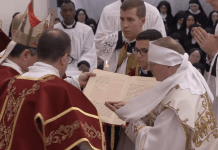
Ward, 60, until recently principal of St. Stephen’s House, Oxford, made public on February 14 that he had been received into the Catholic Church at St. Michael’s Benedictine Abbey in Farnborough. The reception was conducted by Dom Cuthbert Brogan, the abbey’s abbot. Writing of the moment in Latin, Ward reflected on its sacramental finality: “With nine words, I received the seal of the Holy Spirit… and the seal to complete a journey I began some 40 years ago in the city of Oxford.”
A Scholar Formed by Faith and Tradition
An Oxford-trained scholar and priest, Ward studied medieval English at Magdalen College before preparing for ordination at St. Stephen’s House between 1988 and 1991. He later completed his doctorate at King’s College London on The Schism at Antioch in the Fourth Century, developing an expertise in patristics and early Church history that shaped his subsequent teaching and writing on Anglican identity, liturgy, and historical theology.
Married with two children, Ward balanced his academic life with pastoral service. Ordained in 1992, he served in parishes as curate, vicar, and chaplain before being appointed honorary canon of Rochester Cathedral in 2004. Two years later, he became principal of St. Stephen’s House — known affectionately as “Staggers” — and served there for nearly two decades.
Gavin Ashenden, himself a former Anglican chaplain to the Queen who entered the Catholic Church in 2019, described Ward as a “deeply rooted Anglo-Catholic theologian,” whose move to Rome carries “particular poignancy.” His career, Ashenden said, intertwined Oxford’s intellectual rigor with the pastoral and liturgical life of Anglo-Catholicism.
St. Stephen’s House and the Oxford Heritage
Founded in 1876, St. Stephen’s House occupies a unique place in Anglican history as the last theological college associated with the 19th‑century Oxford Movement — the Tractarian revival that sought to restore Catholic thought and practice within Anglicanism. That same movement brought forth one of England’s most notable converts, St. John Henry Newman, to whom Ward would later turn for inspiration and guidance.
Raised in what he called “low-church Anglicanism — liturgical without ceremony, sacramental yet Protestant,” Ward’s encounter with the Anglo‑Catholic tradition at Oxford initiated a lifelong reflection on the nature of the Church. He described the movement as a “fusion of theology and romantic ritualism” that seemed both “marginal and magnetic.”
Over time, however, Ward perceived troubling changes in Anglican ecclesiology and formation. “To run a seminary,” he wrote, “is to propose to students three questions: Who is Jesus Christ? What is a priest? What is the church? The answers to that last question were becoming less and less satisfactory — to me, and to my students.”
The Presence of Oxford’s Catholic Life
Ward noted that his decision was influenced by his long proximity to Oxford’s Catholic communities — the Dominicans at Blackfriars, Jesuits at Campion Hall, and Oratorians of St. Aloysius. These encounters, he said, revealed a “charity and energy” that deepened his understanding of what it means to live a fully sacramental Christian life.
The figure of John Henry Newman, canonized in 2019, loomed large in Ward’s journey. He described the 19th‑century theologian as now rightly honored “as a teacher of our age, as Augustine was for antiquity and Aquinas for the Middle Ages.” Ward adopted Newman’s name at his confirmation, acknowledging in him both an intellectual guide and a spiritual companion.
Citing Newman’s beloved hymn Lead, Kindly Light, Ward concluded: “I now need to learn how to live within the household and to trust in God’s providence for the work and vocation he intends for me: ‘One step enough for me.’”
A Wider Pattern of Conversions
Ward’s reception into the Church adds to a growing list of high‑profile Anglican converts in recent years. Since 2019, several bishops — including Michael Nazir‑Ali, Jonathan Goodall, John Goddard, Peter Forster, Richard Pain, and John Ford — have entered into Roman communion. Since the early 1990s, an estimated 700 Anglican clergy and religious in Britain have made the same move.
Parallel to clergy conversions, lay interest in Catholicism also appears to be rising. The Oxford Oratory at St. Aloysius, a parish central to Ward’s own experience, recently reported receiving more converts in the first months of 2026 than throughout all of last year. According to The Catholic Herald, the Oratory’s confessional and Mass attendance have flourished, with priests hearing over 1,200 confessions monthly and offering the liturgy in both the ordinary and extraordinary forms.
The Last Generation of Anglo‑Catholics?
Ashenden suggested that Ward’s conversion carries a symbolic weight beyond personal conviction. “He represents the last generation of Anglo‑Catholics surviving within the progressive transformation of Anglicanism,” he observed, noting that the modern Church of England has grown increasingly distant from its Catholic heritage.
Ward’s move, he said, may be read as an “unmistakable signal” that those seeking a Catholic identity and continuity may find their spiritual home only in communion with Rome. For Ward himself, the step marks not a rupture but a completion — a resolution of long fidelity to a vision first kindled in Oxford’s lecture halls and chapels, and now fulfilled in the Catholic faith he has come to embrace.
- Raju Hasmukh with files from NCRegister
Related Images: