


For years, the Catholic Church has stood as a spiritual and moral refuge for Nicaraguans, a beacon of hope in a nation gripped by authoritarian control.
Newsroom (09/10/2025, Gaudium Press ) In the quiet sanctuaries of Nicaragua’s Catholic churches, a heavy silence prevails—not one of reverence or contemplation, but one born of fear, surveillance, and unrelenting persecution. For years, the Catholic Church has stood as a spiritual and moral refuge for Nicaraguans, a beacon of hope in a nation gripped by authoritarian control. Yet, under the regime of Daniel Ortega and Rosario Murillo, this sacred institution faces an existential threat: priests exiled, churches monitored, processions banned, and religious voices silenced. Despite these assaults, the Church endures as a symbol of resistance, its faithful clinging to the Gospel and the promise of a brighter future.
A Church Under Siege
On Sunday, October 5, 2025, Managua’s Metropolitan Cathedral hosted its weekly Mass, where Cardinal Leopoldo Brenes, the archbishop of the capital and the highest-ranking Catholic figure in Nicaragua, delivered a sermon imbued with both defiance and hope. “This is not a Church to be confined; this is an outgoing Church, a missionary Church, where we are called to proclaim the person of Jesus in the world,” he declared, invoking the spirit of the late Pope Francis. His words, spoken in the face of relentless state oppression, underscored the Church’s enduring mission to serve as a moral compass, even as its freedoms are curtailed.
The Catholic Church in Nicaragua has been systematically targeted since 2018, when widespread protests against Ortega’s regime were met with brutal repression. According to a September 2025 report by the Nicaragua Nunca Más Collective, 261 religious figures—bishops, priests, and nuns—have been expelled or forced into exile since the unrest began. Among them are prominent leaders like Monsignor Rolando Álvarez, the Bishop of Matagalpa and Apostolic Administrator of Estelí, whose imprisonment and subsequent exile to Rome in 2024 made him a global symbol of faith and resistance. Other notable exiles include Bishops Carlos Herrera, Isidoro Mora, and Silvio Báez, whose departures have left spiritual voids in their dioceses.
The regime’s campaign against the Church extends beyond expulsions. Catholic universities have been confiscated, religious congregations dissolved, and 16,564 religious processions and activities banned between 2019 and 2025, according to researcher Martha Patricia Molina’s August 2025 report, Nicaragua: A Persecuted Church. Temples are under constant surveillance, with priests required to report their movements and activities to authorities. “There’s surveillance everywhere,” a priest from northern Nicaragua, speaking anonymously for fear of reprisals, told this reporter. “We have to report where we go, who we meet, and what we do. It’s a challenge, but we take these difficult times as a source of hope.”
Voices of the Faithful
For ordinary Nicaraguans, the Church remains a lifeline to faith and community, even as its structures crumble under state pressure. “Margarita,” a 62-year-old parishioner at Managua’s Metropolitan Cathedral, spoke wistfully of the Church’s vibrant past. “This is my life; it’s where I grew up, served, and where I will die,” she said, gazing at the Christ figure in the cathedral’s nave. “It pains me to see the Church wounded, with so many limitations. I remember when we went to nearby neighborhoods for missionary work, held vigils, and shared without fear. Now, so much has been taken from us.”
Margarita’s memories are filled with the voices of exiled priests and nuns who once animated her community. She recalls the work of nuns in Granada and Masaya, organizing activities that strengthened local faith. Above all, she misses Monsignor Álvarez, whose courage in denouncing human rights abuses made him a beloved figure. “I long for God to grant me more years to see a strong Church again,” she said, her voice tinged with both sorrow and resolve.
In the rural mountains of Matagalpa, another voice echoes this sentiment. Don “Eusebio,” a minister of communion, carries a worn Bible gifted to him by Álvarez. Every Sunday, he leads prayers in his village’s empty chapel, a space once filled with the bishop’s presence. “Before, Monsignor Rolando would come with his little backpack, so close to everyone here,” Eusebio recalled. “Even when it rained, he would hear our confessions, give us communion, and speak of hope. Now, priests rarely come, but we pray for him and the entire Church. It hurts to know he was expelled, but we cannot let the Church die out.”
A Symbol of Resistance
Monsignor Rolando Álvarez’s story encapsulates the Church’s struggle in Nicaragua. A vocal critic of the Ortega regime, Álvarez was imprisoned for over 100 days before his exile in 2024. His sermons, often delivered in remote communities, emphasized the Church’s role in serving the marginalized—those he called “Jesus’ privileged ones.” In a January 2022 homily, he praised catechists who crossed rivers by boat to bring the Gospel to isolated villages, embodying the Church’s missionary spirit. “The poor are the widows, the orphans, the children on the streets, the women exploited in their sexual lives… they are treated as disposable, as second-class,” he said. “We must give priority to these poor people.”
Álvarez’s exile has left the Diocese of Matagalpa, one of the hardest-hit by persecution, in disarray. Rural parishes, once vibrant with priestly visits, now rely on lay ministers like Eusebio to sustain their faith. “Without priests, there is no Mass, no confession, no baptisms,” Eusebio said. “But God has not gone. The men who guided us have gone, but the faith is still here, among us.”
A Silent Repression
Martha Patricia Molina’s Nicaragua: A Persecuted Church paints a grim picture of the regime’s tactics. From April 2018 to July 2025, the report documented 1,010 attacks on the Church, including 362 direct repressions against religious figures, 244 attacks on temples, 103 robberies and desecrations, and 36 confiscations. The closure of 13 Catholic universities, 24 media outlets, and 75 non-profit organizations has further eroded the Church’s institutional presence. Yet, Molina notes a troubling shift in 2025: a decline in reported attacks, from 321 in 2023 to 32 in the first half of 2025. “This doesn’t mean the repression has stopped,” she warned. “Religious people remain silent for fear of reprisals against their families.”
The absence of independent media in Nicaragua has compounded this silence, making it harder to document abuses. Priests, aware of the consequences of defiance, adhere strictly to state-imposed restrictions. “No one steps out of line,” Molina said. “The dictatorship isn’t playing around. Surveillance is extreme, and there’s no human rights organization left to complain to.”
Despite these challenges, Molina remains defiant. “The dictatorship wants total control over the Catholic Church, but it hasn’t achieved it and won’t,” she asserted. “The Church is in communion with the Gospel and the Pope, not with the dictatorship.”
Resilience Through Faith
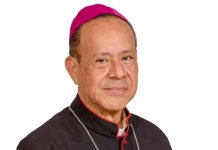
Across the border in Honduras, Monsignor José Antonio Canales, bishop of the Diocese of Danlí, offered a broader perspective on the crisis. “This is not the first time in twenty centuries that a church has been hit by a storm like this,” he said in an interview with 100% Noticias. “The history of the Church is plagued by violence, repression, and expulsions. What the Church of Nicaragua is experiencing is extremely painful, but history shows that faith communities find ways to survive and grow stronger.”
Canales pointed to the resilience of Nicaragua’s Catholics, who continue to pray and gather despite the absence of priests. “The Church in persecuted places has always found a thousand ways to move forward,” he said. For Molina, this resilience is evident in the faithful who remain united in prayer. “The Church has not weakened,” she insisted. “This persecution has strengthened Catholics, who are praying constantly in the face of adversity.”
Cardinal Leopoldo Brenes, navigating the delicate balance of leading the Church under a repressive regime, embodies this resilience. While some bishops enjoy limited leeway, Molina noted that such freedoms come at a high cost. “Each action they can afford is due to the price they have to pay,” she said, hinting at the compromises required to operate under Ortega’s watchful eye.
A Light in the Darkness
As Nicaragua’s Catholic Church faces its darkest hour, its faithful hold fast to the belief that faith will prevail. In Managua’s cathedral, Margarita prays for the return of her exiled priest friends. In Matagalpa’s mountains, Eusebio leads his community in prayer, clutching a Bible that carries the memory of Monsignor Álvarez. Across the country, priests and laypeople alike find hope in the face of persecution, seeing their trials as a call to deepen their faith.
“The Church in Nicaragua will shine,” Monsignor Canales declared. “The history of the universal Church shows that faith endures, even in the face of the greatest storms.” For now, Nicaragua’s Catholics carry on, their voices muted but their spirits unbroken, trusting that their Church—wounded but resolute—will emerge stronger from this crucible of persecution.
- Raju Hasmukh with files from 100% Noticias
Related Images: