

Pope Leo XIV receives alarming report on Nicaragua’s Catholic Church persecution: 16,500+ banned processions, 1,000+ attacks by Ortega-Murillo regime. Exiled voices urge global outcry.
Newsroom (06/10/2025, Gaudium Press ) Pope Leo XIV has been briefed on the intensifying crackdown against the Catholic Church in Nicaragua, receiving a comprehensive report that documents thousands of suppressed religious processions and over 1,000 documented attacks by the government of President Daniel Ortega and Vice President Rosario Murillo.
The report, titled Nicaragua: A Persecuted Church and authored by Nicaraguan researcher Martha Patricia Molina, was hand-delivered to the pontiff on Oct. 2 during a Vatican audience with participants in a conference on migrants and refugees. Nicaraguan-born activist Muriel Sáenz, who fled the country in the 1980s and now aids immigrants in the United States, presented the document on Molina’s behalf.
Molina, speaking to ACI Prensa — the Spanish-language news partner of Catholic News Agency — expressed gratitude for the delivery. “I am happy to know that my friend Muriel Sáenz has personally delivered to Pope Leo XIV the study ‘Nicaragua: A Persecuted Church,’ which is an expression of the Catholic Church and the Nicaraguan people that reflects the persecution of bishops, priests, and laypeople by the Sandinista dictatorship,” she said.
The repression, Molina emphasized, persists unabated. “The repression continues daily, and it is important that the Holy See knows that everything is being documented,” she added. In a separate letter to the pope, Molina affirmed the Nicaraguan Church’s steadfast loyalty: “The Catholic Church in Nicaragua is in total communion with the pope and united in prayer despite the adversity and repression.”
Sáenz, founder of Nicaraguans in the World Texas, Inc. — a nonprofit assisting asylum seekers in U.S. immigration courts — accompanied the report with personal letters from dictatorship victims, including priests, and a gift of Nicaraguan coffee. She urged the pope to amplify international awareness of the crisis.
“I hope the pope continues his support in the global denunciation [of the dictatorship], since remaining silent only allows criminals to continue causing more and more harm,” Sáenz told ACI Prensa. “My intention is also for the world to learn about what is happening in Nicaragua, where the criminals who make people call them president and co-president have an entire country — which has no weapons to defend itself — in their hands.”
She described the regime’s tactics as ruthless: “If one does not obey their absurd demands, one is shamelessly imprisoned in inhumane conditions, enduring degrading treatment and torture. Priests and laypeople are not exempt from such treatment. I am sure that if we manage to force [the regime] to leave, the more than 1 million Nicaraguans scattered around the world would return tomorrow.”
The report’s seventh edition, released Aug. 27, catalogs the prohibition of more than 16,500 religious processions and acts of piety since the Ortega-Murillo administration began tightening controls. Molina noted that bans on such events have escalated since 2022, applied nationwide on an annual basis. However, the documented figure likely understates the scale, as it excludes smaller parish churches and chapels — numbering around 400 in Managua alone. “So the figure presented in the study could be at least three or four times higher than what is being recorded,” she explained.
This year’s assaults on the Church have already reached 32, according to Molina, with the true tally potentially far greater amid heightened government surveillance. In an interview with EWTN News’ Spanish-language edition, she detailed the regime’s invasive monitoring: “There is constant surveillance of priests and bishops. Some of them are even followed 24 hours a day.” Clergy gatherings, she added, are routinely infiltrated by police, who photograph and film attendees.
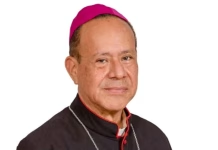
Pope Leo XIV’s engagement with Nicaraguan Church leaders underscores Vatican concern. On Aug. 23, he met with three bishops: exiled Auxiliary Bishop Silvio Báez of Managua, whose appointment the pope reaffirmed; Bishop Isidoro Mora of Siuna; and Bishop Carlos Herrera, president of the Nicaraguan Episcopal Conference, who is in exile in Guatemala.
Báez, now based in the United States, recounted the encounter as affirming. “He encouraged me to continue my episcopal ministry and confirmed me as auxiliary bishop of Managua. I sincerely thank him for his fraternal welcome and his encouraging words,” he said.
The Ortega-Murillo government, rooted in the leftist Sandinista movement, has faced international condemnation for its handling of dissent since mass protests erupted in 2018. Critics, including human rights groups, accuse the regime of authoritarian overreach, including the exile or imprisonment of dozens of clergy and the shuttering of Catholic media outlets. Nicaraguan officials have dismissed such claims as foreign interference, maintaining that restrictions target threats to national security.
- Raju Hasmukh with files from CNA
Related Images: