






Pope Leo XIV moves Archbishop Edgar Peña Parra from Vatican power to Rome’s diplomatic sidelines — exile, probation, or quiet promotion?
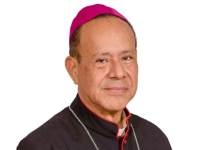
Newsroom (31/03/2026 Gaudium Press ) In a move that reshapes the upper reaches of Vatican power, Pope Leo XIV has transferred Archbishop Edgar Peña Parra—one of the most influential and, at times, controversial figures of the Francis era—from his post as sostituto of the Secretariat of State to become apostolic nuncio to Italy and San Marino. The appointment, announced Monday, marks one of the pope’s most significant personnel decisions since assuming office and signals both continuity and quiet reform in the curia’s turbulent landscape.
For eight years, Peña Parra served as the sostituto, effectively the papal chief of staff, managing the day-to-day operations of the Holy See’s most powerful department. He succeeded Archbishop (later Cardinal) Angelo Becciu in 2018, stepping straight into the chaos of the Vatican’s London property scandal and, later, the challenge of restructuring the curia under Pope Francis’ 2021 apostolic constitution.
Though discreet in manner, Peña Parra became a central player in the inner workings of Francis’ papacy. Trusted by the late pontiff, he wielded influence well beyond his official mandate — and sometimes outside canonical or legal lines.
A Career Marked by Controversy
His tenure, shadowed by scandal and improvisation, became a study in both loyalty and excess. The Venezuelan-born archbishop inherited a Secretariat mired in questionable investments and opaque accounting, and set out to impose order. But his methods — notably short-circuiting oversight and attempting to wall off the Secretariat from its own financial managers — backfired. The result was a financial loss in the hundreds of millions and prolonged embarrassment for Pope Francis.
Later court proceedings revealed even more troubling behavior. Peña Parra admitted ordering illegal surveillance of Vatican banking officials and employing members of Italy’s intelligence community in what prosecutors described as “extra-legal” operations. The most shocking incident came in 2024, when he attempted to reverse the laicization of an Argentine priest convicted of sexually abusing minors—an unprecedented act for an official with no jurisdiction over such cases. The intervention was swiftly nullified by Archbishop John Kennedy of the Dicastery for the Doctrine of the Faith.
In Rome, many wondered not why Peña Parra was reassigned, but why he remained in power so long.
A Move Meant to Solve Two Problems
By late 2024, three assumptions had crystallized among curial insiders. First, Peña Parra’s time as sostituto had simply run its course. Second, his controversies precluded any further Vatican promotion. Third, Pope Francis—whose reliance on him was an open secret—still valued his loyalty too much to cut him loose entirely.
Thus emerged a delicate solution: transfer him to a prestigious but politically neutral role. A nunciature, especially one close to Rome, offered the right balance of dignity and distance. Several postings were rumored—Madrid, Lisbon, Washington—but ultimately it was Italy, the Holy See’s most symbolically charged diplomatic station, that was chosen.
Prestige Without Power
At first glance, the position of apostolic nuncio to Italy carries tremendous status. It is a top-tier diplomatic assignment, placing Peña Parra literally across the street from Vatican City. Yet it is also uniquely limited. The pope personally oversees Italian ecclesiastical appointments and state relations, often leaving the nuncio with little real role beyond ceremony and consultation.
Pope Leo XIV, known for his emphasis on procedural rigor and canonical discipline, may see this as the perfect holding pattern: an honorable exile that keeps a complex legacy contained within the confines of Rome.
Still, the post is no mere sinecure. The nuncio remains an ambassador, intermediary, and recruiter of bishops. How Peña Parra interprets and exercises that authority will reveal whether he intends to fade quietly into diplomatic routine—or use his new base to rehabilitate his standing.
Between the Tiber and the Tightrope
Peña Parra’s future now lies at the intersection of discretion and ambition. At 66, he has roughly a decade before retirement. A five-year term successfully served could open the door to redemptive promotion, potentially even the red hat that tradition once reserved for his office. A misstep or early departure, by contrast, would end a once-meteoric career in muted disgrace.
His new post also keeps him geographically—and politically—close to the Vatican. Whether he stays across the Tiber or occasionally wades back into the currents of Vatican intrigue will depend on his appetite for risk and his ability to adapt to a new era of papal governance.
In the end, Archbishop Peña Parra’s transfer is less a punishment than a pause — a curial compromise between justice, mercy, and memory. Whether it becomes an ending or a strategic intermission may depend not on Pope Leo XIV’s intentions, but on how quietly Peña Parra learns to live in the shadow of power he once held.
- Raju Hasmuk with files from The Pillar
Related Images: