










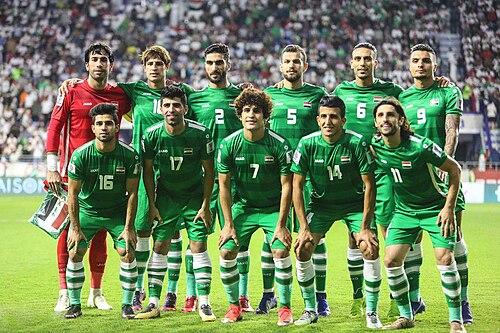
Iraq’s 2026 World Cup squad highlights rare religious diversity, with four Christian players symbolizing unity, diaspora ties, and national pride.
Newsroom (10/06/2026 Gaudium Press ) As national teams gather across the United States, Canada, and Mexico ahead of the 2026 FIFA World Cup, Iraq’s squad has quickly drawn international attention—both for an unusual airport incident and for a deeper story about identity, diversity, and national unity.
Two members of the Iraqi delegation—a player and the team’s photographer—were detained and questioned for several hours upon arrival at Chicago’s airport before eventually being released. While the incident briefly made headlines, it is another aspect of the team that is generating lasting discussion: the composition of the squad itself.
Among Iraq’s 26 players are four Christians, representing roughly 15% of the roster. This is striking in a country where Christians today constitute less than 1% of the population, following decades of migration and upheaval. Their presence underscores not only the reach of Iraq’s diaspora but also the enduring influence of minority communities in the nation’s sporting life.
A Diaspora-Driven Squad
The four Christian players reflect a broader trend in Iraqi football: the reliance on talent developed abroad.
Midfielder Aimar Sher, born in Iraq, moved with his family to Sweden at the age of four. Now playing in Sweden’s domestic league, Sher carries a name inspired by Argentine legend Pablo Aimar, highlighting the global influences shaping modern footballers.
Rebin Sulaka, a central defender, was born in Ankawa—a predominantly Christian suburb in Erbil, Iraqi Kurdistan—before relocating to Sweden at age 10. He currently plays professionally in Thailand, another example of the geographical spread of Iraqi talent.
Kevin Yakob, also a midfielder, represents the next generation of diaspora players. Born in Sweden, he developed his game at Assyriska BK in Gothenburg—a club tied to the Assyrian/Syriac community—before advancing to Sweden’s top tier and later moving to Denmark.
Frans Putros, a defender born in Denmark to Iraqi Christian parents, currently plays in Indonesia. His career trajectory illustrates how Iraqi heritage players are contributing to the national team from leagues worldwide.
Together, these players reflect long-standing migration patterns, particularly to Sweden, which has become a hub for Middle Eastern Christian communities. Clubs such as Assyriska and Syrianska have historically provided both cultural identity and footballing pathways for these populations.
Representation and Symbolism
The significance of Christian representation in the squad extends beyond statistics. For many Iraqi Christians—both within the country and in diaspora communities—it carries emotional and symbolic weight.
Marsen Banni, a Chaldean Catholic living in the United States, described the squad as a source of “hope, pride, and excitement.” For a community that has faced decades of hardship, he said, seeing its members represented on the national stage reinforces a sense of belonging.
“It serves as a reminder that we still belong in this country and that we continue to contribute to Iraq’s achievements and success,” Banni noted. He added that such visibility “strengthens the idea that Iraq is a homeland for all its communities.”
Yara, another Chaldean Catholic in the U.S., echoed that sentiment, emphasizing football’s unifying power. She described the national team as a rare force capable of bridging divisions in a country often marked by political and sectarian tensions.
“When Iraq plays, the entire community—from north to south—unites,” she said. “People go beyond religious differences and focus on being sons and daughters of the same country.”
Historical Context and Regional Contrast
Although the current Christian population in Iraq is small, its historical impact on the country’s footballing legacy is substantial. Ammo Baba, widely regarded as Iraq’s greatest footballer, was himself a Christian. He scored Iraq’s first international goal in 1957 and later served as national team coach. His legacy endures, with a new 31,000-seat stadium bearing his name under construction in Baghdad.
Iraq’s current level of religious diversity in its squad is also notable when compared with other countries in the region. In Egypt, for example, it has been 23 years since a Christian player last appeared for the national team, despite Christians—primarily Copts—making up about 10% of the population. Iran, which has historically fielded Armenian Christian players, currently has none in its squad.
Among Arab nations competing in the 2026 World Cup, only Jordan shows a somewhat comparable pattern. Christians there account for about 3% of the population but maintain a visible presence in sport. The Jordanian squad includes two Christian players, including captain Ihsan Haddad.
A Unifying Force Beyond Politics
The Iraqi team’s diversity extends beyond religion. The squad includes Kurds, Sunni and Shia Muslims, and a mix of domestic and diaspora players, reflecting the country’s complex social fabric.
For some observers, this diversity provides a rare point of unity. Hussain Sinjari, a former diplomat and independent presidential candidate, described the national team as one of the few areas where Iraqis can find common ground.
“At least we have one uniting element,” he said, pointing to sports—and art more broadly—as forces capable of transcending political divisions and systemic challenges such as corruption.
“In the long run, this is a very important step forward,” Sinjari added.
Looking Ahead
Iraq will open its 2026 World Cup campaign against Norway on June 16 in Boston. As the tournament begins, attention will not only be on the team’s performance but also on the message it carries.
In a region where national teams do not always reflect internal diversity, Iraq’s squad offers a distinct narrative—one shaped by diaspora, resilience, and the enduring hope that sport can bring unity where politics often cannot.
- Raju Hasmukh with files from The PIllar
Related Images: