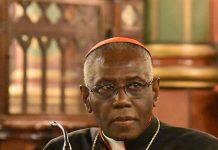








Cardinal Müller defends Pope Leo XIV, rejecting Trump’s criticism and reaffirming the Pope’s mission as a voice for peace beyond politics.
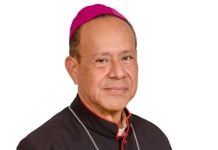
Newsroom (15/04/2026 Gaudium Press ) Cardinal Gerhard Ludwig Müller has issued a strong defense of Pope Leo XIV following U.S. President Donald Trump’s recent criticism of the Pontiff, declaring that no one has the authority to question the Pope when he fulfills his divine mission of proclaiming the Gospel of peace. In an emphatic statement published by Kath.net, the former Prefect of the Congregation for the Doctrine of the Faith reaffirmed the spiritual independence of the papacy from political influence, calling any attempt to manipulate it a betrayal of the Church’s sacred trust.
Müller reminded readers that the election of a pope is conducted “in conscience before God” and that cardinals solemnly vow obedience and fidelity to the successor of Peter. For Müller, this obedience extends not only to Church hierarchy but to the spiritual truth embodied in the papal office itself. “The Holy Father can do nothing other than work for peace among peoples,” he stated, underscoring that the Pope’s mission cannot and must not be shaped by geopolitical agendas.
The Papacy and Political Power
The German cardinal’s message directly challenges efforts to politicize the papacy, insisting that the Pope’s authority operates on a divine plane that transcends worldly politics. Müller’s reflections come at a moment of heightened tension between religious and secular leaders, highlighting the perennial question of how far leaders may go in evaluating or opposing the moral appeal of the Catholic Church.
According to Müller, criticism of the Pope for fulfilling his Gospel mission undermines the universal call to peace entrusted to the Church. He views the papal vocation not as a political program but as a witness to Christ’s commandment of reconciliation. “No one,” he stresses, “has the right to criticize the Pope” when he acts as a herald of peace.
The United States and Global Responsibility
While evoking the Pope’s transcendent authority, Müller did not dismiss the United States’ role on the international stage. He recognized America’s historical responsibility in defending freedom and maintaining global stability. Yet he drew a critical distinction: international law, he argued, must serve humanity, not power. It is, he said, “not meant to protect tyrants, but the people.”
In this regard, Müller acknowledged that nations sometimes face difficult moral choices. He conceded that measures such as economic sanctions—or, in extreme cases, the use of force—may be required to confront regimes that pose an imminent threat to peace. Still, he warned that all acts of statecraft must remain accountable to moral and ethical judgment.
War, Justice, and the Moral Burden
Turning to the question of war, the cardinal framed it as a profound moral dilemma rather than a political strategy. “There are no clean wars,” he cautioned, adding that every decision to fight carries heavy ethical consequences. He pointed to the historical failures of appeasement policies toward totalitarian regimes such as Nazi Germany, arguing that defending against aggression can sometimes be the lesser evil.
Müller’s reflections drew on centuries of Catholic moral teaching, invoking the tradition of just war while emphasizing that moral discernment—not expediency—must guide nations when they resort to arms.
Iran, Israel, and the Perils of Religion Misused
In some of his sharpest commentary, Müller condemned the Iranian regime for using religion to justify violence, calling it a distortion of faith’s true purpose. He maintained that no interpretation of religious teaching can legitimize the murder of innocents. “Faith,” he insisted, “must never be turned into a weapon.”
At the same time, he reaffirmed Israel’s right to exist and expressed hope that the region could find paths to peace without plunging into greater conflict. Müller’s appeal to moral clarity in international affairs thus extended from moral theology to diplomacy, where he urged that religious integrity be preserved in the pursuit of global stability.
The Pope’s Authority and the Voice of Conscience
In his conclusion, Cardinal Müller returned to the theme that runs through his entire text: the independence of the papal mission from political calculation. He warned against subjecting the Pope’s message to temporal interests or judging it by standards of national advantage. For Müller, the Pope speaks as a witness to the Gospel of peace, not as a participant in the struggles for power that define the world order.
By reaffirming this principle, Müller placed Pope Leo XIV’s words on a moral plane above political rivalry, reminding believers and leaders alike that the papal voice—the conscience of the Church—must never be constrained by statecraft. In Müller’s vision, the Pope’s task is unambiguous: to proclaim the truth of the Gospel, stand with the oppressed, and call the world toward peace grounded in justice and faith.
- Raju Hasmukh with files from Infovaticana
Related Images: