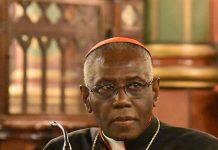








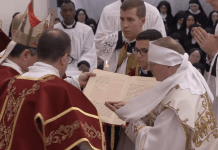
Cardinal Francis Arinze calls on priests worldwide to honor the integrity of the Mass, warning that irreverence and liturgical novelty harm the Church’s faith.
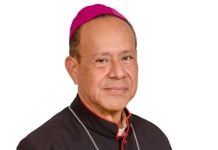
Newsroom (13/04/2026 Gaudium Press ) At ninety-three, Cardinal Francis Arinze remains a moral and spiritual touchstone for the Catholic Church. Decades after his service in the Vatican’s highest offices, the Nigerian-born cardinal continues to speak with incisive clarity on the heart of Catholic worship: the liturgy. In a wide-ranging conversation with journalist Michael Haynes, Arinze renewed his call for clergy and faithful alike to rediscover the reverence that gives life to the Church’s prayer.
“The liturgy gives witness to the practice of the faith,” he said with conviction. “If a priest invents new or unlawful elements of the Mass, no matter his intentions, he damages the Church.”
For Arinze, whose ecclesial philosophy has shaped modern Catholic liturgical understanding, the sacred rites of the Church are not mere forms or traditions — they are theology made visible. He reminds believers of the ancient maxim lex orandi, lex credendi — “the law of prayer is the law of belief” — emphasizing that what the Church prays reveals what it believes.
The Heart of Christian Mystery
Reflecting specifically on the profound season of Holy Week, the cardinal described its ceremonies as rich in symbols that encapsulate redemption itself. “Holy Week is particularly eloquent,” he observed. “If a person, even without prior knowledge of Christianity, were attentive to what is read, preached, and celebrated throughout that week, they would grasp the heart of Christianity.”
This pedagogical power of the liturgy, Arinze suggested, is inherent in its structure. Each word and gesture in the rites — from the solemn processions of Palm Sunday to the silence of Good Friday and the triumph of Easter Vigil — invites the faithful into the mystery of Christ. He likened the liturgy to an eloquent teacher: communicative, precise, and transformative when celebrated with devotion.
Reverence and Culture
Arinze’s reflections also delved into how culture shapes religious practice. “There is plenty of room for opinion here,” he remarked, noting that African congregations often exhibit visible fervor, while European parishes can appear restrained. “Part of it is cultural,” he said. “Africans express joy and participation physically, Europeans do so more internally.”
Yet Arinze cautions that culture must never override the dignity of divine worship. “When we celebrate the sacred mysteries, there should be restraint; culture cannot be allowed to overrule reverence, prayer, and respect.”
He illustrated the cultural interplay through his own experience. In Nigeria, clerical attire such as cassocks and zucchettos are familiar signs of office, often greeted with respect. “At the airport, officials ask me for blessings — even Muslims,” he recalled. “In Rome or London, however, I would not wear it publicly. Customs differ, yet reverence must remain constant.”
Liturgical Abuses and the Priest’s Role
Turning to the widespread concern about liturgical abuses, Cardinal Arinze offered one of the most pointed warnings of his career. “Whoever has a key role in the celebration of the sacred mysteries must understand its seriousness,” he said. “A careless priest damages the Church.”
Arinze drew a vivid parallel between national anthems and the Mass itself: both demand respect and fidelity to their established form. “You cannot make your country’s anthem more personal by adding new words,” he noted. “How much more the sacred mysteries of our faith?”
His statement mirrors Pope Leo’s recent admonition that the sacred liturgy must be protected from theatrical or improvised elements. For Arinze, this is not simply an issue of aesthetics — it is a question of doctrinal integrity. The liturgy, he insists, is the visible expression of the Church’s belief; altering it distorts that belief.
When celebrating the Mass, he continued, “We must carry it out with seriousness, maturity, and respect — and a bit of common sense. Although sometimes it seems that sense is not common.” The Mass, he said, must lead observers, even non-Christians, to recognize “something very serious” being celebrated: the mystery of Christ’s death and resurrection.
A Life Formed by Service
Born in Nigeria in 1932, Francis Arinze was consecrated a bishop at just thirty-two, then became the world’s youngest Catholic bishop. His pastoral leadership in Nigeria during decades of growth and change caught the Vatican’s attention, leading to his appointment to the Roman Curia in 1984. A year later, Pope John Paul II created him cardinal. Arinze first led the Secretariat for Non-Christians, now the Dicastery for Interreligious Dialogue, and later served as Prefect of the Congregation for Divine Worship and the Discipline of the Sacraments from 2002 to 2008.
During his tenure, he became a leading global voice on liturgical discipline, emphasizing reverence as the essence of credible worship. His teachings underlined that authentic participation does not mean creativity but contemplation and unity with the universal Church.
Now in retirement, though largely out of media sight, Cardinal Arinze remains active both in Rome and Africa, teaching and writing on liturgy and interreligious dialogue.
The Call to Fidelity
Arinze’s counsel echoes through generations of clergy and laity: a Mass celebrated well is itself a silent catechism, while a careless one undermines faith. “The priest who introduces unapproved parts or removes approved elements—even with good intentions—does harm,” he reiterated.
His words carry a prophetic urgency at a time when the Church continues to balance pastoral adaptation with doctrinal continuity. “If only all of us would listen,” he said at the close of his interview. “We would be better.”
Though spoken softly and without fanfare, Cardinal Arinze’s renewed appeal is a clarion call to spiritual seriousness — that reverence, not innovation, must remain the heart of worship, for the sacred liturgy is not ours to rearrange but God’s gift to receive and revere.
- Raju Hasmukh with files from Permariam.com
Related Images: